The Phytochemical Punicalin from Pomegranates Shows Promise Against Aggressive Breast Cancer
Nikhil Prasad Fact checked by:Thailand Medical News Team Feb 06, 2026 7 months, 3 weeks, 5 days, 6 minutes ago
Medical News: Researchers from Spain have uncovered compelling new evidence that punicalin, a natural compound found in pomegranates, may help slow the progression of one of the most aggressive forms of breast cancer by targeting not only cancer cells but also the blood vessels that support tumor growth. Triple negative breast cancer is notoriously difficult to treat, and this
Medical News report highlights findings that may open new avenues for future therapies.
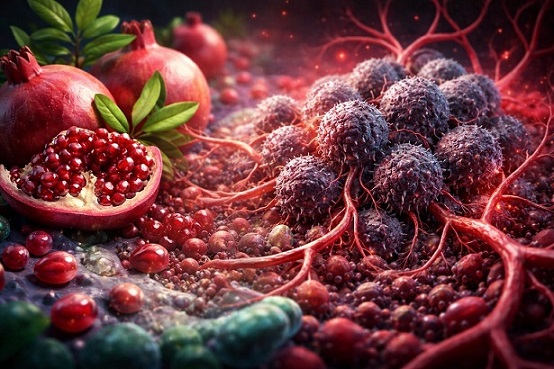 Punicalin from pomegranates may block tumor growth and blood vessel formation in aggressive breast cancer
Why Triple Negative Breast Cancer Is So Dangerous
Punicalin from pomegranates may block tumor growth and blood vessel formation in aggressive breast cancer
Why Triple Negative Breast Cancer Is So Dangerous
Triple negative breast cancer lacks the three common receptors used in targeted cancer treatments, leaving patients with fewer therapy options and poorer outcomes. This cancer type grows quickly and spreads easily, partly because it manipulates its surrounding environment, known as the tumor microenvironment, to secure oxygen and nutrients through new blood vessel formation.
The Role of the Tumor Microenvironment
The tumor microenvironment includes blood vessels, immune cells, and supporting tissues that cancer cells exploit to survive and spread. New blood vessel growth, a process called angiogenesis, is especially important because it allows tumors to expand and metastasize. Stopping this process is considered a critical strategy in cancer control.
How Punicalin Was Studied
Scientists examined the effects of punicalin on triple negative breast cancer cells and different types of human endothelial cells, which line blood vessels. They focused on oxidative stress, autophagy, cell movement, and the ability of endothelial cells to form vessel like structures. These processes are essential for both cancer growth and angiogenesis.
Key Findings Explained Simply
Punicalin significantly reduced harmful oxidative stress in cancer cells, even under conditions designed to increase cellular damage. This antioxidant effect can weaken cancer survival pathways. In contrast, in tumor associated endothelial cells, punicalin disrupted stress balance and reduced autophagy, a survival mechanism these cells rely on during vessel formation. Importantly, punicalin slowed the movement of cancer cells and strongly interfered with the ability of endothelial cells to form new blood vessel networks, a critical step in tumor expansion. Normal endothelial cells were far less affected, suggesting a degree of selectivity that is highly desirable in cancer treatment research.
Why These Results Matter
By targeting both cancer cells and the blood vessels that feed them, punicalin shows potential as a compound that works on multiple fronts. This dual action is especially valuable in aggressive cancers where single target approaches often fail.
Institutions Behind the Research
The study was conducted by researchers from the Department of Molecular Biology and Biochemistry
, Faculty of Science, Universidad de Málaga, Spain; the Molecular Bases of Biological Systems Group at the Biomedical Research Institute of Málaga and IBIMA Plataforma Bionand; and the Center for Biomedical Network Research in Rare Diseases, Instituto de Salud Carlos III, Madrid, Spain.
Conclusions and Future Outlook
These findings suggest that punicalin could form the basis of future treatments aimed at weakening triple negative breast cancer while sparing healthy blood vessels. Although more studies are needed, especially in animals and humans, this research strengthens the idea that natural compounds can play meaningful roles in modern cancer therapy by disrupting both tumors and their supportive environments in a targeted manner.
The study findings were published in the peer reviewed International Journal of Molecular Sciences.
https://www.mdpi.com/1422-0067/27/3/1533
For the latest on Herbs and Phytochemicals, keep on logging to Thailand
Medical News.
Read Also:
https://www.thailandmedical.news/articles/herbs-and-phytochemicals




 Share
Share
 Tweet
Tweet
 Share
Share

































