Nikhil Prasad Fact checked by:Thailand Medical News Team Feb 13, 2026 6 months, 2 weeks, 3 days, 18 hours, 18 minutes ago
Medical News: Persistent Gene Regulators May Explain Chronic Symptoms
Long COVID continues to puzzle doctors worldwide, with millions reporting fatigue, breathlessness, “brain fog,” heart issues and metabolic problems months after recovering from acute infection. A new scientific review sheds light on an unexpected culprit: microscopic strands of RNA known as microRNAs.
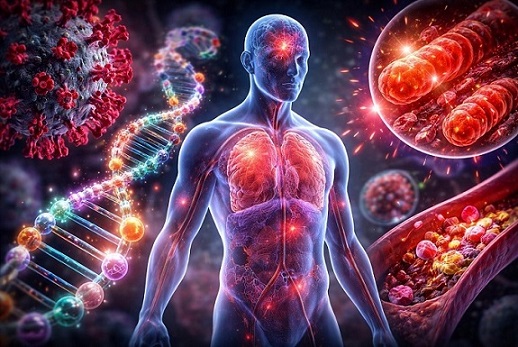 MicroRNAs may drive persistent inflammation, fatigue and vascular injury in long COVID patients
The study was conducted by researchers from the Laboratory of Cancer Biology and Molecular Immunology at the Faculty of Sciences-I, Lebanese University in Beirut; the Department of Biomedical Sciences, School of Pharmacy, Lebanese International University; University Grenoble Alpes, CEA, Inserm, IRIG, UA13 BGE, Biomics in France; and the Department of Natural and Applied Sciences, The American University of Iraq-Baghdad.
MicroRNAs are short pieces of genetic material that act like dimmer switches, controlling how strongly certain genes are turned on or off. According to this
Medical News report, these tiny regulators may hold the key to understanding why inflammation and organ damage continue long after the virus is gone.
Persistent Inflammation After Infection
The review explains that some microRNAs that normally calm inflammation are reduced in long COVID patients. One example is miR-146a, which usually acts as a brake on inflammatory pathways. When its levels drop, inflammatory signals such as IL-6 and NF-κB remain active, potentially explaining lingering fatigue and systemic inflammation.
At the same time, other microRNAs such as miR-155 and miR-21 may be elevated. These molecules amplify immune responses and promote tissue scarring. The imbalance creates a state of chronic, low-grade inflammation that affects multiple organs, including the heart, lungs and brain.
Mitochondria And Energy Collapse
Another striking finding involves the cell’s energy factories, known as mitochondria. Certain microRNAs like miR-210 and miR-34a interfere with mitochondrial function. They reduce the cell’s ability to generate ATP, the molecule that powers nearly every biological process.
The researchers describe how this disruption can lead to reduced exercise tolerance, post-exertional malaise and cognitive fatigue. Increased oxidative stress, triggered by dysfunctional mitochondria, may further damage tissues and prolong inflammatory cycles.
Blood Vessels and Fibrosis
Long COVID has also been linked to vascular injury and abnormal clotting. The review highlights reduced levels of miR-126, a microRNA essential for maintaining healthy blood vessel linings. Lower levels may impair repair mechanisms and increase clot risk.
Meanwhile, reduced miR-29 and increased miR-21 may encourage fibrotic remodeling, a process in which normal tissue is replaced with stiff scar-like material. This mechanism mirrors what is seen in chronic lung and h
eart diseases, suggesting overlapping pathways.
Biomarkers and Future Therapies
Because microRNAs circulate in blood and are remarkably stable, they may serve as non-invasive biomarkers. Measuring specific microRNA patterns could help doctors identify high-risk patients, cluster symptoms, and monitor disease progression.
Even more promising is the idea of therapeutic targeting. Scientists are exploring microRNA mimics and inhibitors designed to restore balance. Although still largely experimental, these strategies represent a precision-medicine approach to treating long COVID at its molecular roots.
Conclusion
The evidence presented suggests that long COVID is not simply lingering infection but a complex molecular disturbance involving immune, metabolic and vascular pathways. Dysregulated microRNAs appear to connect these systems, acting as master regulators that sustain inflammation, mitochondrial dysfunction and fibrosis. While further clinical validation is needed, these findings open a new frontier in diagnostics and targeted therapy, offering hope for millions struggling with persistent symptoms.
The study findings were published in the peer reviewed journal: Biomolecules.
https://www.mdpi.com/2218-273X/16/2/283
For the latest on Long COVID, keep on logging to Thailand
Medical News.
Read Also:
https://www.thailandmedical.news/articles/coronavirus
https://www.thailandmedical.news/articles/long-covid




 Share
Share
 Tweet
Tweet
 Share
Share