Natural Compound Shows Promise Against Pancreatic Cancer by Targeting Key Tumor Pathways
Nikhil Prasad Fact checked by:Thailand Medical News Team May 31, 2026 3 months, 2 days, 11 hours, 32 minutes ago
Medical News: Pancreatic cancer remains one of the deadliest forms of cancer, but new research suggests that a natural plant-derived compound could offer a fresh avenue for treatment. Scientists in China have found that dehydrocorydaline, a major active ingredient extracted from the traditional medicinal herb Corydalis yanhusuo, can slow the growth of pancreatic cancer cells, trigger their death, and reduce their ability to spread.
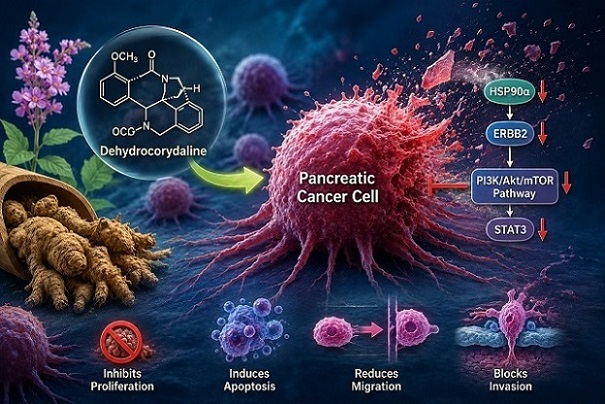 Natural plant compound dehydrocorydaline dramatically slows pancreatic cancer cell growth and spread by
blocking key cancer-driving pathways
The research was conducted by scientists from the School of Clinical Pharmacy, Shenyang Pharmaceutical University, Shenyang, China, and the School of Life Sciences and Biopharmaceutical Science, Shenyang Pharmaceutical University, Shenyang, China.
A Desperate Need for Better Treatments
Pancreatic cancer is notorious for being difficult to detect in its early stages. Most patients are diagnosed only after the disease has already spread, leaving them with limited treatment options. The disease currently has one of the lowest five-year survival rates among major cancers.
While surgery remains the most effective treatment when tumors are discovered early enough, more than 80 percent of patients are diagnosed with advanced disease. Existing chemotherapy drugs such as gemcitabine often provide only modest benefits, highlighting the urgent need for new therapeutic approaches.
Ancient Medicinal Herb Reveals Modern Potential
Corydalis yanhusuo has been used in traditional Chinese medicine for centuries, mainly as a pain-relieving remedy. Researchers have recently become interested in its anticancer properties, particularly those of its alkaloid compounds.
In this study, scientists examined four major compounds from the herb and discovered that dehydrocorydaline, often abbreviated as DHC, was the most powerful at suppressing pancreatic cancer cells. Laboratory tests showed that DHC significantly reduced the survival of BxPC-3 pancreatic cancer cells while having much milder effects on normal pancreatic cells. This selectivity is especially important because it suggests the compound may be able to target cancer cells more effectively than healthy tissue.
Cancer Cells Stopped from Growing and Spreading
The researchers carried out a series of experiments to determine how DHC affected pancreatic cancer cells.
They found that treatment with DHC reduced the cells' ability to multiply and form new colonies. The compound also triggered apoptosis, a natural process often referred to as programmed cell death. Cancer cells typically develop ways to avoid apoptosis, allowing them to survive and grow uncontrollably. DHC appeared to reverse this advantage.
Even more impressive was its effect on cancer spread. Pancreatic cancer is particularly deadly because of its ability to invade nearby tissues and migrate to distant organs. The study showed that DHC significantly reduced both migration and invasion of cancer cells in a dose-dependent manner, meaning higher concent
rations produced stronger effects.
Uncovering the Molecular Mechanism
To understand why DHC was so effective, the research team combined laboratory testing with advanced bioinformatics analysis.
They identified more than 100 potential molecular targets linked to both pancreatic cancer and DHC. Further analysis highlighted several critical proteins involved in cancer growth, including HSP90α, ERBB2, STAT3, Cyclin D1, and mTOR. These proteins are known to help cancer cells survive, multiply, and resist treatment.
The researchers discovered that DHC suppressed HSP90α, a molecular chaperone that helps stabilize many cancer-promoting proteins. By reducing HSP90α activity, DHC also appeared to trigger degradation of ERBB2, an important cancer-driving receptor.
This chain reaction ultimately shut down the PI3K/Akt/mTOR signaling pathway and weakened STAT3 activity. These pathways are considered major "control centers" that cancer cells use to fuel growth, prevent cell death, and promote metastasis.
Important Changes Inside Cancer Cells
The study also revealed several biological changes consistent with a strong anticancer effect.
DHC reduced levels of Ki67, a marker associated with cell proliferation, while increasing levels of Bax, a protein that promotes cell death. At the same time, it lowered levels of Bcl-2, a protein that helps cancer cells survive.
The compound also decreased proteins associated with invasion and metastasis, including MMP2, MMP9, and N-cadherin, while increasing E-cadherin, a protein linked to healthier and less aggressive cellular behavior. These findings suggest that DHC not only slows tumor growth but may also make pancreatic cancer cells less capable of spreading throughout the body.
Encouraging Results but More Work Needed
This
Medical News report notes that although the findings are highly encouraging, the research was conducted primarily in laboratory-grown pancreatic cancer cells. The scientists acknowledged several limitations, including the use of a single cancer cell line and the absence of animal or human studies.
Future investigations will need to confirm whether the same benefits occur in living organisms and whether DHC can be safely developed into a clinical treatment. Researchers also plan to perform additional experiments to prove the exact cause-and-effect relationships behind the molecular mechanisms observed in the study.
Conclusion
The findings provide compelling evidence that dehydrocorydaline, a natural compound derived from Corydalis yanhusuo, possesses significant anti-pancreatic cancer activity. By simultaneously promoting cancer cell death, suppressing tumor growth, and limiting the ability of cancer cells to migrate and invade, DHC appears to attack pancreatic cancer on multiple fronts. Its ability to interfere with the HSP90α, ERBB2, PI3K/Akt/mTOR, and STAT3 signaling networks makes it particularly interesting because these pathways are among the most important drivers of pancreatic cancer progression. While much more research is needed before any clinical application becomes possible, the study provides a strong scientific foundation for exploring DHC as a future therapeutic candidate against one of the world's most lethal cancers.
The study findings were published in the peer reviewed journal: Pharmaceuticals.
https://www.mdpi.com/1424-8247/19/6/864
For the latest on pancreatic cancer, keep on logging to Thailand
Medical News.
Read Also:
https://www.thailandmedical.news/articles/cancer
https://www.thailandmedical.news/articles/herbs-and-phytochemicals




 Share
Share
 Tweet
Tweet
 Share
Share