Nikhil Prasad Fact checked by:Thailand Medical News Team Apr 19, 2026 5 months, 2 weeks, 1 day, 2 hours, 12 minutes ago
Medical News: A growing body of research is uncovering a serious but often overlooked complication of diabetes—its damaging effects on male reproductive health. A new experimental study now provides compelling evidence that diabetes can impair testicular function through a specific form of cell death, while also identifying a naturally occurring compound that may help counter this damage.
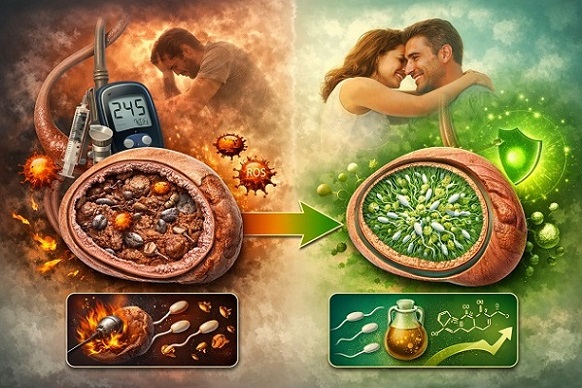 A natural molecule shows potential in protecting male fertility from diabetes-related damage
Diabetes Triggers Iron-Driven Testicular Damage
A natural molecule shows potential in protecting male fertility from diabetes-related damage
Diabetes Triggers Iron-Driven Testicular Damage
Diabetes does far more than disrupt blood sugar levels. Over time, it creates a harmful internal environment marked by high glucose, abnormal lipids, and persistent inflammation. In this study, researchers demonstrated that these changes directly impact the testes, leading to both structural and functional deterioration.
A central mechanism identified was ferroptosis, a form of cell death driven by iron overload. In diabetic rats, excessive iron accumulated in testicular tissue, triggering oxidative stress and the production of damaging molecules that attack cell membranes. This process disrupted the architecture of the seminiferous tubules and impaired sperm production.
As a result, diabetic animals exhibited significantly reduced testosterone levels, lower sperm counts, and decreased sperm motility, alongside clear microscopic evidence of tissue damage.
Oxidative Stress and Inflammation Accelerate Injury
Further investigation revealed that diabetes significantly increased oxidative stress markers and inflammatory mediators within the testes, while simultaneously reducing protective antioxidants such as glutathione and GPX4.This imbalance created a destructive cycle—iron accumulation fueled oxidative damage, while weakened antioxidant defenses allowed cellular injury to progress. The combined effect led to widespread dysfunction of testicular cells and declining fertility potential.
Lipoxin A4 and Its Therapeutic Relevance
Lipoxin A4 (LXA4), a naturally occurring eicosanoid, is an omega-6 polyunsaturated fatty acid with potent antioxidant and anti-inflammatory actions and is generated endogenously from arachidonic acid.
Beyond its basic definition, Lipoxin A4 plays a critical regulatory role in resolving inflammation rather than simply blocking it. In healthy conditions, it helps switch off excessive immune responses and promotes tissue repair. However, in diabetes, its levels are often reduced, leaving tissues more vulnerable to chronic oxidative and inflammatory damage.
What makes Lipoxin A4 particularly important in this study is its ability to directly interfere with the same biological processes responsible for diabetes-induced testicular injury, especially oxidative stress and ferroptosis.
How Lipoxin A4 Counteracts Testicular Damage
When administered to diabetic rats, Lipoxin A4 produced measurable protective effects across multiple biological systems.
It reduced iron accumulation within the testes, thereby limiting the primary trigger fo
r ferroptosis. At the same time, it lowered oxidative stress markers and suppressed inflammatory signals that contribute to cellular injury.
Crucially, Lipoxin A4 reactivated the Nrf2/SLC7A11/GPX4 pathway, a key antioxidant defense system. By restoring this pathway, it enhanced the production of protective molecules such as glutathione and GPX4, which are essential for neutralizing oxidative damage and preventing cell death.
These molecular improvements translated into functional recovery. Testosterone levels increased, sperm counts improved, and sperm motility showed significant enhancement compared to untreated diabetic animals, although not fully to normal levels.
Comparative Effectiveness and Clinical Implications
While Lipoxin A4 demonstrated clear benefits, the study also found that a direct ferroptosis inhibitor, ferrostatin-1, produced stronger protective effects. This suggests that Lipoxin A4 works more indirectly by restoring cellular balance rather than completely blocking iron-driven cell death.
This
Medical News report underscores that Lipoxin A4’s real strength lies in its multi-targeted action. It simultaneously reduces inflammation, improves antioxidant defenses, and supports metabolic regulation, making it a promising candidate for combination therapies aimed at preserving male fertility in diabetic patients.
Conclusion
This study provides strong evidence that diabetes can severely impair male reproductive health through iron-driven oxidative damage and ferroptosis. Importantly, it also shows that this damage may be partially reversible. Lipoxin A4 demonstrated significant protective effects by reducing iron overload, restoring antioxidant pathways, and improving sperm function. Although it was less potent than direct ferroptosis inhibitors, its natural origin and broad biological activity make it an attractive candidate for future therapeutic development. Further research is needed to determine its effectiveness in humans, optimize dosing strategies, and explore how it can be combined with other treatments to fully restore fertility in diabetic individuals.
The study findings were published in the peer reviewed International Journal of Molecular Sciences.
https://www.mdpi.com/1422-0067/27/8/3548
For the latest on diabetes induced male fertility issues, keep on logging to Thailand
Medical News.
Read Also:
https://www.thailandmedical.news/articles/diabetes
https://www.thailandmedical.news/articles/reproductive-medicine




 Share
Share
 Tweet
Tweet
 Share
Share