Nikhil Prasad Fact checked by:Thailand Medical News Team May 06, 2026 4 months, 4 weeks, 23 hours, 44 minutes ago
Medical News: A worrying new study has revealed that the dangerous H5N1 bird flu virus may be spreading through the air and wastewater on California dairy farms, raising fresh concerns about how easily the infection could move between cows, workers, wildlife, and possibly even humans. Scientists say the findings suggest the virus is using far more transmission routes than previously believed.
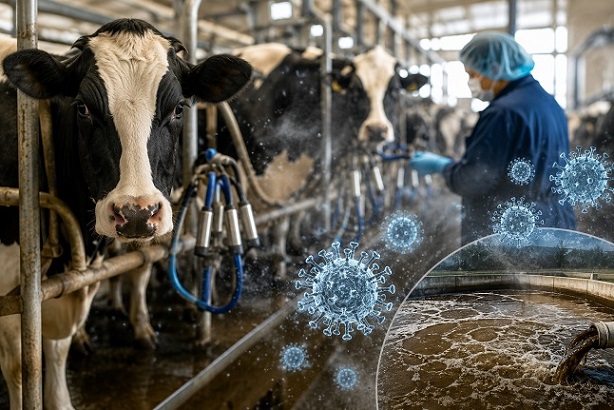 Scientists discover bird flu virus spreading through air and wastewater on California dairy farms, raising concerns
over hidden transmission risks
Researchers from the Emory University School of Medicine and Colorado State University examined infected dairy farms across California and discovered infectious H5N1 virus particles in the air inside dairy parlors, in wastewater systems, and even in the breath exhaled by infected cows.
The study comes at a time when the H5N1 avian influenza outbreak continues to spread rapidly among animals worldwide. While bird flu is traditionally associated with poultry, the virus has increasingly infected mammals including dairy cattle, elephant seals, sea lions, foxes, and other species. Health experts fear that continued spread in mammals could eventually help the virus adapt better to humans.
Virus Found Floating in the Air
The researchers collected air, wastewater, and milk samples from 14 California dairy farms that had confirmed H5N1 infections between October 2024 and January 2025. Their investigations revealed that virus particles were present in airborne droplets produced during milking activities and from infected cows themselves.
This discovery is particularly alarming because it means workers could potentially inhale infectious viral particles while working in enclosed dairy environments. Until now, scientists mainly believed that contaminated raw milk and milking equipment were the primary sources of transmission.
Associate Professor Seema Lakdawala, who co-led the study, explained that the findings confirm infectious virus exists not only in milk but also in farm air and reclaimed wastewater systems.
The researchers also performed genome sequencing on the virus samples to monitor for genetic changes and mutations that might increase transmission risks.
Silent Infections Found in Dairy Herds
One of the most concerning findings was that many infected cows showed no obvious signs of illness despite carrying large amounts of the virus. Scientists found high viral loads and H5 antibodies even in cows that appeared healthy.
This means the infection may be spreading quietly through herds without farmers realizing it.
According to the researchers, this hidden spread could make controlling outbreaks far more difficult because asymptomatic cows may continue contaminating farm environments undetected.
California alone has reported more than 700 infected dairy herds, making it the hardest-hit U.S. state since the virus was first detected in American cattle in 2024. The outbreak has now spread to at least 16 U.S. states.
This
ong>Medical News report highlights growing concerns among scientists that widespread environmental contamination on dairy farms may expose not only farm workers but also nearby wildlife and domestic animals to the virus.
Wastewater Also Emerges as a Risk
The study additionally found infectious virus in wastewater collected from dairy operations. Researchers say contaminated waste streams could become another major pathway for viral spread.
The presence of H5N1 in wastewater suggests that disposal systems on farms may unintentionally help distribute the virus through surrounding environments. Wildlife or other animals coming into contact with contaminated water could potentially become infected.
The scientists said they were surprised by how much infectious material was circulating throughout farm environments.
To reduce risks, the research team recommended improving ventilation systems in dairy parlors to reduce airborne particles and properly treating infected milk before disposal. These interventions may create additional protective barriers for farm workers and animals.
More Studies Still Needed
Although the findings are significant, the scientists cautioned that additional long-term studies involving larger numbers of farms and animals are still necessary to fully understand exactly how the virus spreads in real-world conditions.
Still, the discovery of airborne virus and widespread environmental contamination has added urgency to efforts aimed at containing the outbreak before the virus evolves further.
The conclusions from the study are deeply concerning because they suggest that bird flu transmission on dairy farms may be much more complex than previously believed. If the virus can spread through air, wastewater, contaminated surfaces, and asymptomatic animals simultaneously, controlling future outbreaks may become far more difficult. Researchers warn that stronger monitoring systems, improved farm safety measures, and rapid intervention strategies are urgently needed to reduce risks to both humans and animals.
The study findings were published in the peer reviewed journal: PLOS Biology.
https://journals.plos.org/plosbiology/article?id=10.1371/journal.pbio.3003761
For the latest H5N1 news, keep on logging to Thailand
Medical News.
Read Also:
https://www.thailandmedical.news/articles/h5n1-avian-flu




 Share
Share
 Tweet
Tweet
 Share
Share

































