Ebola Animal Vectors Trigger New Global Fears Amid Rising Wildlife Transmission Risks
Nikhil Prasad Fact checked by:Thailand Medical News Team May 25, 2026 3 months, 1 week, 1 day, 16 hours, 59 minutes ago
Medical News: As fresh Ebola outbreaks once again alarm health officials in parts of Africa, scientists are intensifying warnings about the growing number of animals capable of carrying and spreading the deadly virus. While Ebola has long been associated with infected humans and great apes, new investigations are shedding light on a far broader network of wildlife species that may silently contribute to outbreaks.
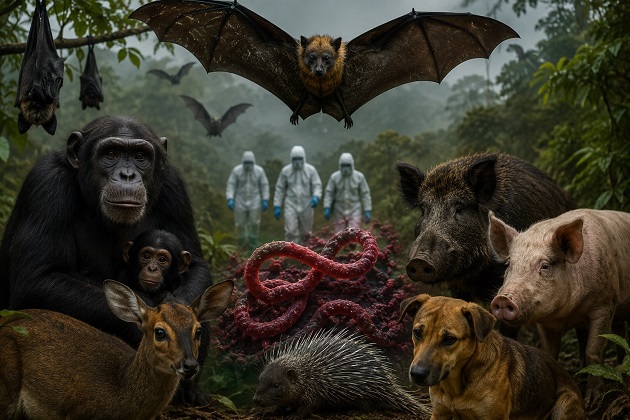 Scientists warn that bats pigs primates and other wildlife may be silently fueling future Ebola outbreaks across vulnerable
regions worldwide
Health authorities including the World Health Organization and the Centers for Disease Control and Prevention continue to identify fruit bats as the most likely natural reservoir hosts of Ebola viruses. These bats can harbor the virus without becoming severely ill, allowing them to spread viral particles through saliva, urine, and feces across forest ecosystems.
Fruit Bats Remain the Main Suspected Reservoir
Researchers say fruit bats from the Pteropodidae family remain central to the Ebola transmission cycle. Unlike many infected mammals that quickly die from the disease, bats appear capable of coexisting with the virus for extended periods. Studies have shown that infected bats can contaminate fruits and leaves with infected saliva or droppings, exposing other animals that feed in the same areas.
Scientists are especially concerned because bats often migrate across large distances, potentially carrying the virus between regions and countries. Evidence of Ebola antibodies has even been detected in fruit bats in parts of Asia, suggesting the geographic range of Ebola-related viruses could be wider than previously believed.
Gorillas Chimpanzees and Monkeys Face Massive Death Rates
Among the most vulnerable spillover hosts are non-human primates including gorillas, chimpanzees, and monkeys. Unlike bats, these animals often develop severe hemorrhagic disease similar to humans and frequently die after infection. Several historic Ebola outbreaks in Central Africa were linked to human contact with infected ape carcasses discovered in forests.
Experts warn that hunting and butchering infected primates for bushmeat remains one of the highest-risk activities for triggering human outbreaks. Wildlife die-offs among gorilla populations have also been documented shortly before human Ebola epidemics emerged.
This
Medical News report highlights growing concerns among disease ecologists that deforestation and habitat disruption are increasing direct interactions between humans and infected wildlife species, potentially accelerating future spillover events.
Forest Antelopes Porcupines and Wild Mammals Also Involved
Investigators have also identified duikers, small forest antelopes commonly hunted for meat, as possible Ebola transmission sources. Porcupines and forest pigs have similarly been linked to infections in the wild.
Some studies suggest a surpr
isingly wide range of mammals may be susceptible under certain environmental conditions. Rodents, foxes, cats, and several scavenging species are now being monitored in ecological surveillance programs as researchers attempt to understand how Ebola survives between outbreaks.
Pigs Raise New Transmission Questions
One of the most unsettling findings in recent years involves pigs. Scientists discovered that pigs can become infected with certain Ebola strains, particularly Reston ebolavirus. Experimental studies demonstrated that infected pigs were capable of transmitting the virus to non-human primates under laboratory conditions.
Although there is still no confirmed case of pig-to-human Ebola transmission, experts fear pigs could act as “amplifying hosts,” meaning they may increase viral circulation and create more opportunities for spillover into humans or wildlife.
Researchers say the respiratory involvement seen in pigs is particularly concerning because it differs from the classical transmission routes normally associated with Ebola.
Dogs May Carry Antibodies Without Symptoms
Dogs living in outbreak regions have also attracted scientific attention. Several investigations found that dogs exposed to Ebola outbreaks developed antibodies against the virus despite showing no obvious symptoms. Scientists believe scavenging behavior, especially contact with infected carcasses, may expose dogs to viral material.
While there is still no definitive proof that dogs directly spread Ebola to humans, researchers say their close interaction with both wildlife and people means they cannot be completely ignored during outbreak surveillance.
Insects Are Not Considered Ebola Vectors
Despite widespread fears, there remains no evidence that mosquitoes, ticks, or biting flies spread Ebola. Global health authorities continue to emphasize that Ebola transmission occurs mainly through direct contact with infected bodily fluids rather than airborne or insect-borne spread.
Researchers have examined whether certain insects could indirectly participate in maintaining viral circulation among wildlife, but no confirmed insect vector has ever been identified.
Growing Ecological Threats Fuel Future Outbreak Concerns
Scientists warn that environmental destruction, wildlife trafficking, mining expansion, and increasing human encroachment into forests are intensifying opportunities for Ebola spillover events. Recent outbreaks involving the Bundibugyo Ebola strain in Central Africa have renewed fears that evolving wildlife transmission patterns could complicate disease containment efforts.
Many experts now believe Ebola should no longer be viewed solely as a human epidemic problem but as a complex ecological disease involving interconnected wildlife systems. The expanding list of potentially infected animals suggests that monitoring wildlife health may become just as important as monitoring infected humans. Continued surveillance of bats, primates, pigs, and other mammals could prove critical in predicting and stopping future outbreaks before they spiral into global emergencies.
References:
https://www.woah.org/en/disease/ebola-virus-disease/
https://www.nature.com/articles/s41598-020-71226-0
https://vcahospitals.com/know-your-pet/pets-and-ebola
https://www.scielo.org.mx/scielo.php?script=sci_arttext&pid=S2007-33642015000300515
https://www.healthnz.govt.nz/health-topics/conditions-treatments/infectious-diseases/ebola
https://wwwnc.cdc.gov/eid/article/11/3/04-0981_article
https://elifesciences.org/articles/04395
https://pubmed.ncbi.nlm.nih.gov/23689899/
https://link.springer.com/article/10.1186/s12941-015-0089-x
https://www.mdpi.com/1999-4915/10/10/549
https://pmc.ncbi.nlm.nih.gov/articles/PMC5482517/
For the latest Ebola news, keep on logging to Thailand
Medical News.
Read Also:
https://www.thailandmedical.news/articles/ebola




 Share
Share
 Tweet
Tweet
 Share
Share