Nikhil Prasad Fact checked by:Thailand Medical News Team Apr 02, 2026 5 months, 7 hours, 17 minutes ago
Medical News: Recent scientific findings are shedding new light on a powerful cancer-driving pathway known as RET, offering both hope for better treatments and caution about emerging drug resistance. Researchers are now uncovering how this pathway fuels tumor growth and why some therapies eventually stop working.
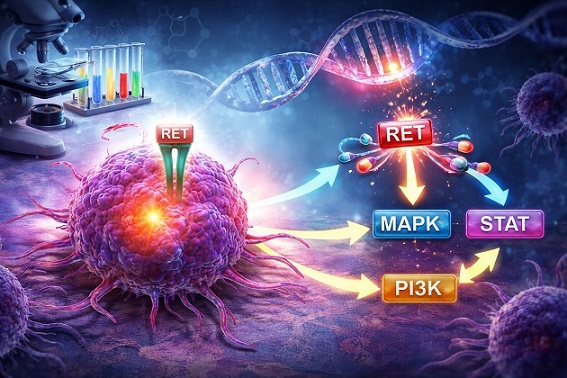 New research reveals how RET-driven cancers grow and why next-generation treatments are urgently needed
What Is the RET Pathway and Why It Matters
New research reveals how RET-driven cancers grow and why next-generation treatments are urgently needed
What Is the RET Pathway and Why It Matters
The RET gene plays an essential role in normal human development, especially in the nervous system, kidneys, and thyroid. However, when this gene becomes altered through mutations or gene fusions, it can trigger uncontrolled cell growth, leading to cancers such as thyroid cancer and non-small cell lung cancer.
The study, conducted by researchers from the Hematology/Oncology Department at Memorial Healthcare System, Pembroke Pines, Florida, USA, along with collaborators affiliated with Florida Atlantic University, provides a detailed look at how RET signaling works and how it becomes dangerous when disrupted.
RET alterations activate key internal signaling routes like MAPK, PI3K-AKT, and JAK-STAT pathways. These pathways act like communication highways inside cells, telling them to grow, divide, and survive. When constantly switched on, they allow cancer cells to multiply rapidly and resist natural cell death.
How RET Drives Different Cancers
RET abnormalities are most strongly linked to thyroid cancers, including papillary and medullary thyroid carcinoma. In some inherited conditions, such as multiple endocrine neoplasia type 2, RET mutations can almost guarantee cancer development over time.
In lung cancer, particularly non-small cell lung cancer, RET fusions occur in a smaller percentage of patients but are still clinically important. These genetic changes are often seen in younger patients and non-smokers, highlighting a distinct subgroup of cancer driven by molecular changes rather than lifestyle factors.
The research also shows that RET alterations can appear in other cancers, including breast, colorectal, pancreatic, and ovarian cancers, though less frequently. In each case, the abnormal RET signaling promotes tumor growth, survival, and sometimes even helps tumors evade the immune system.
Breakthroughs in Targeted Treatments
One of the most promising developments is the rise of selective RET inhibitors. Earlier drugs known as multi-kinase inhibitors targeted several pathways at once but often caused significant side effects and had limited effectiveness.
Newer drugs such as selpercatinib and pralsetinib are designed specifically to block RET activity. These targeted therapies have shown impressive response rates, improved patient outcomes, and better tolerability. In some cases, they can even shrink tumors in the brain, a major challenge in cancer treatment.
This
Medical News report highlights that these n
ewer drugs represent a major step forward in precision oncology, where treatments are tailored to the genetic profile of a patient’s tumor.
The Growing Problem of Drug Resistance
Despite these advances, researchers warn that resistance to RET-targeted therapies is becoming a major obstacle. Cancer cells can develop new mutations that prevent drugs from binding effectively. In other cases, tumors activate alternative pathways such as MET or EGFR to bypass the blocked RET signal.
These resistance mechanisms mean that even highly effective drugs may eventually lose their impact. Scientists are now exploring next-generation inhibitors and combination therapies to overcome this problem and extend treatment benefits.
Future Directions and Hope Ahead
The study emphasizes that the future of RET-targeted therapy lies in smarter treatment strategies. Combining RET inhibitors with other therapies, such as immune checkpoint inhibitors or drugs targeting bypass pathways, may help prevent resistance.
Additionally, advanced genetic testing will play a crucial role in identifying patients who are most likely to benefit from these treatments. Personalized medicine is expected to become increasingly important in managing RET-driven cancers.
Conclusion
The latest research into the RET signaling pathway offers a powerful mix of optimism and realism. While targeted therapies have significantly improved outcomes for patients with RET-driven cancers, the emergence of resistance highlights the need for continued innovation. Ongoing research into combination therapies, next-generation inhibitors, and personalized treatment approaches will be essential to fully unlock the potential of RET-targeted cancer care and improve long-term survival outcomes for patients worldwide.
The study findings were published in the peer reviewed International Journal of Molecular Sciences.
https://www.mdpi.com/1422-0067/27/7/3180
For the latest on cancer research, keep on logging to Thailand
Medical News.
Read Also:
https://www.thailandmedical.news/articles/cancer




 Share
Share
 Tweet
Tweet
 Share
Share

































