Nikhil Prasad Fact checked by:Thailand Medical News Team May 16, 2026 3 months, 2 weeks, 3 days, 10 hours, 34 minutes ago
Medical News: Scientists in China have identified a natural plant-derived compound called berbamine hydrochloride (please do not get mixed up with Berberine Hydrochloride, another phytochemical that is also from the same plant) that could potentially become a new weapon against the deadly Ebola virus. Researchers from the Chinese Academy of Medical Sciences and Peking Union Medical School found that the compound was able to strongly block Ebola virus replication in both laboratory cell studies and animal experiments, raising hopes for a future low-cost treatment option for one of the world’s deadliest infectious diseases.
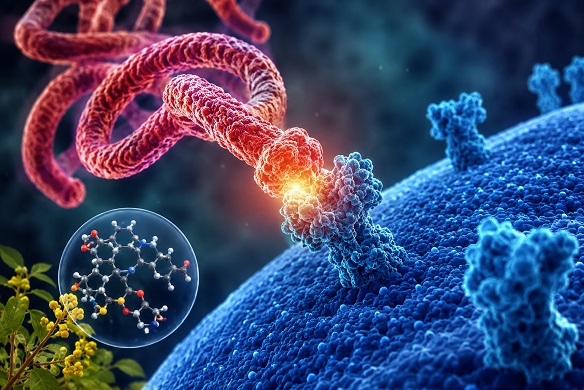 Chinese researchers discover that a natural plant-derived compound may block Ebola virus entry into human
cells and potentially help prevent deadly infections
Ebola virus disease is notorious for causing severe hemorrhagic fever and extremely high death rates. Past outbreaks in Africa have killed thousands, with the massive West African epidemic between 2014 and 2016 claiming more than 11,000 lives. Despite years of research, treatment options remain limited and expensive, making the search for affordable antiviral drugs critically important.
Natural Compound Shows Powerful Antiviral Activity
The research focused on berbamine hydrochloride, also known in the study as EEI-10. The compound is a natural alkaloid extracted from plants belonging to the Berberis family. Scientists discovered the compound through advanced structure-based virtual screening methods designed to identify molecules capable of interfering with Ebola virus entry into human cells.
The Ebola virus infects cells using a surface structure called glycoprotein, or GP. Once the virus enters the body, this glycoprotein attaches to a receptor inside human cells known as Niemann-Pick C1 (NPC1). This interaction is crucial because it allows the virus to fuse with the cell membrane and release its genetic material into the host cell.
The Chinese researchers discovered that berbamine hydrochloride binds directly to the cleaved Ebola glycoprotein known as GPcl. By attaching itself to this viral structure, the compound blocks GPcl from interacting with the NPC1 receptor. Without this interaction, the virus cannot successfully enter cells or continue its replication cycle.
This
Medical News report highlights that the compound essentially acts like a molecular barricade, preventing Ebola from unlocking the door into human cells.
Promising Results in Laboratory and Animal Studies
The study showed that berbamine hydrochloride demonstrated strong antiviral activity both in vitro, meaning in infected cell cultures, and in vivo, meaning in living animals. Scientists observed that the compound sharply reduced viral replication and protected mice from lethal Ebola infection.
Researchers explained that the Ebola virus relies heavily on the GPcl-NPC1 interaction, and even slight disruptions to this process can dramatically weaken the virus. Since the binding between GPcl and NPC1 is relatively weak
by nature, berbamine hydrochloride was particularly effective at interrupting this critical step.
The compound also showed activity against Marburg virus, another deadly filovirus closely related to Ebola. This finding suggests the possibility that the drug could eventually become a broad-spectrum antiviral treatment capable of targeting multiple highly dangerous viruses.
Why Researchers Are Excited
One major reason scientists are optimistic is that berbamine hydrochloride is not an entirely new experimental chemical. The compound has already been used clinically in China for the treatment of leukopenia, a condition involving low white blood cell counts. Because its safety profile and pharmacological properties are already partially understood, researchers believe the drug could potentially move more quickly into further testing for Ebola treatment.
The study also revealed that the compound may provide additional immune-related benefits. Researchers suspect that besides directly blocking the virus, berbamine hydrochloride could help regulate immune pathways and reduce harmful inflammatory responses triggered during Ebola infection.
Scientists did acknowledge that viral resistance could eventually emerge. The study identified a specific viral mutation involving a residue known as I113 that may reduce sensitivity to the compound. However, researchers believe this mutation could weaken the virus itself, creating a natural barrier against widespread resistance.
Current Ebola Treatments Still Remain Standard Care
Although the findings are highly encouraging, experts caution that berbamine hydrochloride is still in the early research stage and has not yet been approved for treating Ebola in humans. Current FDA-approved Ebola treatments remain monoclonal antibody therapies such as Inmazeb and Ebanga, which are specifically designed for Zaire ebolavirus infections. They do not work against other Ebola strains such as the Bundibugyo strain. Berbamine hydrochloride however works as broad-spectrum antiviral agent against all Ebola strains.
Researchers emphasized that more studies, including human clinical trials, will be necessary before berbamine hydrochloride could become an approved Ebola therapy. Scientists are also exploring ways to chemically modify the compound to create even stronger antiviral versions with improved resistance protection.
Conclusions
The discovery of berbamine hydrochloride as a potential Ebola inhibitor represents an important breakthrough in antiviral research. By directly targeting the Ebola virus glycoprotein and blocking its interaction with the NPC1 receptor, the compound attacks one of the virus’s most essential survival mechanisms. The fact that it already has some history of clinical use for other conditions further increases its potential as a rapidly repurposed treatment option. Researchers believe the findings could pave the way for affordable, small-molecule therapies capable of helping control future Ebola outbreaks and possibly even other deadly filovirus infections.
The study findings were published in the peer reviewed journal: Cell Death Discovery.
https://www.sciencedirect.com/science/article/pii/S2211383522002453
For the latest on Ebola, keep on logging to Thailand
Medical News.
Read Also:
https://www.thailandmedical.news/news/u-s-nih-study-finds-that-algal-lectin-griffithsin-shows-promise-in-preventing-ebola-virus-infection
https://www.thailandmedical.news/news/preliminary-findings-indicate-that-a-new-sublineage-of-the-bundyibugyo-strain-is-behind-the-ebola-virus-outbreak-in-drc
https://www.thailandmedical.news/news/ebola-outbreak-in-drc-has-spread-to-uganda-and-possibly-to-south-sudan-and-rwanda
https://www.thailandmedical.news/news/new-ebola-outbreak-infects-246-and-kills-65-in-drc-with-new-virus-strain-possibly-involved
Medical Disclaimer: All content published by Thailand Medical News is based on scientific research and is intended for informational and educational purposes only. It is not medical advice, diagnosis, or treatment. Readers must not attempt to use, apply, or experiment with any protocols, compounds, or therapies mentioned without first consulting a qualified and licensed medical doctor. Many findings discussed are experimental or preliminary, and only a licensed healthcare professional can determine what is safe and appropriate for an individual’s specific medical condition.




 Share
Share
 Tweet
Tweet
 Share
Share