Nikhil Prasad Fact checked by:Thailand Medical News Team Jun 21, 2026 3 months, 1 week, 5 days, 12 hours, 43 minutes ago
Medical News: A large new study has found that the most important temperature measurement after a stroke may not be the one taken when a patient first arrives at the hospital. Instead, a rise in body temperature during the first 24 hours appears to be a powerful warning sign that a patient is more likely to suffer long-term disability.
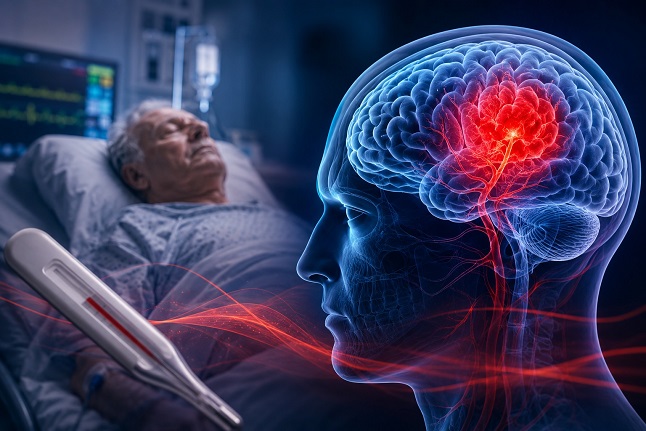 Stroke patients whose body temperature rises during the first 24 hours face a significantly greater risk of long-term
disability and poor recovery
The findings are drawing attention because doctors have traditionally focused on whether a patient has a fever upon admission. However, researchers now say that monitoring how temperature changes over time could provide a much clearer picture of how much damage is occurring inside the brain.
The study was conducted by researchers from the Neuroimaging and Biotechnology Laboratory (NOBEL), the Clinical Neurosciences Research Laboratory (LINC), the Health Research Institute of Santiago de Compostela (IDIS), Hospital Clínico Universitario de Santiago de Compostela, the Neuroradiology Group at IDIS, the Stroke Unit of Hospital Clínico Universitario de Santiago de Compostela, the Stroke Unit of Hospital Clínico Universitario de A Coruña, the Translational Stroke Laboratory (TREAT), the NeuroAging Laboratory (NEURAL), and the Centro de Investigación Biomédica en Red en Enfermedades Neurodegenerativas (CIBERNED), Spain.
Tracking More Than 5,800 Stroke Patients
To better understand the relationship between temperature and stroke outcomes, researchers analyzed data from 5,883 patients. Of these, 4,830 had ischemic strokes caused by blocked blood vessels, while 1,053 had hemorrhagic strokes caused by bleeding in the brain.
Body temperatures were measured when patients arrived at the hospital and repeatedly during the first 24 hours after admission. Researchers then examined how these temperature patterns related to recovery and disability three months later.
Surprisingly, the temperature recorded at admission showed little value in predicting long-term outcomes. What mattered most was whether the patient's temperature increased during the first day.
Rising Temperature Signals Greater Brain Damage
The study found a strong relationship between increasing temperature and worsening brain injury.
Among patients with ischemic stroke, those whose temperatures rose during the first 24 hours faced nearly a tenfold higher risk of poor functional recovery three months later. In hemorrhagic stroke patients, the risk was even greater, increasing more than seventeenfold.
Researchers also discovered that patients experiencing temperature increases tended to show less neurological improvement during the first day after their stroke. In hemorrhagic stroke patients, rising temperature was linked to larger amounts of swelling around the area of bleeding, a dangerous condition known as perihematomal edema.
These findings suggest that a rising temperature may reflect ongoing injury and inflammation inside the brain rather than simply indicating the presence of a
n infection.
Why Temperature Matters After a Stroke
Following a stroke, several biological processes can trigger increases in body and brain temperature. Reduced blood flow, inflammation, oxidative stress, and excessive stimulation of damaged brain cells can all contribute to rising temperatures.
Scientists explained that the brain often becomes warmer than the rest of the body after a stroke. This hotter environment can worsen injury by increasing inflammation and accelerating the destruction of vulnerable brain tissue.
This
Medical News report highlights that temperature changes may serve as a real-time biological marker showing whether brain damage is continuing to progress during the critical hours after a stroke.
Better Guidance for Treatment
Patients whose temperatures reached 37.5 degrees Celsius or higher received fever-reducing treatment using paracetamol or metamizole.
The study found that treating patients based solely on their admission temperature was not particularly useful. Instead, the best predictor of who would benefit from treatment was whether their temperature increased during the first 24 hours.
Among treated patients, a temperature increase proved far more accurate than admission temperature in identifying those at risk of poor outcomes. Researchers believe this finding could help doctors decide when fever-lowering therapy should be started and which patients require closer monitoring.
Conclusions
The study provides compelling evidence that temperature trends are more important than a single temperature reading after a stroke. Patients who experience a rise in body temperature during the first 24 hours face a dramatically higher risk of disability and poor recovery months later. The findings suggest that routine monitoring of temperature changes could become an important part of stroke care, helping doctors identify high-risk patients earlier and target treatment more effectively. Researchers emphasize that future randomized clinical trials are still needed to confirm whether acting on these temperature changes can further improve outcomes and reduce long-term disability.
The study findings were published in the peer reviewed Journal of Clinical Medicine.
https://www.mdpi.com/2077-0383/15/12/4786
For the latest on stroke recovery, keep on logging to Thailand
Medical News.
Read Also:
https://www.mdpi.com/2077-0383/15/12/4786
https://www.thailandmedical.news/news/natural-compound-shows-promise-against-stroke-damage
https://www.thailandmedical.news/news/phytochemical-from-black-seed-shows-powerful-brain-protection-after-stroke




 Share
Share
 Tweet
Tweet
 Share
Share

































