Nikhil Prasad Fact checked by:Thailand Medical News Team Jun 03, 2026 4 months, 1 day, 10 hours, 15 minutes ago
Medical News: A new study has uncovered a surprising benefit of lactulose, a synthetic sugar commonly used to treat constipation and improve gut health. Researchers found that lactulose may significantly weaken several key survival mechanisms used by non-typhoidal Salmonella, one of the world's most common causes of foodborne illness.
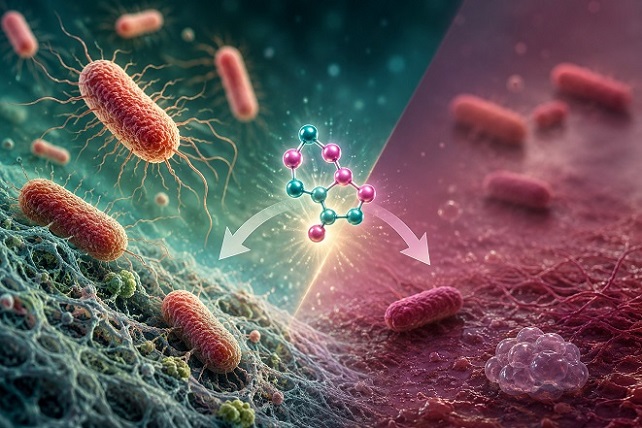 Scientists discover that lactulose can weaken Salmonella's ability to form biofilms, move, and persist in the environment.
The study was conducted by scientists from the School of Veterinary Medicine at Texas Tech University in Amarillo, Texas, USA, and the Environmental Microbial and Food Safety Laboratory at the Beltsville Agricultural Research Center of the United States Department of Agriculture in Maryland, USA.
Salmonella Can Use Lactulose but Pays a Price
Lactulose is widely used in both human and veterinary medicine and is generally regarded as a prebiotic that supports beneficial gut bacteria. Scientists had previously assumed that harmful bacteria could not effectively use this sugar. However, earlier research showed that non-typhoidal Salmonella could actually metabolize lactulose.
The new study set out to discover what happens inside Salmonella when it is exposed to lactulose. Using advanced gene expression analysis, the researchers examined how the bacterium responded after being grown in the presence of lactulose.
The results revealed a dramatic shift in bacterial behavior. More than 1,500 genes changed their activity levels. While many genes involved in sugar uptake and metabolism became more active, numerous genes linked to bacterial survival and persistence were switched off.
Lactulose Forces a Major Genetic Reprogramming
Researchers discovered that Salmonella does not possess a dedicated lactulose transport system. Instead, it appears to hijack existing sugar transport pathways to bring lactulose into the cell. Once inside, the sugar is broken down into fructose and galactose, which are then routed through several metabolic pathways to generate energy.
This metabolic flexibility demonstrates how adaptable Salmonella can be. Yet the process comes with a significant trade-off.
The bacterium redirected much of its energy toward processing lactulose while simultaneously reducing the activity of genes involved in movement, attachment, and biofilm formation. These changes suggest that lactulose pushes Salmonella into a less aggressive and less persistent state.
Biofilm Production Falls Sharply
One of the most important findings involved biofilms. Biofilms are protective communities that bacteria build around themselves. These structures help them survive harsh environmental conditions, resist cleaning procedures, and persist on food-processing surfaces.
The researchers found that lactulose strongly suppressed the genetic machinery responsible for producing curli fibers, a critical component of Salmonella biofilms. Laboratory testing confirmed that bacteria exposed to lactulose developed much smoother colonies and showed a significant reduction in biofilm-associated ch
aracteristics.
This
Medical News report highlights that the reduction was observed across multiple Salmonella serotypes, suggesting the effect is not limited to a single strain.
The study also found reduced accumulation of cellulose, another important biofilm component. Although some cellulose-production genes became more active, overall cellulose levels dropped, indicating that lactulose may promote breakdown of the biofilm matrix faster than it can be rebuilt.
Bacteria Lose Their Ability to Move Efficiently
Movement is another important survival tool for Salmonella. The pathogen uses whip-like structures called flagella to swim through its environment and establish infections.
The research showed that lactulose dramatically reduced activity in many flagella-related genes. Laboratory experiments confirmed the genetic findings. Salmonella cells exposed to lactulose moved more slowly, traveled shorter distances, and produced much smaller swimming zones in motility tests.
Reduced movement could limit the bacterium's ability to colonize hosts and spread within environments where contamination occurs.
Attachment Mechanisms Also Shut Down
The study revealed that lactulose suppressed genes responsible for producing type-1 fimbriae, tiny hair-like structures that help Salmonella attach to intestinal cells and surfaces.
These attachment structures play an important role during the early stages of infection. By reducing their production, lactulose may interfere with the bacterium's ability to establish itself in the host.
At the same time, the researchers observed activation of several stress-response systems. This suggests that metabolizing lactulose may place physiological stress on the bacteria, contributing to the suppression of persistence-related traits.
Conclusions
The findings provide compelling evidence that lactulose does far more than simply act as a prebiotic sugar. While Salmonella can utilize lactulose as an energy source, doing so appears to trigger a profound genetic reprogramming that weakens several traits essential for long-term survival and transmission. The bacterium becomes less capable of forming protective biofilms, less able to move efficiently, and less equipped to attach to host tissues. These combined effects could potentially reduce its persistence in both environmental and host-associated settings. Although further studies are needed to determine whether the same effects occur inside living animals and humans, the research raises intriguing possibilities for using lactulose as part of future strategies aimed at reducing Salmonella contamination and foodborne disease risks.
The study findings were published in the peer reviewed journal: Pathogens.
https://www.mdpi.com/2076-0817/15/6/592
For the latest on preventing or treating Salmonella infections, keep on logging to Thailand
Medical News.
Read Also:
https://www.thailandmedical.news/articles/diets-and-nutrition
https://www.thailandmedical.news/articles/gastroenterology




 Share
Share
 Tweet
Tweet
 Share
Share

































