Nikhil Prasad Fact checked by:Thailand Medical News Team Jul 06, 2026 1 month, 3 weeks, 6 days, 15 hours, 52 minutes ago
Medical News: Scientists Discover Another Hidden Way COVID 19 Reprograms Human Cells
Scientists investigating the long-term biological consequences of COVID-19 have uncovered compelling evidence that SARS-CoV-2 infection is driving the emergence of novel chimeric RNAs within infected human cells, revealing yet another mechanism by which the virus alters human biology. Rather than simply using the host's cellular machinery to replicate, the virus appears to fundamentally disrupt RNA processing, creating unusual fusion transcripts that could influence immunity, inflammation, disease severity, and possibly even the development of long COVID and even new medical and health conditions!
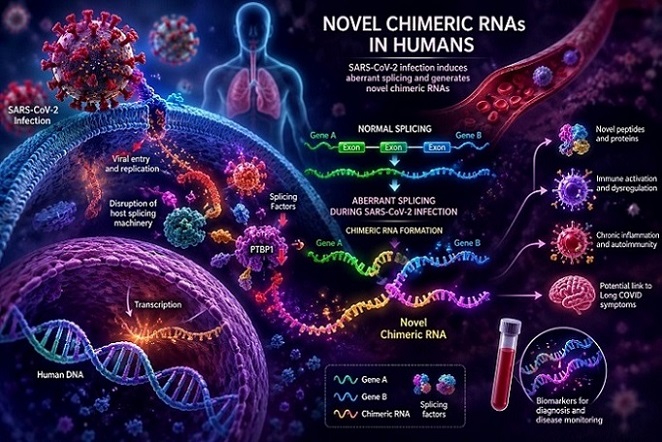 Scientists uncover hundreds of novel fusion RNAs created by SARS-CoV-2 that may help explain severe COVID-19 and long COVID
These findings significantly expand our understanding of how SARS-CoV-2 manipulates the human transcriptome and may ultimately pave the way for new biomarkers and therapeutic targets.
What Are Chimeric RNAs and Why Do They Matter
Chimeric RNAs are hybrid RNA molecules created when segments from two or more separate RNA transcripts become fused into a single molecule. Normally, RNA is produced through carefully regulated transcription and splicing processes. However, errors during RNA splicing, trans-splicing events, or genomic rearrangements can produce these unexpected fusion transcripts.
For years, chimeric RNAs have primarily been associated with cancer biology, where they can generate abnormal proteins that drive tumor growth. Scientists are now discovering that viral infections, especially SARS-CoV-2, can also trigger widespread production of these fusion transcripts by interfering with the host's RNA processing machinery.
The growing body of evidence suggests that COVID-19 infection does far more than temporarily disturb cellular function. Instead, it may leave behind profound molecular changes capable of altering gene expression long after the initial infection has subsided.
This
Medical News report highlights one of the most intriguing molecular discoveries to emerge from post-pandemic research.
SARS-CoV-2 Disrupts Critical RNA Splicing Machinery
One of the defining features of SARS-CoV-2 infection is its ability to interfere with normal RNA splicing. The virus interacts with numerous host splicing factors, disrupting the highly coordinated process that removes introns and joins exons into mature messenger RNA.
When this process becomes dysregulated, abnormal RNA products begin to accumulate, including novel chimeric RNAs.
Researchers have identified one particularly important target of viral disruption: PTBP1, a major RNA-binding protein that normally functions as a splicing repressor. Reduced PTBP1 activity during severe COVID-19 appears to create ideal conditions for the generation of specific fusion transcripts.
The loss of this critical regulator provides one of the strongest
mechanistic links yet between SARS-CoV-2 infection and widespread abnormalities in host RNA processing.
Hundreds of Previously Unknown Fusion Transcripts Identified
One of the most significant studies examining this phenomenon was published in Viruses in 2023. Scientists analyzed blood transcriptomes from patients suffering from severe COVID-19 and made a remarkable discovery.
The researchers identified 424 chimeric transcripts that were unique to patients with severe COVID-19. These fusion RNAs were absent or extremely rare in healthy individuals and in patients suffering from other respiratory infections.
Even more striking, 42 of these chimeric RNAs repeatedly appeared across multiple patients, suggesting they were not random events but reproducible molecular signatures associated with severe SARS-CoV-2 infection.
The investigators concluded that virus-induced disruption of host splicing machinery and altered transcriptional dynamics were directly responsible for generating these fusion transcripts. Many involved human genes that could potentially produce entirely new proteins capable of modifying immune responses, cellular signaling pathways, or normal biological functions.
New Study Reveals More Than 350 Additional COVID Specific Chimeric RNAs
Further evidence emerged in 2025 through a study published in Genes & Diseases, which mapped chimeric RNAs in whole blood samples obtained from COVID-19 patients.
To maximize detection accuracy, investigators employed three independent prediction platforms: STAR-Fusion, SoapFuse, and EricScript.
Their analysis uncovered more than 350 novel chimeric RNAs that were present in COVID-19 patients but completely absent from healthy whole-blood controls contained within the GTEx database.
Among these newly identified fusion transcripts, one stood out because it displayed a particularly strong association with COVID-19 disease status.
Detailed molecular analysis revealed that its formation depended on suppression of PTBP1 activity, further strengthening evidence that SARS-CoV-2-induced disruption of RNA splicing directly generates disease-specific chimeric RNAs.
The researchers proposed that these newly discovered fusion transcripts could eventually serve as valuable biomarkers for diagnosing COVID-19, monitoring disease progression, or predicting disease severity.
Viral Human Fusion RNAs Spark Scientific Debate
Another fascinating area of investigation concerns whether SARS-CoV-2 sequences themselves can become incorporated into human genetic material.
In 2021, researchers led by Zhang, Richards, and colleagues, including Rudolf Jaenisch, published a study in PNAS reporting that SARS-CoV-2 RNA could undergo reverse transcription and become integrated into cultured human cell DNA through LINE-1 retrotransposon activity.
The team detected viral-host chimeric transcripts in infected laboratory cells and reanalyzed patient RNA sequencing datasets, proposing that some viral RNA detected in recovered individuals might originate from integrated DNA copies rather than ongoing viral replication. This hypothesis offered one possible explanation for prolonged positive PCR tests after clinical recovery.
However, the integration hypothesis remains controversial. A companion PNAS study published in 2021 by Parry and colleagues challenged these conclusions, arguing that there was no convincing evidence that viral-host chimeric transcripts resulted from genomic integration. Instead, the researchers suggested that most fusion reads represented technical artifacts generated during RNA sequencing library preparation through template switching during reverse transcription.
Supporting this interpretation, another 2021 study published in Frontiers in Microbiology by Kazachenka and colleagues demonstrated that many apparent human-SARS-CoV-2 chimeric reads preferentially aligned with highly expressed exons and even formed between viral RNA and non-integratable RNA molecules such as mitochondrial and episomal RNA. These findings strongly suggested that many viral-host fusion reads reflected sequencing artifacts rather than genuine genomic integration.
Strong Evidence Supports Virus Induced Host RNA Fusion
Although scientists continue to debate whether SARS-CoV-2 occasionally integrates into the human genome, there is growing consensus regarding another key finding.
Multiple independent investigations consistently demonstrate that SARS-CoV-2 infection disrupts host RNA splicing and drives the formation of novel host-derived chimeric RNAs. This mechanism is supported by reproducible transcriptomic analyses, mechanistic studies involving PTBP1 dysfunction, and repeated observations across independent patient cohorts.
The dominant biological process therefore appears to involve virus-induced errors in RNA processing rather than permanent rewriting of the human genome.
Potential Links to Long COVID and Future Diagnostics
The clinical implications of these discoveries could be substantial. Some chimeric RNAs may produce previously unknown peptides capable of stimulating autoimmune responses, sustaining chronic inflammation, or interfering with normal protein interaction networks. These mechanisms could contribute to persistent symptoms frequently reported by long COVID patients, including fatigue, cognitive impairment, brain fog, and multi-organ dysfunction.
Researchers also believe these fusion transcripts may become valuable diagnostic biomarkers capable of identifying persistent molecular effects of SARS-CoV-2 infection, monitoring recovery, or distinguishing COVID-19 from other respiratory viral illnesses. Future therapies targeting disrupted RNA splicing pathways may even help reduce some of the long-term biological consequences associated with infection.
As long-read sequencing technologies continue to improve and functional studies become increasingly sophisticated, scientists expect to determine which chimeric RNAs remain biologically active, how long they persist after infection, and exactly how they influence disease progression and recovery.
The growing evidence demonstrates that SARS-CoV-2 exerts remarkably complex effects on human gene regulation that extend far beyond acute respiratory illness. Rather than merely exploiting host cells to reproduce, the virus profoundly reshapes RNA biology through widespread splicing dysregulation, generating hundreds of previously unknown chimeric RNAs that may influence immunity, inflammation, disease severity, and long COVID. These discoveries open important new directions for molecular diagnostics, therapeutic development, and our broader understanding of viral pathogenesis for years to come.
References:
https://www.pnas.org/doi/10.1073/pnas.2105968118
https://www.pnas.org/doi/10.1073/pnas.2109066118
https://www.frontiersin.org/journals/microbiology/articles/10.3389/fmicb.2021.676693/full
https://www.mdpi.com/1999-4915/15/2/433
https://www.sciencedirect.com/science/article/pii/S2352304224001454
https://febs.onlinelibrary.wiley.com/doi/10.1111/febs.16723
https://www.biorxiv.org/content/10.1101/2020.12.12.422516v1
For the latest COVID-19 news, keep on logging to Thailand
Medical News.
Read Also:
https://www.thailandmedical.news/articles/coronavirus
https://www.thailandmedical.news/articles/long-covid




 Share
Share
 Tweet
Tweet
 Share
Share