Nikhil Prasad Fact checked by:Thailand Medical News Team May 30, 2026 3 months, 3 days, 11 hours, 53 minutes ago
Medical News: Long COVID patients may be experiencing far more than lingering fatigue and brain fog. A new brain imaging study has found that the condition appears to alter the way the brain shifts between important functional networks, potentially helping explain why many sufferers struggle with concentration, memory, mental stamina, and emotional wellbeing long after recovering from the initial infection.
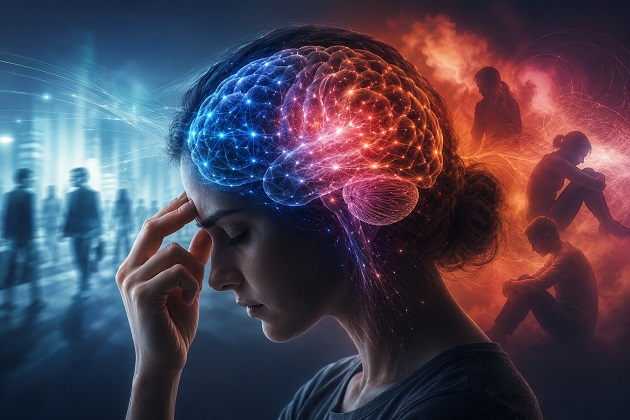 New brain scans reveal that Long COVID may push the brain away from attention-focused networks and toward
internally focused emotional states
Researchers from the Department of Neuroimaging, Department of Psychological Medicine, Department of Psychosis Studies, and the Institute for Human and Synthetic Minds at King's College London, United Kingdom, along with scientists from the Department of Clinical Neurosciences and Mental Health and RISE-HEALTH at the University of Porto, Portugal, investigated how the brains of people with Post-COVID-19 Syndrome (PCS), also known as Long COVID, function while at rest.
Brain Networks Become Stuck in the Wrong Mode
The research involved 20 individuals with Long COVID and 20 recovered individuals who had previously contracted COVID-19 but no longer had symptoms. Using advanced resting-state functional MRI scans, the team examined how different brain regions communicated with one another over time.
The scientists identified five recurring brain states. Some were associated with attention and interaction with the outside world, while others were linked to internal thoughts, emotions, and self-reflection.
A key discovery was that people with Long COVID spent significantly less time in a brain state involving the visual and dorsal attention networks. These networks are essential for focusing, processing information from the environment, and maintaining concentration.
At the same time, Long COVID patients spent more time in a brain state dominated by the limbic system and the default mode network. These brain regions are strongly linked to emotions, self-focused thinking, memory, and internal awareness.
Possible Explanation for Brain Fog
The findings suggest that the brains of Long COVID patients may be shifting away from networks needed for attention and mental performance and spending more time in networks associated with inward-focused processing.
Researchers also found that Long COVID participants remained in attention-related states for shorter periods. Their brains appeared less flexible when switching between different functional states, suggesting a reduced ability to adapt efficiently to changing mental demands.
This
Medical News report notes that such changes could help explain common Long COVID complaints including mental fog, slowed thinking, poor concentration, memory difficulties, and emotional disturbances.
Links to Cognition and Inflammation
/>
The study also uncovered intriguing clues connecting brain activity, cognition, and inflammation.
Participants who showed greater activity in the limbic-default mode network state tended to perform worse on global cognitive assessments. Researchers also observed an association between this brain pattern and higher levels of interleukin-1 beta (IL-1β), an inflammatory molecule involved in immune responses.
Although these links did not remain statistically significant after the strictest corrections, they point toward a possible relationship between persistent inflammation and ongoing neurological symptoms.
The researchers emphasize that Long COVID may involve subtle disruptions in large-scale brain systems rather than obvious structural damage. Traditional brain scans often appear normal in these patients, making these dynamic network changes especially important.
A New Understanding of Long COVID
The study suggests that Long COVID may create a brain that is less able to engage with the external world and more likely to become focused on internal signals and emotional processing. This shift may contribute to the persistent fatigue, cognitive dysfunction, and mood-related symptoms experienced by many patients.
The researchers caution that the study involved a relatively small number of participants and larger investigations are needed. However, the findings provide some of the strongest evidence yet that Long COVID is associated with measurable alterations in how the brain organizes and transitions between functional networks.
Conclusion
The study provides compelling evidence that Long COVID is associated with significant disruptions in the brain's natural communication patterns. Instead of smoothly moving between attention, sensory, and emotional networks, the brains of affected individuals appear to spend less time in states that support focus and more time in internally oriented emotional states. These changes may underlie many of the cognitive and psychological symptoms reported by patients. While further research is needed, the findings offer an important step toward understanding the biological basis of Long COVID and may eventually help guide future diagnostic tools and treatments.
The study findings were published in the peer reviewed journal: Brain, Behavior, & Immunity - Health.
https://www.sciencedirect.com/science/article/pii/S2666354626001079
For the latest on Long COVID, keep on logging to Thailand Medical News.
Read Also:
https://www.thailandmedical.news/articles/long-covid




 Share
Share
 Tweet
Tweet
 Share
Share

































