Nikhil Prasad Fact checked by:Thailand Medical News Team Jan 01, 2026 9 months, 2 days, 23 hours, 16 minutes ago
Medical News: The SARS-CoV-2 virus, responsible for the COVID-19 pandemic, has been extensively studied for its impact on human health. Beyond acute infection, emerging research suggests that the virus may interact with the human genome in unexpected ways. Specifically, evidence indicates that SARS-CoV-2 RNA can be reverse-transcribed and integrated into human DNA, potentially leading to insertions or deletions within intronic regions of genes. This phenomenon raises questions about long-term effects on cellular function and disease persistence. In this exclusive
Medical News report, we explore the scientific basis for these claims, drawing on peer-reviewed studies to highlight how such genomic alterations might occur. While the idea of viral integration into host DNA is not new—seen in viruses like HIV—it is surprising for an RNA virus like SARS-CoV-2, which lacks its own reverse transcriptase enzyme
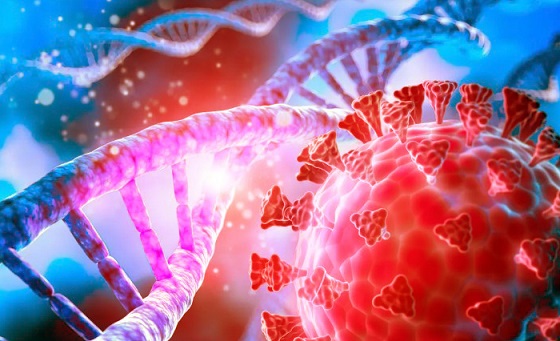 SARS-CoV-2 RNA can be reverse-transcribed and integrated into human DNA, potentially leading to
insertions or deletions within intronic regions of genes
Mechanism of Viral Integration
SARS-CoV-2 is an RNA virus that typically replicates in the cytoplasm without entering the nucleus. However, studies propose that it hijacks endogenous human machinery, particularly LINE-1 (Long Interspersed Nuclear Element-1) retrotransposons, to achieve integration.
LINE-1 elements encode reverse transcriptase and endonuclease proteins that can mobilize DNA sequences within the genome. The process begins with reverse transcription of viral RNA into complementary DNA (cDNA) using LINE-1 reverse transcriptase. This cDNA can then be inserted into the host genome via target-primed reverse transcription, often at sites recognized by LINE-1 endonuclease. Integrations frequently occur in non-coding regions, such as introns or intergenic areas, where they might disrupt gene regulation without immediately affecting protein-coding sequences. Insertions add viral genetic material, potentially causing frameshifts or splicing errors, while deletions could arise from imprecise integration or repair mechanisms responding to the insertion.
Evidence from Peer-Reviewed Studies
A landmark study published in the Proceedings of the National Academy of Sciences (PNAS) in 2021 provided compelling evidence for this integration.
Researchers analyzed genomic DNA from SARS-CoV-2-infected human cell lines overexpressing LINE-1 and found chimeric sequences where viral RNA fragments fused with human DNA. Using Nanopore and Illumina sequencing, they identified integration sites flanked by target site duplications and LINE-1 recognition sequences, hallmarks of retrotransposition. Notably, about 71% of these viral integrations were in intronic or intergenic regions, with 29% in exons.
This distribution suggests non-random insertion, potentially favoring gene-rich areas. The study also detected expression of these integrated sequences as chimeric transcripts in patient-derived tissues, explaining persistent PCR positivity in recovered individuals without active infection. Supp
orting this, a preprint on bioRxiv detailed similar findings, showing SARS-CoV-2 subgenomic RNAs, particularly the nucleocapsid region, being reverse-transcribed and integrated.
Induction of LINE-1 expression upon viral infection or cytokine exposure was observed, providing a mechanistic link. While direct deletions weren't emphasized, the integration process could induce local genomic instability, leading to indels during DNA repair. Another analysis in Frontiers in Microbiology examined chimeric reads but cautioned they might arise from library preparation artifacts, yet acknowledged potential genuine integrations in specific contexts.
A recent study published in Wiley’s Advanced Genetics found that pediatric patients with MIS-C who had been previously exposed to COVID-19 had intronic insertions or deletions in immune genes such ORAI1, STAT4, and ITPR1. Though was not validated that SARS-CoV-2 was the causative agent…the presence of these modified genes raised questions.
Implications for Human Health
If SARS-CoV-2 integrations cause intronic insertions or deletions, the consequences could be profound. Introns play crucial roles in alternative splicing, gene expression regulation, and non-coding RNA production. An insertion in an intron might alter splice sites, leading to aberrant protein isoforms or reduced gene function. For instance, if integrated near regulatory elements, it could promote oncogenesis or autoimmune responses by mimicking endogenous retroelements.
Deletions, though less directly documented, might occur if integration triggers non-homologous end joining or other repair pathways that excise DNA segments. This could contribute to chronic conditions post-COVID, such as long COVID symptoms involving neurological or immunological dysregulation. Moreover, if integrations are heritable—though unlikely in somatic cells—they raise concerns for germline effects, albeit no evidence supports this yet. The persistence of viral sequences might also explain recurrent positive tests and could influence vaccine responses or antiviral therapies. However, these integrations appear rare and primarily in cultured cells or severe cases, not widespread in the population.
Controversies and Future Research
The concept of SARS-CoV-2 genome integration remains controversial. Several studies have failed to replicate these findings using long-read sequencing in infected cells, finding no evidence of integration and attributing chimeric sequences to artifacts.
For example, deep Oxford Nanopore sequencing of infected HEK293T cells detected no viral integrations, instead identifying natural LINE-1-mediated events.
Critics argue that observed chimeras result from extrachromosomal DNA or sequencing errors, not true genomic insertion. Despite this, the PNAS study counters with robust controls and patient data, suggesting integrations occur under specific conditions like high LINE-1 activity. Future research should employ single-cell genomics and longitudinal studies to confirm in vivo integrations and assess indel frequencies. Understanding these mechanisms could inform treatments targeting retrotransposons or enhancing DNA repair.
Conclusion
SARS-CoV-2's potential to cause intronic insertions or deletions in human genes challenges our view of RNA virus-host interactions. While evidence from key studies supports integration via LINE-1, debates persist, underscoring the need for more investigation. As the pandemic evolves, monitoring genomic impacts remains essential for public health.
References:
https://www.pnas.org/doi/10.1073/pnas.2105968118
https://www.biorxiv.org/content/10.1101/2020.12.12.422516v1
https://www.frontiersin.org/journals/microbiology/articles/10.3389/fmicb.2021.676693/full
https://www.sciencedirect.com/science/article/pii/S221112472100961X
https://pmc.ncbi.nlm.nih.gov/articles/PMC8316065/
https://advanced.onlinelibrary.wiley.com/doi/10.1002/ggn2.202500023
For the latest COVID-19 News, keep on logging to Thailand
Medical News.
Read Also:
https://www.thailandmedical.news/news/covid-19-news-harvard-and-mit-study-alarmingly-shows-that-sars-cov-2-rna-integrates-into-human-genome-with-varying-implications
https://www.thailandmedical.news/news/breaking-news-new-research-by-mit-and-nci-provides-further-evidence-of-controversial-claims-that-sars-cov-2-genes-can-integrate-with-human-dna




 Share
Share
 Tweet
Tweet
 Share
Share

































