Nikhil Prasad Fact checked by:Thailand Medical News Team Feb 13, 2026 6 months, 2 weeks, 3 days, 21 hours, 29 minutes ago
Medical News: A newly modified natural compound derived from quercetin, a plant flavonoid found in fruits and vegetables, is showing powerful anti-cancer effects against aggressive brain tumors known as gliomas. Scientists have discovered that a chemically enhanced version called 3-O-decanoylquercetin, or Q-3-Dec, can attack multiple survival systems inside glioma cells at the same time, potentially opening the door to new treatment strategies.
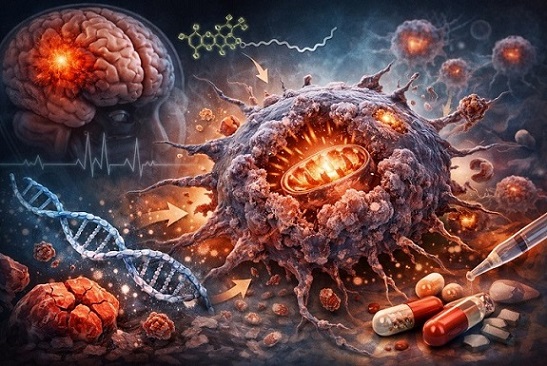 A modified quercetin compound attacks brain cancer cells by crippling their energy systems and survival pathways
Researchers from the Institute for Biomedical Research and Innovation (IRIB), National Research Council of Italy (CNR), Catania; the Department of Biomedical and Biotechnological Sciences, University of Catania; the Institute for Systems Analysis and Computer Science “A. Ruberti” (IASI), CNR, Rome; Mahidol University, Bangkok; Óbuda University, Budapest; and the Institute of Biomolecular Chemistry (ICB), CNR, Catania, worked together on the study.
Understanding Why Gliomas Are So Hard to Treat
Gliomas are among the deadliest brain cancers. Even with surgery, chemotherapy, and radiotherapy, many patients survive less than 18 months after diagnosis. One major reason is that glioma cells activate internal survival pathways that protect them from treatment and help them resist cell death.
In this
Medical News report, researchers explain that ordinary quercetin has known anti-cancer properties, but its effects are often limited. To improve its power, scientists added a fatty chemical chain to the molecule, making it more capable of entering cells and interacting with critical structures such as mitochondria, the energy-producing units of cells.
Early Mitochondrial Damage Triggers Cell Collapse
The team treated human U373-MG glioma cells with Q-3-Dec and observed dramatic changes. Within just one to three hours, the treated cancer cells began losing their mitochondrial membrane potential. This is a key sign that mitochondria are failing. When mitochondria lose stability, they can release signals that trigger programmed cell death.
Importantly, this mitochondrial damage happened before major changes were seen in other survival pathways. This suggests that the compound first strikes at the energy core of the cancer cell, setting off a chain reaction that eventually leads to its destruction.
Blocking Cancer Survival Signals
The study found that Q-3-Dec significantly reduced activation of two powerful cancer-promoting proteins called NF-κB and STAT3. These proteins normally switch on genes that help tumors grow, avoid death, and resist therapy.
After treatment, levels of phosphorylated NF-κB dropped by about 53 percent at 12 and 24 hours. STAT3 phosphorylation decreased by up to 69 percent, with the strongest suppression observed at 48 hours. This shutdown weakened the cancer cells’ internal defense systems.
At the same time, two
major anti-death proteins, survivin and Bcl-2, were sharply reduced. Survivin levels fell by roughly 50 percent, while Bcl-2 levels dropped by as much as 70 percent after prolonged exposure. These proteins normally protect cancer cells from self-destruction, so their reduction makes tumors far more vulnerable.
Reducing Chemotherapy Resistance
One of the most striking findings involved MGMT, a DNA repair enzyme that helps glioma cells resist chemotherapy drugs such as temozolomide. Q-3-Dec significantly lowered MGMT protein levels between 6 and 24 hours of treatment. This suggests the compound may weaken the tumor’s ability to repair chemotherapy-induced DNA damage, potentially improving future combination therapies.
By 48 hours, about 30 percent of glioma cells had died, confirming that the combined effects on mitochondria, survival signaling, and DNA repair ultimately push cancer cells toward irreversible collapse.
Conclusion
This research shows that Q-3-Dec does not attack just one target. Instead, it simultaneously damages mitochondrial function, suppresses NF-κB and STAT3 signaling, lowers anti-apoptotic proteins, and reduces MGMT levels linked to drug resistance. Such a multi-pronged strategy may be especially valuable against aggressive gliomas that rely on overlapping survival systems. Although these findings are based on laboratory cell models and require further animal and clinical studies, they provide a strong scientific foundation for future preclinical development of this enhanced quercetin derivative.
The study findings were published in the peer reviewed International Journal of Molecular Sciences.
https://www.mdpi.com/1422-0067/27/4/1726
For the latest on Glioblastoma and other brain cancers, keep on logging to Thailand
Medical News.
Read Also:
https://www.thailandmedical.news/articles/cancer




 Share
Share
 Tweet
Tweet
 Share
Share