Challenging the Fallacy - Evidence for Recombination and Reassortment Potential Between Viruses from Different Families in Rats
Nikhil Prasad Fact checked by:Thailand Medical News Team May 07, 2026 4 months, 3 weeks, 6 days, 23 hours, 45 minutes ago
Medical News: For decades, virologists have largely believed in the fallacy that viruses from completely different families were biologically incapable of exchanging genetic material in meaningful ways. Differences in genome structures, replication methods, enzymes, and viral architecture were thought to create nearly impossible barriers to recombination or reassortment between distant viral groups. However, emerging research involving wild rats is now challenging that long-held assumption and raising serious concerns about the future emergence of novel zoonotic pathogens.
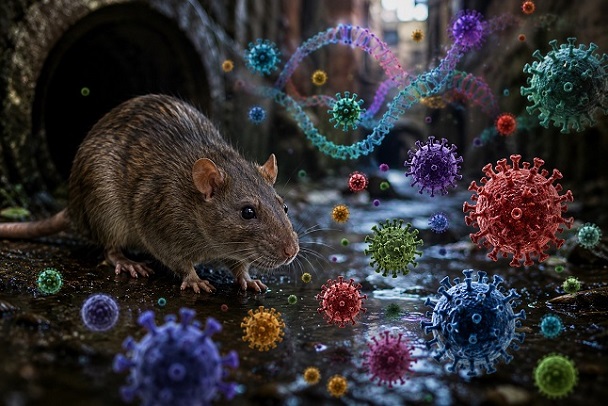 Wild rats carrying multiple unrelated viruses may be creating the perfect conditions for dangerous new hybrid pathogens to emerge
Metagenomic studies involving wild brown rats, scientifically known as Rattus norvegicus, are revealing that these rodents often carry numerous unrelated viruses simultaneously within the same tissues and organs. Scientists warn that such intense viral co-infections may provide the exact biological conditions needed for rare but potentially dangerous inter-family genetic exchanges.
Wild Rats Harbor Multiple Viral Families at Once
Rats are considered ideal reservoirs for viral evolution studies because they thrive in crowded urban environments and live-in close association with humans. Their dense populations and exposure to sewage, waste, and contaminated food sources make them hosts to a remarkably diverse range of viruses.
Modern virome analyses have repeatedly identified viruses from highly divergent families co-existing in the same rat samples. These include Astroviridae, Caliciviridae, Hepeviridae, Picornaviridae, Parvoviridae, Anelloviridae, and several others. Scientists explain that when multiple viruses infect the same cell simultaneously, opportunities emerge for recombination, where nucleotide sequences are exchanged, or reassortment, where genome segments are swapped among segmented viruses.
Although such events are considered rare, researchers now stress that they are biologically plausible and may occur more frequently than previously assumed.
Hungarian Study Reveals Extensive Viral Coinfections
One of the most striking investigations came from Hungary in 2021, where researchers conducted a metagenomic and PCR-based analysis of wild and laboratory rats. The study identified three major RNA viruses from completely separate viral families circulating within the same rat populations.
Scientists discovered a novel rat astrovirus belonging to Astroviridae, a rat norovirus from Caliciviridae, and rat hepevirus or orthohepevirus C from Hepeviridae. These viruses were detected not only in fecal material but also across multiple organs including the liver, kidney, spleen, and lungs.
Most alarming was the discovery that approximately 28 percent of examined wild rats carried simultaneous infections involving multiple viral families. Some rats harbored combinations such as astrovirus with norovirus, astrovirus with hepevirus, or norovirus with hepevirus.
In one extraordinary fecal sample, researchers detected as many as five different RNA viruses
at the same time, including picornaviruses from yet another unrelated viral family. Investigators also observed high viral loads within these shared samples, strongly indicating active replication within co-infected cells. Although the researchers did not isolate definitive recombinant viral offspring, they emphasized that these findings provide compelling ecological evidence that the conditions for inter-family recombination already exist naturally in rat populations.
Chinese Scientists Detect Potential Recombinant Virus
A second major study published in 2023 expanded these concerns further. Researchers in China examined viral communities in the blood, feces, and internal tissues of wild brown rats captured from natural environments. Their analysis uncovered novel viral genome sequences spanning several unrelated families including Anelloviridae, Parvoviridae, Astroviridae, Picornaviridae, and CRESS DNA viruses. Many of these viruses were found systemically throughout the animals, suggesting active viremia and widespread organ dissemination.
Most notably, the investigators explicitly reported the presence of what they described as a “potential recombinant virus” within the complex viral mixtures identified in the rats.
Phylogenetic analysis showed that many detected viruses clustered with strains originating from multiple animal hosts, suggesting ongoing cross-species viral movement and adaptation. Scientists also identified unusual dual-segment picornavirus-like genomes within fecal samples, further complicating understanding of viral evolution within rodents.
This
Medical News report highlights growing evidence that wild rats may function as viral mixing vessels capable of fostering entirely new genetic combinations among viruses previously assumed incapable of interacting.
Viral Evolution May Be Far More Flexible Than Expected
Broader rodent virome studies continue to reinforce the same disturbing pattern. Rats frequently carry segmented viruses alongside non-segmented RNA viruses within the same biological environments.
While true reassortment between unrelated families remains mechanistically difficult, experts say the simultaneous presence of diverse viral types raises theoretical possibilities involving segment exchanges, module swapping, or horizontal gene transfer during intense co-infection scenarios.
Supporting these concerns, recent evolutionary analyses involving animal viruses have already documented examples where genes from one viral family became incorporated into another. Scientists have identified viral hybrids containing replication machinery from one lineage combined with structural proteins from another, proving that viral modularity can occur under the right evolutionary pressures.
SARS-CoV-2 and H5N1 Infecting Rats and Other Rodents That Are Already Carrying Various Hantavirus Strains
Numerous studies have already validated that rats and many other rodents are easily infected with the various SARS-CoV-2 variants and also the various H5N1 strains. With many of these rats and sewer animals carrying various other viruses including hantavirus etc, the emergence of reassortant events with newer strains appearing is very high if they not already occurred.
Growing Concerns About Future Zoonotic Threats
Researchers now warn that co-infection rates exceeding 20 to 30 percent in wild rat populations provide repeated opportunities for the emergence of chimeric viruses possessing altered host ranges, enhanced immune evasion abilities, or expanded tissue tropism.
Because rats inhabit sewers, homes, food markets, transportation hubs, and hospitals worldwide, any newly evolved recombinant virus could potentially gain direct access to human populations. Scientists are increasingly calling for advanced surveillance methods including long-read sequencing, single-cell viromics, and controlled co-infection experiments to better detect and characterize novel recombinant progeny before potential spillover events occur.
The growing body of evidence strongly suggests that the old belief claiming viruses from entirely different families cannot exchange genetic material may no longer be scientifically sustainable. While such events remain uncommon, the repeated discovery of dense multi-family viral infections in wild rats demonstrates that nature may possess far greater evolutionary flexibility than previously appreciated. These findings could profoundly reshape understanding of viral emergence, zoonotic disease evolution, and pandemic preparedness strategies in the years ahead.
References:
https://elifesciences.org/reviewed-preprints/97647
https://link.springer.com/article/10.1007/s11262-018-1590-z
https://virology.ws/2016/10/27/genome-recombination-across-viral-families/
https://www.sciencedirect.com/topics/immunology-and-microbiology/reassortment
https://www.tandfonline.com/doi/full/10.1080/22221751.2024.2396874
https://www.sciencedirect.com/science/article/pii/S004268229798990X
https://www.biorxiv.org/content/10.1101/2025.08.20.670882v1.full
https://www.sciencedirect.com/science/article/abs/pii/S1567134821002392
https://www.sciencedirect.com/science/article/pii/S2405844023044304
https://journals.plos.org/plosone/article?id=10.1371/journal.pone.0316882
For the latest news, keep on logging to Thailand
Medical News.
Read Also:
https://www.thailandmedical.news/news/breaking-china-s-scientists-say-omicron-most-probably-originated-from-a-mouse-and-not-from-a-human-host




 Share
Share
 Tweet
Tweet
 Share
Share

































