The Phytochemical Kolaviron from Garcinia Kola (Bitter Kola) Shows Potential Against the Ebola Virus. Further Studies Needed
Nikhil Prasad Fact checked by:Thailand Medical News Team May 17, 2026 3 months, 2 weeks, 2 days, 3 hours, 1 minute ago
Medical News: A natural phytochemical compound derived from Garcinia Kola, commonly known as Bitter Kola, is once again drawing scientific attention for its potential ability to combat Ebola virus infections, including the dangerous Bundibugyo strain. Researchers studying the plant’s active phytochemical compound, kolaviron, say its antiviral, antioxidant, and anti-inflammatory properties may provide valuable clues for future therapeutic strategies against one of the world’s deadliest viral diseases. There are some other experts who however argue that Kolaviron does not help with Ebola infections, hence the need for more detailed studies.
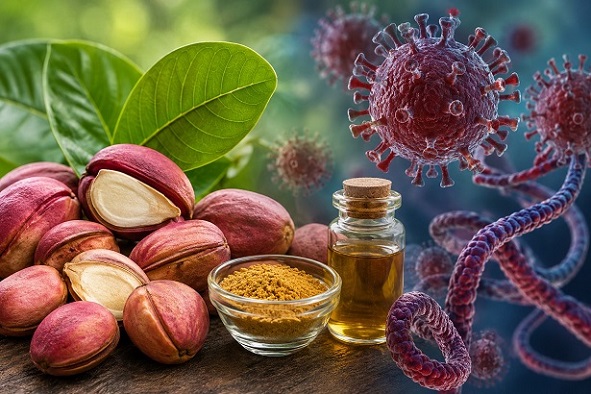 Researchers are investigating whether kolaviron from Bitter Kola can help suppress Ebola viral activity and
dangerous inflammatory responses
Traditional African Medicinal Plant Enters Modern Viral Research
Garcinia kola is a tropical tree native to West and Central Africa, where its bitter seeds have been consumed for centuries in traditional medicine. Local healers have historically used Bitter Kola for respiratory illnesses, infections, inflammatory disorders, and general immune support.
Modern scientific investigations have identified kolaviron as one of the plant’s most important bioactive components. Kolaviron is a biflavonoid complex consisting mainly of compounds known as GB-1, GB-2, and kolaflavanone.
Numerous studies have shown that the phytochemical possesses strong antioxidant and immunomodulatory properties while also demonstrating antiviral activity against several viruses.
Scientists are now increasingly interested in whether these biological effects could help counter Ebola virus disease, particularly strains such as Bundibugyo ebolavirus, which first emerged in Uganda during outbreaks in 2007 and 2008.
The Bundibugyo strain causes severe hemorrhagic fever characterized by high fever, internal bleeding, immune dysfunction, organ failure, and in many cases death. Although its mortality rate is lower than that of the Zaire Ebola strain, health experts still consider it highly dangerous due to its ability to spread rapidly and trigger devastating inflammatory responses.
Landmark 1999 Experiments Produced Surprising Results
One of the most cited investigations involving Garcinia kola and Ebola virus dates back to 1999, when Nigerian pharmacognosist Professor Maurice Iwu collaborated with researchers at the US Army Medical Research Institute of Infectious Diseases.
Researchers tested extracts from Garcinia kola seeds on Ebola infected monkey kidney cell cultures. The flavonoid-rich extracts reportedly inhibited viral replication at non-toxic concentrations. According to reports, viral multiplication slowed significantly after exposure to the extracts, suggesting that compounds within Bitter Kola interfered with important stages of the viral life cycle.
Professor Iwu stressed at the time that the extract was not a cure for Ebola. However, the findings suggested that it might help suppress viral replication long enough for the immune system to mount a more effective de
fense.
Despite attracting considerable media coverage, the findings were never fully developed into clinical programs, largely because of funding limitations and shifting research priorities.
How Kolaviron Could Reduce Ebola Damage
Scientists now believe that kolaviron’s greatest strength may lie not only in direct antiviral effects but also in its ability to control the severe inflammatory damage associated with Ebola infections.
Ebola viruses are known to trigger massive oxidative stress and cytokine storms inside the body. In severe infections, immune cells release large amounts of inflammatory molecules such as TNF alpha and IL-6, leading to vascular leakage, tissue destruction, and organ failure.
Laboratory studies involving kolaviron have demonstrated that the compound can suppress inflammatory signaling pathways such as NF kappa B and AP-1. Researchers have also observed reductions in inflammatory enzymes including iNOS and COX-2.
At the same time, kolaviron enhances antioxidant defenses by boosting glutathione levels and neutralizing harmful free radicals. These effects may help reduce cellular injury and protect organs from the excessive inflammatory damage commonly seen during advanced Ebola virus disease.
Influenza Research Added More Scientific Support
Additional evidence supporting kolaviron’s therapeutic potential came from a 2015 animal study involving influenza A H3N2 infection in BALB c mice.
Scientists administered oral kolaviron at doses of 400 milligrams per kilogram and observed remarkable improvements in disease outcomes. Treated mice experienced reduced lung inflammation, less tissue damage, lower nitric oxide production, and improved liver and lung function.
Importantly, the compound appeared to reduce harmful immune overactivation without completely preventing viral clearance. Researchers believe this balancing effect could be extremely relevant in Ebola infections, where excessive immune responses often contribute significantly to mortality.
This
Medical News report notes that many experts now view immune modulation as one of the most promising approaches for reducing severe Ebola complications.
Computer Simulations Reveal Possible Viral Targets
Further support for Garcinia kola’s antiviral promise emerged from a 2017 bioinformatics study examining how Bitter Kola compounds interact with Ebola virus proteins.
Using molecular docking analyses, researchers found that several kolaviron-related biflavonoids showed binding affinity to Ebola glycoproteins, membrane proteins, metalloproteases, and serine proteases involved in viral entry and replication.
Although these findings were computational rather than clinical, they suggested that Garcinia kola compounds may interfere with multiple viral mechanisms simultaneously. Scientists believe these mechanisms could potentially apply not only to Zaire ebolavirus but also to Bundibugyo ebolavirus because of important similarities between the viral proteins.
Important Challenges Still Need to Be Addressed
Despite the growing excitement, scientists continue to caution that evidence supporting kolaviron against Ebola remains preliminary.
Most existing studies involve laboratory experiments, animal models, or computer simulations rather than human clinical trials. No published studies have directly tested purified kolaviron against live Bundibugyo virus under high containment laboratory conditions. Researchers also still need to determine appropriate dosing, absorption, bioavailability, and safety during acute Ebola infections.
Health authorities previously warned against exaggerated claims during the 2014 Ebola outbreak after misinformation surrounding Bitter Kola spread widely online. Experts emphasize that Bitter Kola should never be viewed as a replacement for professional medical care or approved therapies.
Nevertheless, many scientists believe kolaviron deserves far more research attention. Its relatively low toxicity, widespread availability in endemic regions, antioxidant capacity, and potential antiviral effects make it an intriguing candidate for future adjunctive Ebola therapies. Researchers say that carefully designed laboratory studies, animal investigations, and eventual clinical trials will be necessary to determine whether this traditional African phytochemical can truly contribute to the global fight against Ebola virus disease.
References:
https://www.jocpr.com/articles/bioinformatics-analysis-of-garcinia-kola-active-components-and-glycoproteins-of-ebola-virus-zaire-ebolavirus.pdf
https://www.jocpr.com/abstract/bioinformatics-analysis-of-garcinia-kola-active-components-and-glycoproteins-of-ebola-virus-zaire-ebolavirus-8811.html
https://medwinpublishers.com/OAJPR/OAJPR16000105.pdf
https://www.newscientist.com/article/mg16321991-700-ebola-drug-found-in-forest/
https://news.bbc.co.uk/2/hi/health/411030.stm
https://journals.sagepub.com/doi/abs/10.1089/vim.2015.0013
https://www.researchgate.net/publication/318660024_Bioinformatics_Analysis_of_Garcinia_Kola_Active_Components_and_Glycoproteins_of_Ebola_Virus_Zaire_ebolavirus
https://ajbps.org/possible-role-of-kolaviron-a-garcinia-kola-bioflavonoid-in-inflammation-associated-covid-19-infection/
For the latest on the Ebola virus, keep on logging to Thailand
Medical News.
Read Also:
https://www.thailandmedical.news/news/ebola-outbreak-in-congo-and-neighboring-countries-declared-a-public-health-emergency-of-international-concern-by-who
https://www.thailandmedical.news/news/preliminary-findings-indicate-that-a-new-sublineage-of-the-bundyibugyo-strain-is-behind-the-ebola-virus-outbreak-in-drc
https://www.thailandmedical.news/news/new-ebola-outbreak-infects-246-and-kills-65-in-drc-with-new-virus-strain-possibly-involved
https://www.thailandmedical.news/news/study-finds-that-berberine-hydrochloride-could-be-used-to-inhibit-ebola-virus
https://www.thailandmedical.news/news/u-s-nih-study-finds-that-algal-lectin-griffithsin-shows-promise-in-preventing-ebola-virus-infection
Medical Disclaimer: All content published by Thailand Medical News is based on scientific research and is intended for informational and educational purposes only. It is not medical advice, diagnosis, or treatment. Readers must not attempt to use, apply, or experiment with any protocols, compounds, or therapies mentioned without first consulting a qualified and licensed medical doctor. Many findings discussed are experimental or preliminary, and only a licensed healthcare professional can determine what is safe and appropriate for an individual’s specific medical condition.




 Share
Share
 Tweet
Tweet
 Share
Share