Nikhil Prasad Fact checked by:Thailand Medical News Team Jan 17, 2026 6 months, 1 week, 2 days, 14 hours, 48 minutes ago
Medical News: A New View on Diabetic Eye Disease
For decades doctors believed diabetic retinopathy was mainly a blood vessel disease. Eyes were checked for leaking capillaries and abnormal new vessels and treatment focused on laser burns or injections to stop swelling. But a sweeping review led by Spanish scientists from Vall d’Hebron Research Institute and Universitat Autònoma de Barcelona together with CIBERDEM Instituto de Salud Carlos III Madrid reveals a different beginning to the story—damage to the eye’s nerve cells starts long before blood vessels visibly go bad.
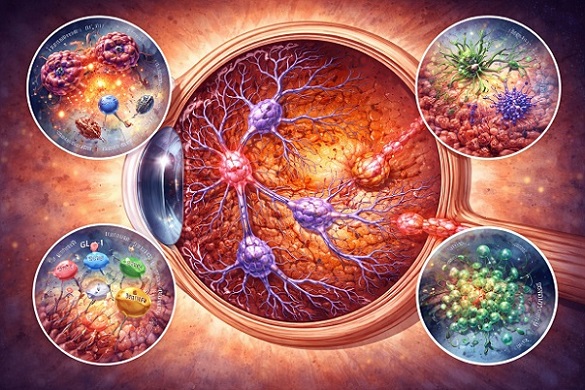 New research shows diabetic retinopathy begins with hidden nerve injury long before blood vessels leak
This
Medical News report shows that diabetes quietly injures retinal neurons many years before patients notice blurry vision. The causes are constant high sugar levels damaging cells, toxic chemical reactions inside the retina, inflammation, and the loss of protective brain-like growth factors.
Why the Eyes Nerves Suffer First
The retina is one of the hungriest tissues in the body. It cannot store energy and depends on a steady stream of glucose to fire signals to the brain. When blood sugar rises daily, excess sugar overwhelms its normal chemistry. The study explains that four sugar-driven pathways—protein kinase C activation, the polyol and hexosamine pathways, and advanced glycation—tangle together to produce swelling, toxic by-products and tiny molecular changes that poison nerve cells.
Mitochondria, the cells’ power stations, then begin generating harmful oxygen particles. Their repair tools slow, DNA is damaged, and even the retinal glial cells that normally nourish neurons start releasing inflammatory chemicals. On top of that, the retina fails to clear excess glutamate, its key messenger signal. The messenger becomes a toxin that over-stimulates cells until they burn out and die.
Nerves and Blood Vessels Fall Together
Although nerves are hit first, blood vessel cells are not spared. Endothelial cells lose their tight junctions, allowing fluid and proteins to leak into delicate retinal layers. Pericytes—supporting cells wrapped around capillaries—disappear. The researchers describe this as a destructive “neurovascular loop”: nerve damage worsens vessel damage, and leaky vessels further starve and inflame nerves. Over time vision fades, and sight-threatening complications like macular edema and abnormal vessel growth emerge.
How Doctors Could Spot Trouble Earlier
The authors highlight that today’s eye exams mostly track vessel injury. But optical coherence tomography scans and electroretinogram testing can detect thinning nerve layers or weak electrical signals years before classic diabetic retinopathy appears. The review argues that patients should be classified into new subgroups—those who show early neurodegeneration and those who do not—because they may need different preventive care.
/>
Toward Neuroprotective Treatments
This shift opens the door for new therapies aimed at protecting nerves—not just fixing leaking vessels. Several experimental strategies are under study, including antioxidant medicines, drugs that block glutamate toxicity, and eye drops or implants carrying growth factors like somatostatin, GLP-1 and brain-derived neurotrophic factor. A major lesson from trials so far is that these treatments must be tested earlier and measured with nerve-based outcomes, not only vessel changes.
Conclusion
The research teams make a convincing case that early nerve damage should no longer be treated as a side note in diabetic retinopathy. Diabetes unleashes a web of chemical stress, inflammation and loss of protective hormones that quietly attacks retinal neurons years before patients see floaters or distortions.
Recognizing and treating this phase could dramatically delay or prevent blindness. The authors conclude that embracing advanced imaging, tracking functional nerve loss and expanding clinical trials to include neuroprotective agents will reshape diabetic eye care. Patients stand to benefit most if eye specialists adopt a future where nerves and vessels are treated together rather than separately.
The study findings were published in the peer reviewed International Journal of Molecular Sciences.
https://www.mdpi.com/1422-0067/27/2/901
For the latest on diabetic retinopathy news, keep on logging to Thailand
Medical News.
Read Also:
https://www.thailandmedical.news/articles/diabetes
https://www.thailandmedical.news/articles/ophthalmology-(eye-diseases)




 Share
Share
 Tweet
Tweet
 Share
Share