Nikhil Prasad Fact checked by:Thailand Medical News Team Jun 06, 2026 3 months, 3 weeks, 6 days, 23 hours, 6 minutes ago
Medical News: A naturally occurring amino acid called L-citrulline is emerging as a potential new treatment for some of the most serious heart, lung, and blood vessel complications affecting infants and children. Researchers are now exploring whether this inexpensive compound could help reduce illness and improve survival in young patients suffering from conditions linked to dangerous vascular disease.
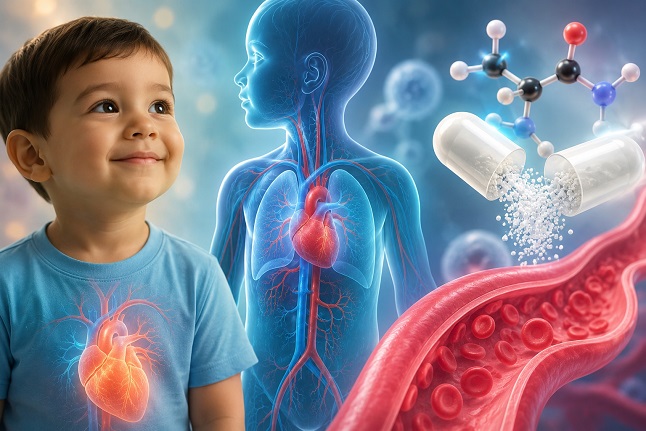 Researchers find that the amino acid L-citrulline may help protect children from serious heart, lung, and blood vessel
complications
The research was conducted by scientists from the Department of Pediatrics at University of Utah Health in Salt Lake City, the Diversified Search Group in St. Louis, and the Center for Discovery and Innovation and the Department of Pediatrics at Hackensack Meridian School of Medicine in Nutley, New Jersey.
Why Blood Vessel Health Matters in Children
Many infants and children with congenital heart disease, sickle cell disease, chronic lung disease of prematurity, and kidney disorders face a heightened risk of developing serious damage to their blood vessels. These complications can affect blood flow throughout the body or the lungs and are often associated with high rates of illness and death despite advances in modern medical care.
Researchers have increasingly focused on nitric oxide, a naturally produced molecule that helps blood vessels relax, improves circulation, reduces inflammation, prevents abnormal clotting, and supports healthy vessel growth. In many childhood vascular disorders, nitric oxide production becomes impaired. This is where L-citrulline may play a critical role.
How L-Citrulline Works
L-citrulline is an amino acid that the body converts into L-arginine, which is then used to produce nitric oxide. Scientists believe L-citrulline may be more effective than directly giving L-arginine because it is absorbed better and remains available in the body for longer periods.
Beyond increasing nitric oxide production, L-citrulline also appears to have antioxidant and anti-inflammatory properties. Studies reviewed by the researchers showed that it can help reduce harmful oxidative stress and lower levels of inflammatory molecules that contribute to blood vessel injury.
Interestingly, watermelon is the richest natural dietary source of L-citrulline, although therapeutic doses require pharmaceutical-grade formulations.
Encouraging Results in Children with Heart Disease
One of the most extensively studied uses of L-citrulline involves children undergoing surgery for congenital heart defects. These patients can develop life-threatening pulmonary hypertension, a condition in which blood pressure inside the lungs rises dangerously after surgery.
Several early clinical studies found that children who maintained higher blood levels of L-citrulline after surgery were less likely to develop post-operative pulmonary hypertension. Intravenous formulations were also shown to be safe and well tolerated.
Although a large international Phase 3 trial did not demonstrate clear
overall benefits across all participating centers, further analysis suggested that children treated in United States hospitals experienced faster recovery, earlier removal from ventilators, and reduced need for medications that support heart function.
These findings indicate that specific patient groups may still benefit from the therapy.
Potential Relief for Sickle Cell Patients
Researchers are also investigating whether L-citrulline can help children with sickle cell disease, particularly during painful vaso-occlusive crises.
These episodes occur when abnormally shaped red blood cells block blood vessels and restrict blood flow. The resulting pain can be severe and often leads to emergency hospital visits.
Early studies found that children receiving oral L-citrulline reported improved well-being and experienced no significant side effects. More recent investigations demonstrated that intravenous L-citrulline could safely achieve blood concentrations thought to improve nitric oxide availability. Larger clinical trials are currently underway to determine whether it can shorten painful crises and reduce reliance on opioid medications.
Hope for Premature Infants
Premature babies with bronchopulmonary dysplasia frequently develop pulmonary hypertension, a devastating complication associated with poor survival rates.
Animal studies showed that L-citrulline increased nitric oxide production, reduced abnormal blood vessel remodeling, and slowed the progression of pulmonary hypertension. Early human studies also found that the amino acid was safe for premature infants and could successfully raise blood concentrations into potentially therapeutic ranges.
Researchers are now conducting additional studies to determine the most effective doses and whether treatment can prevent or improve established disease.
Conclusions
The growing body of evidence suggests that L-citrulline could become an important new therapy for several serious childhood diseases involving blood vessel dysfunction. While definitive proof of effectiveness is still pending, the amino acid has consistently demonstrated a strong safety profile across multiple pediatric populations. This
Medical News report highlights how researchers are moving beyond traditional treatments and investigating ways to restore the body's natural nitric oxide system. If ongoing and future clinical trials confirm the promising early findings, L-citrulline could offer a relatively simple, affordable, and widely accessible option for improving outcomes in children facing life-threatening vascular complications affecting the heart, lungs, blood, and possibly even the kidneys.
The study findings were published in the peer reviewed journal: Pharmaceuticals.
https://www.mdpi.com/1424-8247/19/6/896
For the latest on treating childhood vascular diseases, keep on logging to Thailand
Medical News.
Read Also:
https://www.thailandmedical.news/news/long-covid-blood-vessel-damage-may-improve-with-citrulline
https://www.thailandmedical.news/news/arginine-and-citrulline-may-help-fight-tuberculosis-faster




 Share
Share
 Tweet
Tweet
 Share
Share

































