Nikhil Prasad Fact checked by:Thailand Medical News Team Apr 15, 2026 5 months, 2 weeks, 5 days, 1 hour, 29 minutes ago
Medical News: A growing body of scientific evidence is now pointing to a striking and underappreciated link between long-term blood sugar levels and cancer risk in people with type 2 diabetes. Researchers are proposing a new concept called “glycohypoxia,” a process where elevated HbA1c levels impair oxygen delivery to tissues, potentially triggering cancer development across multiple organs.
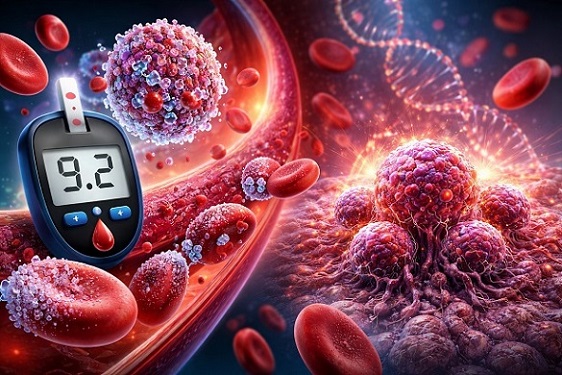 Chronic high blood sugar may silently trigger cancer by starving tissues of oxygen
A New Mechanism Behind Diabetes-Linked Cancers
Chronic high blood sugar may silently trigger cancer by starving tissues of oxygen
A New Mechanism Behind Diabetes-Linked Cancers
Type 2 diabetes has long been associated with higher cancer risk, but the exact reasons have remained unclear. Traditional explanations have focused on obesity, insulin resistance, and inflammation. However, this new research suggests something more fundamental may be at play - how sugar in the blood alters oxygen delivery in the body.
The study titled was conducted by researchers from the Faculty of Medicine at National Research Lobachevsky State University of Nizhny Novgorod, Russia, and the Public Health Department at Riyadh First Health Cluster, Ministry of Health, Saudi Arabia. Their work proposes that high HbA1c levels - an indicator of long-term blood sugar - cause hemoglobin to hold onto oxygen more tightly, reducing oxygen release to tissues.
This creates a state similar to low oxygen conditions, even when oxygen levels in the blood appear normal. Scientists describe this as “pseudohypoxia,” which may activate cancer-promoting pathways.
What the Study Found
The researchers analyzed data from 14 large studies involving more than 500,000 individuals with type 2 diabetes over periods ranging from 5 to 36 years. They found a clear and consistent pattern: for every 1% increase in HbA1c, cancer risk rose significantly.
Pancreatic cancer risk increased by 25 percent, liver cancer by 22 percent, endometrial cancer by 19 percent, kidney cancer by 18 percent, colorectal cancer by 16 percent, and breast cancer by 12 percent. These findings highlight that even small increases in HbA1c can have meaningful long-term consequences.
Even more striking was the effect of cumulative exposure. People with prolonged high HbA1c levels had nearly double the overall cancer risk compared to those with better glucose control. The data showed that long-term glycemic burden, rather than short-term spikes, plays a crucial role in driving cancer development.
Why Oxygen Matters in Cancer
At the center of this discovery is how cells respond to oxygen deprivation. When tissues receive less oxygen, the body activates a protein called HIF-1α, which helps cells adapt by switching to a different form of energy production known as the Warburg effect - a hallmark of cancer cells.
This
Medical News report highlights that chronic high blood sugar may trick the body into behaving as if it is constantly in a low-oxygen state. This environment encourages abnormal cell growth, inflammation, and gen
etic instability - all key ingredients for cancer.
The study also found that organs most sensitive to oxygen changes, such as the pancreas and liver, showed the highest cancer risk increases. This aligns with biological observations that these tissues are especially vulnerable to metabolic stress.
A Hidden Danger of Poor Glucose Control
Importantly, the increased cancer risk was independent of body weight, smoking, or how long a person had diabetes. This suggests that blood sugar itself - not just associated lifestyle factors - is a major driver.
Another key finding was the concept of “glycemic memory,” where long-term exposure to high blood sugar leaves lasting damage in tissues. Even if glucose levels improve later, the accumulated effects may continue to increase cancer risk.
Conclusions
The findings from this large-scale analysis provide compelling evidence that chronic high HbA1c levels may directly contribute to cancer development through a newly identified mechanism involving impaired oxygen delivery and metabolic reprogramming. By demonstrating a clear dose-response relationship between HbA1c and multiple cancer types, the study shifts the focus from traditional risk factors to the long-term impact of glucose control itself. Maintaining HbA1c below 7 percent could significantly reduce cancer risk, potentially preventing up to 20 to 30 percent of diabetes-related cancers. These results also open the door for new treatment strategies targeting hypoxia-related pathways. Overall, this research underscores the urgent need for tighter blood sugar management not just for preventing complications like heart disease, but also as a critical measure in cancer prevention.
The study findings were published on a preprint server and are currently being peer reviewed.
https://www.preprints.org/manuscript/202604.0857
For the latest cancer research, keep om logging to Thailand
Medical News.
Read Also:
https://www.thailandmedical.news/articles/cancer
https://www.thailandmedical.news/articles/diabetes




 Share
Share
 Tweet
Tweet
 Share
Share