Nikhil Prasad Fact checked by:Thailand Medical News Team Apr 04, 2026 4 months, 4 weeks, 18 hours, 19 minutes ago
Medical News: A naturally occurring plant compound found in everyday fruits and vegetables is now drawing major scientific attention after researchers uncovered how it can shut down a dangerous cancer-driving cycle in colorectal tumors. The compound, known as apigenin, appears to interfere with key metabolic and inflammatory processes that fuel tumor growth, offering fresh hope for safer and more effective therapies.
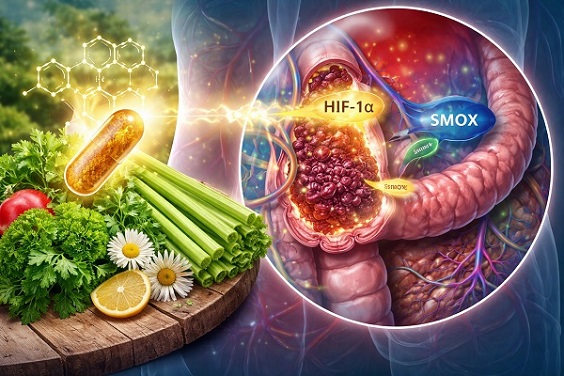 Natural compound apigenin blocks a key cancer-driving feedback loop to slow colorectal tumor growth
What Is Driving Colorectal Cancer?
Natural compound apigenin blocks a key cancer-driving feedback loop to slow colorectal tumor growth
What Is Driving Colorectal Cancer?
Colorectal cancer remains one of the most common and deadly cancers worldwide. Scientists have long known that inflammation and low oxygen conditions inside tumors create a hostile environment that encourages cancer cells to grow, spread, and resist treatment. However, the exact internal mechanisms that sustain this growth have remained unclear.
Researchers from the Department of Biochemistry & Molecular Biology, West China School of Basic Medical Sciences & Forensic Medicine, Sichuan University, Chengdu, China, along with collaborators from the Chongqing Advanced Pathology Research Institute, Jinfeng Laboratory, Chongqing, China, set out to investigate these hidden processes.
Their work revealed that cancer cells rely heavily on something called polyamine metabolism—a system that helps regulate cell growth and survival. In colorectal cancer, this system becomes overactive and unbalanced, accelerating tumor progression.
Apigenin Emerges as a Powerful Natural Compound
Using advanced metabolomics and network pharmacology techniques, the research team identified apigenin as a promising anti-cancer candidate. Apigenin is commonly found in parsley, celery, chamomile, and other plant-based foods.
Laboratory experiments showed that apigenin significantly reduced the growth, movement, and invasion of colorectal cancer cells. It also increased cancer cell death. In animal models, tumors treated with apigenin were smaller, lighter, and showed clear signs of damage and reduced viability.
Breaking a Dangerous Cancer Feedback Loop
This
Medical News report highlights a key discovery: apigenin works by disrupting a harmful “positive feedback loop” inside cancer cells.
This loop involves two critical components—HIF-1α, a protein activated under low oxygen conditions, and SMOX, an enzyme involved in polyamine metabolism. Together, they reinforce each other, creating a continuous cycle that drives inflammation and tumor growth.
The researchers found that apigenin acts like a circuit breaker. It shuts down SMOX activity, reduces HIF-1α levels, and weakens inflammatory signaling pathways such as TLR4/MyD88.
How the Study Proved Its Findings
The team conducted a wide range of experiments to confirm their results. They analyzed human tumor sa
mples and found clear metabolic differences between cancerous and normal tissues. They also screened over 860 naturally occurring metabolites and discovered that polyamine-related compounds could reverse the effects of apigenin, proving that this pathway is central to its action.
Further tests showed that apigenin changes the internal balance of key molecules like spermidine and spermine, reducing the ratio linked to cancer progression. It also directly interacts with SMOX and prevents it from promoting harmful oxidative stress and DNA damage.
Importantly, when scientists artificially increased SMOX levels, the anti-cancer effects of apigenin were weakened—strong evidence that SMOX is a primary target of the compound.
A New Direction for Cancer Treatment
These findings suggest that targeting metabolic pathways, rather than just killing cancer cells outright, could be a powerful new strategy in cancer therapy. Natural compounds like apigenin may offer fewer side effects and reduce the risk of drug resistance.
However, the researchers caution that more studies are needed, especially in models with fully functioning immune systems, to fully understand how apigenin interacts with the body’s defenses.
Conclusion
The discovery of how apigenin dismantles the HIF-1α/SMOX feedback loop represents a major step forward in understanding colorectal cancer biology. By targeting both metabolism and inflammation simultaneously, this natural compound offers a dual-action approach that could reshape future treatments. While still in the research phase, the findings open the door to safer, plant-based therapeutic options that could complement or even enhance existing cancer therapies. Continued investigation will be crucial to determine how these laboratory results translate into real-world clinical benefits for patients.
The study findings were published in the peer reviewed International Journal of Molecular Sciences.
https://www.mdpi.com/1422-0067/27/7/3261
For the latest on colon cancer, keep on logging to Thailand
Medical News.
Read Also:
https://www.thailandmedical.news/articles/cancer




 Share
Share
 Tweet
Tweet
 Share
Share

































