Nikhil Prasad Fact checked by:Thailand Medical News Team May 08, 2026 4 months, 3 weeks, 6 days, 8 hours, 11 minutes ago
Medical News: A team of international scientists has uncovered promising evidence that natural compounds extracted from a rare Brazilian tree could become a powerful new weapon against COVID-19. The phytochemical compounds, known as galloylquinic acids or GQAs, were found to attack SARS-CoV-2 in several different ways at the same time, including blocking the virus from entering cells, stopping it from replicating, and reducing dangerous inflammation linked to severe disease.
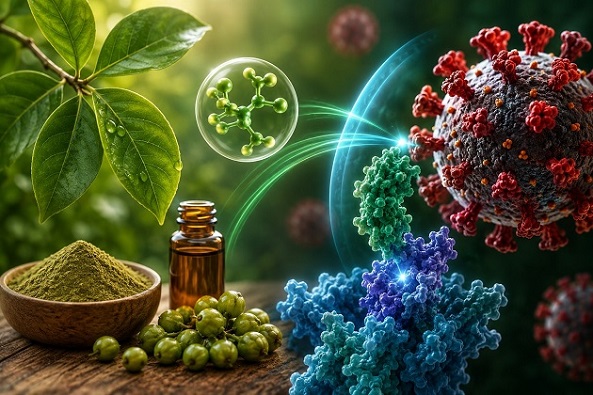 Natural compounds from a rare Brazilian tree were found to block COVID-19 infection, replication, and inflammation
all at once in laboratory studies
The discovery is especially important because many currently available antiviral drugs focus on only one viral target. Viruses can mutate over time and become resistant to these single-target treatments. However, the newly studied compounds appear to strike the virus on multiple fronts simultaneously, potentially making resistance much harder to develop.
The research was led by scientists from the Ribeirão Preto School of Pharmaceutical Sciences at the University of São Paulo in Brazil, in collaboration with researchers from the Faculty of Pharmacy at Delta University of Science and Technology, Tanta University, Alexandria University in Egypt, and the School of Health Sciences at Pompeu Fabra University TecnoCampus in Barcelona, Spain.
Hidden Treasure from Brazil’s Atlantic Forest
The plant at the center of the research is Copaifera lucens Dwyer, a tree native to Brazil’s Atlantic Forest. Scientists extracted galloylquinic acids from its leaves and tested their effects against SARS-CoV-2 using both laboratory experiments and computer-based molecular simulations.
Researchers selected this species because earlier studies involving other Copaifera plants had already shown that their compounds possess antifungal, anticancer, and antiviral properties. Previous investigations also demonstrated that related galloylquinic acid compounds could strongly inhibit HIV replication while causing relatively low toxicity to healthy cells.
That earlier evidence encouraged scientists to explore whether the compounds could also work against SARS-CoV-2.
Strong Antiviral Effects Seen in Laboratory Tests
The study produced surprisingly strong results. Laboratory testing showed that the compounds could neutralize up to 93 percent of viral particles at higher concentrations. Scientists also found that the compounds were relatively safe for healthy cells.
The compounds achieved an IC50 value of 3.81 µg/mL, meaning only a very small concentration was needed to significantly inhibit the virus. At the same time, the compounds showed low toxicity, with a CC50 value of 387.7 µg/mL. This resulted in a high selective index of around 102, suggesting the compounds were much more harmful to the virus than to normal cells.
For comparison, many natural plant extracts tested against SARS-CoV-2 in previous studies showed weaker activity or higher toxicity. The new findings pl
ace these Brazilian plant compounds among the more promising natural antiviral candidates studied so far.
Blocking The Virus at Multiple Stages
One of the most important findings was that the compounds interfered with several stages of the viral life cycle.
Scientists discovered that GQAs could prevent the virus from attaching to human cells during the earliest stages of infection. In laboratory adsorption tests, viral inhibition reached 80 percent.
The compounds also disrupted viral replication after the virus entered cells. Replication inhibition reached approximately 85.6 percent in some experiments.
In addition, the compounds demonstrated direct virucidal effects, meaning they could damage viral particles themselves before infection even begins.
This
Medical News report highlights that such multitarget activity is extremely valuable because it may provide broader protection against future variants of SARS-CoV-2.
Targeting Critical Viral Proteins
The scientists closely examined how the compounds interacted with several crucial viral proteins.
One major target was the spike protein receptor-binding domain, often called the RBD. This part of the virus acts like a key that allows SARS-CoV-2 to attach to human ACE2 receptors and enter cells.
Computer simulations revealed that the galloylquinic acids formed strong molecular interactions with important spike protein residues including Tyr453, Arg403, Asp405, Tyr505, and Gln409. These interactions may destabilize the virus’s ability to attach to cells.
The compounds also targeted the virus’s RNA-dependent RNA polymerase, known as RdRp. This enzyme is essential for viral replication because it helps the virus copy its genetic material. Researchers found that GQAs could block the entry tunnel used by the polymerase, interfering with viral replication machinery.
Another important target was papain-like protease, or PLpro, an enzyme SARS-CoV-2 uses to evade immune defenses and support replication. The compounds inhibited PLpro activity by more than 63 percent at higher concentrations.
Reduction In Viral Protein Production
Western blot experiments showed that the compounds significantly reduced production of several important viral proteins, including spike, nucleocapsid, and envelope proteins.
The nucleocapsid protein is especially critical because it helps package viral RNA and supports viral replication. Reducing this protein can lower infectivity and viral spread.
Meanwhile, reduced spike protein production may impair the virus’s ability to infect new cells.
Importantly, healthy cellular proteins remained stable during testing, suggesting the antiviral effects were not simply caused by toxic damage to cells.
Possible Benefits Beyond Antiviral Action
Researchers also believe the compounds may help calm excessive immune reactions associated with severe COVID-19.
Galloylquinic acids showed anti-inflammatory and immunomodulatory properties, which could potentially reduce tissue damage caused by overactive immune responses.
This may be particularly important because severe COVID-19 often involves both viral infection and harmful inflammation that damages the lungs, heart, kidneys, and blood vessels.
Scientists noted that SARS-CoV-2 continues to remain a global health concern even in 2025 due to persistent circulation, ongoing mutations, and long-term health complications linked to infection.
Why New Antivirals Are Still Needed
Although drugs such as remdesivir and Paxlovid are currently available, researchers emphasized that important limitations remain.
Mutations in viral proteins may eventually reduce the effectiveness of existing antivirals. Some patients treated with Paxlovid have also experienced rebound infections shortly after completing treatment.
The researchers argue that safer, more effective, and more widely accessible therapies are still urgently needed, especially therapies capable of working against multiple viral targets simultaneously.
Natural plant-derived compounds are receiving increasing scientific attention because they may offer lower toxicity and broader biological activity compared to some synthetic drugs.
Biodiversity Could Hold Future Medical Breakthroughs
The study also underscores the enormous medical value hidden within global biodiversity.
Brazil’s Atlantic Forest is one of the world’s richest ecosystems, yet many of its plant species remain poorly studied. Researchers believe these ecosystems may contain numerous undiscovered compounds with major therapeutic potential.
While the current findings are highly encouraging, scientists caution that additional research is still required before any treatment could become available.
Future studies must include animal testing, safety evaluations, dosing studies, and eventually clinical trials in humans.
Still, the results strongly suggest that galloylquinic acids from Copaifera lucens represent one of the more promising natural antiviral discoveries in recent years. Their ability to simultaneously block viral entry, replication, immune evasion, and viral protein production may provide a valuable new strategy in the ongoing battle against COVID-19 and future coronavirus threats.
The conclusions of the researchers were clear: multitarget antiviral therapies may become increasingly important as SARS-CoV-2 continues evolving. Compounds capable of attacking several stages of the viral life cycle at once could reduce resistance risks, improve treatment effectiveness, and potentially complement existing antiviral drugs. Galloylquinic acids now stand out as promising candidates deserving urgent further investigation.
The study findings were published in the peer reviewed journal: Scientific Reports.
https://www.nature.com/articles/s41598-025-25217-8
For the latest COVID-19 news, keep on logging to Thailand
Medical News.
Read Also:
https://www.thailandmedical.news/articles/coronavirus
https://www.thailandmedical.news/articles/herbs-and-phytochemicals
https://www.thailandmedical.news/articles/covid-19-herbs




 Share
Share
 Tweet
Tweet
 Share
Share

































