Long COVID Study Finds SARS-CoV-2 Viral Persistence in Colorectal Tissues and Gut Immune Chaos
Nikhil Prasad Fact checked by:Thailand Medical News Team Aug 12, 2026 1 month, 3 weeks, 1 day, 10 hours, 3 minutes ago
A detailed investigation of intestinal tissue from people with Long COVID has uncovered signs of lingering SARS-CoV-2 alongside major disturbances in the gut’s immune defenses, potentially offering important clues about why symptoms can continue for years after the original infection.
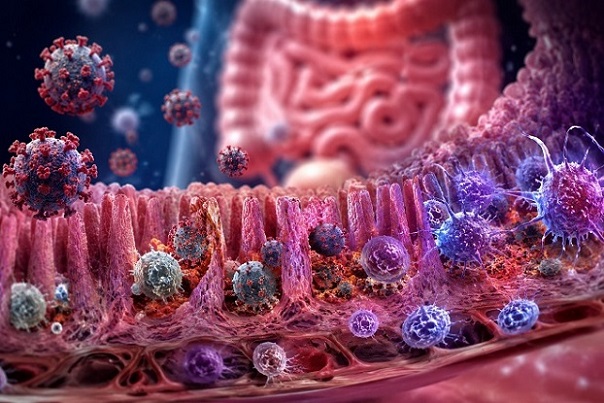 Scientists find lingering SARS-CoV-2 signals and widespread immune disruption in colorectal tissue from people
with Long COVID.
Researchers examined colorectal tissue and blood from 57 participants in the UCSF Long-term Impact of Infection with Novel Coronavirus program. Forty-four had Long COVID, while 13 had recovered without persistent symptoms. Tissue was collected a median of roughly two years after participants’ first known infection.
Researchers Look Deep Inside the Gut
The research team came from the University of California, San Francisco (UCSF), including its Divisions of Experimental Medicine; HIV, Infectious Diseases and Global Medicine; Gastroenterology; Cardiology; and Infectious Diseases, plus the Departments of Clinical Pharmacy, Pathology, Laboratory Medicine, and Epidemiology and Biostatistics. Researchers from the Gladstone Institute of Data Science and Biotechnology at Gladstone Institutes were also involved.
Rather than relying mainly on blood tests, scientists used numerous advanced techniques to examine tissue directly, including RNA sequencing, single-cell analysis, viral sequencing, PCR, protein measurements and spatial molecular profiling.
Viral Material Was Still Detectable
Evidence of SARS-CoV-2 persistence using the study’s tissue-detection approaches was found in 12 of 44 Long COVID participants, compared with one of 13 recovered controls. Importantly, viral persistence was therefore neither found in every Long COVID patient nor completely absent from recovered people.
This Thailand
Medical News report highlights another important observation: viral material was much easier to identify in intestinal tissue than through blood-based testing. This suggests that blood samples alone may provide an incomplete picture of biological abnormalities occurring deep inside body tissues.
Immune System Appears Stuck in the Wrong Gear
The most striking discovery involved immune regulation. Researchers found signs of continued inflammatory activity involving macrophages and other cells, while several mechanisms needed to recognize and eliminate virus-containing cells appeared weakened.
Pathways involved in antigen processing, phagocytosis—the process immune cells use to engulf unwanted material—and cytotoxic immune activity were reduced. In simple terms, parts of the immune system appeared to remain highly alarmed while some of the machinery required to remove the suspected source of that alarm was functioning less effectively.
Whole-tissue RNA analysis identified 4,757 genes whose activity differed between Long COVID participants and recovered controls. Increased activity involved inflammation, TNF s
ignaling, cell growth and metabolic pathways, while other metabolic pathways were reduced. Remarkably, these extensive tissue abnormalities were not mirrored nearly as strongly in blood.
What The Findings Could Mean
The results support the possibility that persistent viral material and disturbed local immunity interact in Long COVID. However, the researchers could not prove that lingering virus causes the condition. Viral RNA was detected only in a subgroup, and similar immune abnormalities existed even when viral material could not be detected.
Conclusions
The findings strengthen the argument that understanding Long COVID may require looking beyond routine blood measurements and directly examining affected tissues. They also suggest future treatments might eventually need to address both persistent viral reservoirs and the abnormal immune environment that may allow them to remain. Larger longitudinal and interventional studies will be necessary to establish whether these mechanisms actually cause symptoms and whether targeting them improves patients’ health.
The study findings were published as a preprint on bioRxiv and have not yet been peer reviewed.
https://www.biorxiv.org/content/10.64898/2026.08.07.743616v1
Read Also:
https://www.thailandmedical.news/articles/coronavirus
https://www.thailandmedical.news/articles/long-covid




 Share
Share
 Tweet
Tweet
 Share
Share

































