Nikhil Prasad Fact checked by:Thailand Medical News Team Jun 06, 2026 3 months, 4 weeks, 1 day, 10 hours, 25 minutes ago
Medical News: Scientists are increasingly warning that the next major infectious disease threat may not come from a newly discovered virus alone, but from the tiny blood-feeding ticks that already infest wildlife, livestock, pets, and humans. A new scientific review has revealed that ticks harbor remarkably complex communities of bacteria, viruses, protozoa, and other microorganisms that could play a critical role in the emergence and spread of future zoonotic diseases.
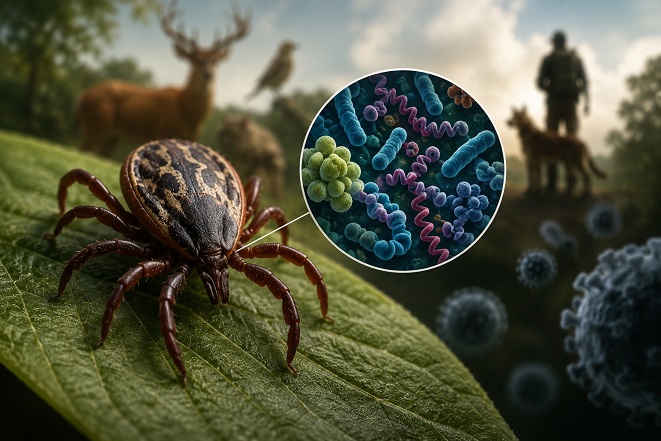 Scientists warn that hidden microbial communities inside ticks may contribute to the emergence of future zoonotic diseases
affecting both humans and animals
The study was conducted by researchers from the Bacterial Disease Division, Department of Animal and Plant Health Research, Animal and Plant Quarantine Agency, Gimcheon-si, Gyeongsangbuk-do, Republic of Korea, including So Youn Youn, Hyang-Sim Lee, Mi-Sun Yoo, and Yun Sang Cho.
The Hidden Ecosystem Living Inside Ticks
Ticks are widely recognized as important disease vectors, second only to mosquitoes in their ability to spread infections. They are known to transmit a wide range of disease-causing organisms including bacteria, viruses, and parasites. However, scientists now believe that the microorganisms living inside ticks may be just as important as the pathogens they carry.
These microbial communities, collectively known as the tick microbiome, consist of hundreds of different organisms that coexist within the tick's body. Some help ticks survive and reproduce, while others influence how effectively dangerous pathogens can establish themselves and spread to new hosts.
Recent advances in genetic sequencing technologies have enabled researchers to study these microbial ecosystems in unprecedented detail. What they have found is both fascinating and concerning. The microbial diversity inside ticks appears to be far greater than previously imagined, with numerous unidentified microorganisms still awaiting characterization.
Climate Change Is Expanding Tick-Borne Risks
The review highlights how climate change is rapidly altering the global landscape of tick-borne diseases. Rising temperatures are extending tick activity seasons and allowing many species to move into regions that were once unsuitable for their survival.
At the same time, urban expansion, deforestation, agricultural development, and increased human interaction with wildlife are creating more opportunities for contact between infected ticks and people.
Researchers note that these environmental changes are accelerating the spread of tick populations and increasing the risk of disease transmission worldwide. As ticks move into new territories, they may also carry unfamiliar microorganisms into regions where human and animal populations have little or no immunity.
A Long List of Dangerous Diseases
Ticks are already responsible for transmitting some of the world's most significant zoonotic diseases.
Among bacterial infections, Lyme disease remains the most widely recognized. Other serious bacterial illnesses include Ro
cky Mountain spotted fever, anaplasmosis, ehrlichiosis, tularemia, and Q fever.
The review also discusses numerous viral threats spread by ticks. These include Tick-Borne Encephalitis Virus, Crimean-Congo Hemorrhagic Fever Virus, Powassan virus, and Severe Fever with Thrombocytopenia Syndrome Virus. Many of these infections can cause severe neurological complications, hemorrhagic disease, organ failure, and death.
Protozoan parasites transmitted by ticks, including Babesia species, can infect red blood cells and trigger serious illnesses that resemble malaria. In vulnerable individuals, such infections can become life-threatening.
Unknown Microbes Could Become Tomorrow's Pathogens
One of the most striking findings of the review is the enormous number of previously unknown microorganisms being discovered within tick populations.
Using modern molecular technologies, researchers have identified hundreds of novel viruses and many previously undescribed bacterial and protozoal species. While the disease-causing potential of many of these microbes remains unknown, scientists caution that some could eventually emerge as new zoonotic pathogens.
The review suggests that current knowledge may represent only a small fraction of the microbial diversity actually present within ticks. This raises concerns that potentially dangerous pathogens may already be circulating undetected in nature.
This
Medical News report highlights the growing realization among researchers that the tick microbiome may serve as a hidden reservoir of future infectious threats. As surveillance technologies improve, more microorganisms with possible public health significance are likely to be identified.
Microbial Interactions Can Affect Disease Transmission
The study also reveals that microorganisms living within ticks do not act independently. Instead, they interact in complex ways that can either promote or suppress disease transmission.
Some bacteria compete with harmful pathogens for nutrients and space, limiting their ability to survive. Other microbes may weaken the tick's immune defenses, creating favorable conditions for dangerous pathogens to multiply.
Researchers found evidence that certain naturally occurring bacterial species may even produce antimicrobial substances capable of inhibiting disease-causing organisms. Conversely, disruption of the microbiome can sometimes enhance pathogen transmission by eliminating competing microorganisms.
These intricate microbial relationships may significantly influence which pathogens successfully spread from ticks to humans and animals.
New Technologies and Vaccines Are Being Explored
Scientists are developing innovative approaches to address the growing threat of tick-borne diseases. Portable diagnostic devices, environmental DNA monitoring systems, biosensors, and artificial intelligence-assisted surveillance tools are being designed to improve pathogen detection.
Researchers are also investigating anti-tick vaccines that could reduce tick survival, disrupt feeding, or prevent disease transmission altogether. Particularly promising are microbiome-based interventions that target the microbial communities inside ticks rather than the pathogens themselves.
Such strategies could offer environmentally friendly alternatives to traditional chemical control methods while reducing the risk of resistance development.
Conclusions
The findings of this review underscore the fact that ticks are far more than simple disease carriers. They are complex biological ecosystems containing vast communities of microorganisms that can influence disease emergence, transmission, and evolution. Many of these microbes remain unknown to science, creating the possibility that future zoonotic outbreaks could originate from pathogens currently hidden within tick populations. As climate change, habitat disruption, and human encroachment continue to reshape ecosystems worldwide, understanding tick microbiomes will become increasingly important for global public health. Continued research, improved surveillance systems, rapid diagnostic technologies, and the development of innovative vaccines and microbiome-based interventions may prove essential in identifying and stopping future infectious disease threats before they become widespread outbreaks.
The study findings were published in the peer reviewed journal: Microorganisms.
https://www.mdpi.com/2076-2607/14/6/1281
For the latest on ticks and the dangerous pathogens they carry, keep on logging to Thailand
Medical News.
Read Also:
https://www.thailandmedical.news/articles/infectious-diseases




 Share
Share
 Tweet
Tweet
 Share
Share