Nikhil Prasad Fact checked by:Thailand Medical News Team Jun 05, 2026 3 months, 4 weeks, 16 hours, 49 minutes ago
Medical News: For decades, scientists have wondered why breast cancer rates have traditionally been lower in many Asian countries where soy foods are commonly consumed. Now, a new scientific review suggests that the answer may lie not in adulthood, but much earlier in life. Researchers are increasingly finding evidence that eating soy during childhood and adolescence may help lower the risk of developing breast cancer later in adulthood.
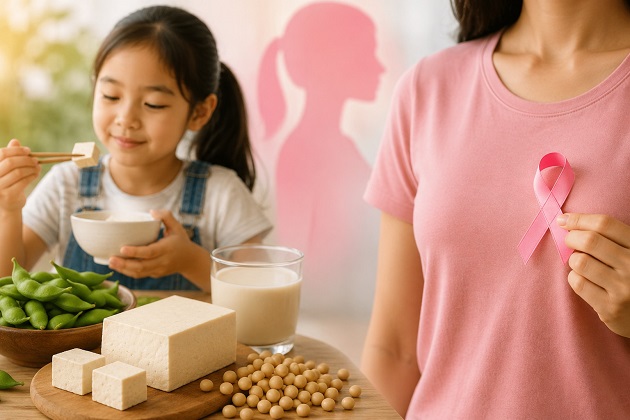 New research suggests that eating soy during childhood and adolescence may help lower the risk of breast cancer later in life
The new review, titled "Soy Intake During Childhood and/or Adolescence and Adult Breast Cancer: An Examination of the Early Soy Intake Hypothesis," was conducted by researchers from the Soy Nutrition Institute Global in Missouri, United States, and the Department of Human Health Sciences at the University of Guelph in Ontario, Canada.
Revisiting a Long-Standing Theory
Breast cancer remains one of the most common cancers affecting women worldwide. Although diet has long been suspected to influence risk, identifying specific foods that offer meaningful protection has proven difficult.
Soy foods have attracted scientific interest because they contain natural compounds called isoflavones. These plant compounds can interact with estrogen receptors in the body. Since estrogen plays a major role in many breast cancers, researchers have spent decades studying whether soy could influence cancer development.
While studies involving adults have produced mixed findings, scientists proposed more than 30 years ago that soy may have its greatest impact when consumed during the years when breast tissue is still developing. This concept became known as the Early Soy Intake Hypothesis.
Strong Support from Animal Research
One of the earliest clues came from animal studies. Researchers found that young rats exposed to genistein, the primary isoflavone found in soybeans, developed significantly fewer mammary tumors later in life.
Additional experiments showed that exposure to soy compounds before puberty appeared to alter the development of breast tissue in ways that made it more resistant to cancer formation. Scientists believe these early-life changes may create lasting biological protection that continues into adulthood.
Importantly, these benefits were observed when soy exposure occurred before cancer development rather than after tumors had already formed.
Human Studies Reveal Similar Patterns
Several observational studies involving women in China and Asian-American populations have also supported the theory.
Women who reported eating more soy foods during childhood and adolescence consistently showed lower rates of breast cancer later in life compared to women who consumed little soy.
One of the most important recent investigations came from researchers in Hong Kong. The study examined 815 premenopausal women and assessed their soy consumption during different stages of life, including ages 6 to 12, 13 to 18, 20 to 34, and
adulthood.
Instead of measuring cancer incidence directly, the researchers analyzed mammographic breast density. Higher breast density is a well-established marker associated with increased breast cancer risk.
The findings were striking. Women who consumed the highest amounts of soy during childhood and adolescence had significantly lower mammographic density compared to those who consumed the least. The strongest benefits were observed among women who ate the most soy between ages 6 and 12.
Researchers found reductions in breast density of more than 6 percent when comparing high versus low soy consumption during childhood. These changes are considered clinically meaningful because they are comparable to reductions associated with factors known to influence breast cancer risk.
Interestingly, soy consumption during adulthood showed little or no significant effect on breast density, suggesting that timing may be crucial.
How Might Soy Provide Protection?
Scientists are still trying to understand exactly how early soy consumption may reduce future cancer risk.
Several possible mechanisms have emerged. Soy isoflavones may help regulate estrogen receptor activity, increasing protective estrogen receptor-beta activity while reducing signals that encourage excessive cell growth.
Soy compounds may also boost the activity of BRCA1, a critical tumor-suppressor gene involved in repairing damaged DNA.
Another promising area involves epigenetics—the biological process that controls how genes are switched on and off. Studies suggest early soy exposure may produce long-lasting changes in gene activity that make breast cells less vulnerable to becoming cancerous later in life.
Some researchers even believe soy may mimic certain protective biological effects associated with an early first pregnancy, which is known to lower breast cancer risk.
Addressing Safety Concerns
The idea of encouraging soy consumption among children naturally raises questions about safety.
The review examined concerns regarding puberty and thyroid health. Current evidence suggests there is no consistent proof that soy intake causes early puberty. Studies have produced mixed results, with some showing earlier puberty, others showing later puberty, and many showing no effect at all.
Similarly, concerns about thyroid function have not been strongly supported by human clinical research. Studies involving both adults and children have generally found that typical soy consumption does not adversely affect thyroid hormone levels.
Conclusions
The growing body of evidence supporting the Early Soy Intake Hypothesis is compelling. Animal studies, observational research, and newer investigations involving breast density all point toward a potentially important role for soy consumption during childhood and adolescence in reducing future breast cancer risk. However, researchers emphasize that definitive proof is still lacking because no long-term randomized clinical trials have been conducted. For now, soy foods cannot be officially recommended solely as a breast cancer prevention strategy. Nevertheless, soy remains a highly nutritious food source that provides quality protein, vitamins, minerals, and healthy nutrients. Given the enormous global burden of breast cancer and the promising findings seen so far, further research into early-life soy consumption could have major implications for future cancer prevention efforts.
The study findings were published in the peer reviewed journal: Nutrients.
https://www.mdpi.com/2072-6643/18/11/1820
For healthcare professionals, researchers, and parents interested in cancer prevention strategies, this
Medical News report highlights an intriguing possibility that dietary habits established during childhood may have lifelong consequences for breast health.
For the latest on Breast Cancer, keep on logging to Thailand
Medical News.
Read Also:
https://www.thailandmedical.news/articles/cancer




 Share
Share
 Tweet
Tweet
 Share
Share