COVID-19 Infection May Trigger Rare Sleep Disorder That Causes Sudden Collapse and Extreme Sleepiness
Nikhil Prasad Fact checked by:Thailand Medical News Team Jun 01, 2026 1 month, 3 weeks, 1 day, 11 hours, 27 minutes ago
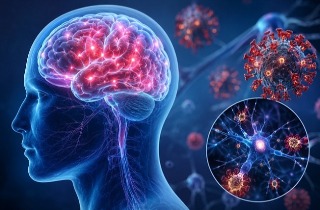
Medical News: For many people, COVID-19 ends after the infection clears. However, doctors are continuing to uncover rare cases in which the virus may leave behind unexpected neurological complications. A newly published case report from Denmark has documented what researchers believe may be one of the world's rare examples of COVID-19 triggering narcolepsy type I, a severe sleep disorder that causes overwhelming daytime sleepiness and sudden episodes of muscle weakness.
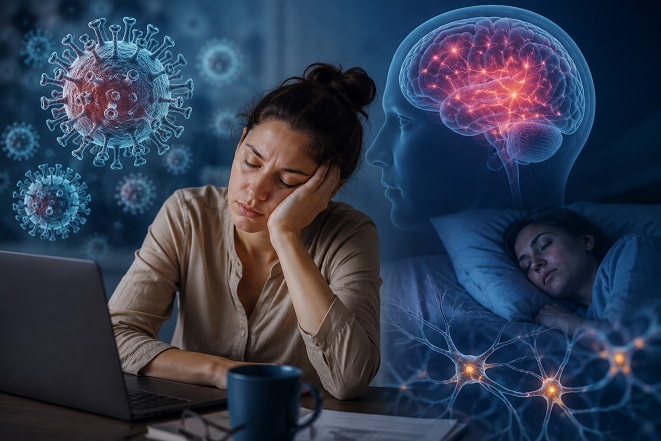 Danish researchers document a rare case in which COVID-19 was followed by the onset of narcolepsy type I, a disabling
sleep disorder linked to severe hypocretin deficiency
The study was conducted by researchers from the Department of Neurology at Viborg Regional Hospital, the Department of Clinical Neurophysiology at Aarhus University Hospital, and the Department of Clinical Medicine at Aarhus University, all in Denmark.
A Healthy Woman Develops Mysterious Symptoms After COVID-19
The report centers on a previously healthy 42-year-old woman who had no history of neurological, psychiatric, immune-related, or sleep disorders. She experienced two confirmed COVID-19 infections, the second occurring in January 2022.
Within a few months of recovering from the infection, she began noticing unusual symptoms. Initially, her legs felt weak and heavy, often described as feeling like "jelly." The weakness gradually spread to her arms, hands, and neck. Episodes became frequent and severe enough that she stopped driving because of concerns about safety.
Doctors initially struggled to explain her condition. Brain scans and neurological testing showed no obvious abnormalities. Conditions affecting muscles and nerve transmission were investigated but ultimately ruled out.
As the months passed, another troubling symptom emerged: overwhelming daytime sleepiness.
A Rare Sleep Disorder Begins to Reveal Itself
By mid-2023, specialists at a sleep clinic identified a pattern strongly suggestive of narcolepsy type I.
Narcolepsy is a chronic neurological disorder that affects the brain's ability to regulate sleep and wakefulness. People with the condition often experience uncontrollable sleep attacks, severe daytime fatigue, vivid dream-like hallucinations while falling asleep or waking up, and sleep paralysis.
The most distinctive feature of narcolepsy type I is cataplexy, a sudden loss of muscle control triggered by emotions such as laughter, excitement, or stress while consciousness remains fully intact.
The patient described frequent episodes lasting about 30 seconds in which her knees and body suddenly lost strength. Emotional situations and physical exertion often triggered these attacks. She also reported vivid hallucinations when falling asleep and waking up, along with episodes of temporary paralysis upon awakening.
Sleep Tests Revealed Striking Abnormalities
To confirm the diagnosis, doctors performed extensive sleep testing. An overnight sleep stud
y showed severely disrupted sleep with frequent awakenings throughout the night. The patient also had periodic limb movements and mild sleep apnea, although these were not severe enough to fully explain her symptoms.
The most revealing test was the Multiple Sleep Latency Test, which measures how quickly a person falls asleep during scheduled daytime naps.
The results were dramatic.
The woman fell asleep in an average of just over one minute. Even more remarkably, she entered rapid eye movement (REM) sleep during all five nap opportunities. Healthy individuals typically take much longer to fall asleep and do not enter REM sleep so rapidly.
Researchers also analyzed her cerebrospinal fluid and found extremely low levels of hypocretin, also known as orexin. This brain chemical is essential for maintaining wakefulness and regulating sleep. Her levels were below 40 ng/L, far below the normal threshold of more than 200 ng/L.
These findings conclusively confirmed narcolepsy type I.
At this stage, this
Medical News report highlights one of the strongest documented examples suggesting that COVID-19 may, in rare circumstances, trigger profound changes in the brain's sleep-regulating systems.
Scientists Suspect an Autoimmune Mechanism
Researchers believe narcolepsy type I develops when the body's immune system mistakenly attacks and destroys specialized neurons in the hypothalamus that produce hypocretin.
Previous studies have linked narcolepsy to infections such as influenza and, in some cases, immune responses following H1N1 exposure. Increasing evidence suggests that SARS-CoV-2 may also trigger autoimmune reactions capable of affecting the nervous system.
The researchers noted that only a handful of similar post-COVID narcolepsy cases have been reported worldwide, making this case particularly important.
Although the study cannot prove direct causation, the close timing between the infection and symptom development, combined with extensive testing that excluded alternative explanations, strengthens the possibility of a post-infectious autoimmune process.
Treatment Helped Restore Daily Life
After receiving the diagnosis, the patient began treatment with medications designed to improve wakefulness and reduce cataplexy.
She was prescribed modafinil and methylphenidate to combat excessive sleepiness, while venlafaxine was used to control cataplexy episodes.
The improvements were substantial. Daily cataplexy attacks that once occurred 10 to 15 times a day fell dramatically to roughly 20 episodes per month. Her daytime alertness improved significantly, and she gradually regained the ability to participate in social activities and return to work through a structured job-training program.
Conclusion
This remarkable case adds to growing evidence that COVID-19 may occasionally trigger serious neurological conditions long after the initial infection has resolved. The findings suggest that narcolepsy type I should be considered in patients who develop persistent daytime sleepiness, unexplained fatigue, sudden muscle weakness, hallucinations during sleep transitions, or sleep paralysis in the months following COVID-19. Early recognition is critical because effective treatment can dramatically improve quality of life and restore normal functioning. While additional research is needed to determine how often this occurs and which individuals may be most vulnerable, the study provides another important clue about the long-term neurological consequences that SARS-CoV-2 may leave behind in rare cases.
The study findings were published in the peer reviewed Journal of Sleep Research.
https://onlinelibrary.wiley.com/doi/10.1111/jsr.70372
For the latest COVID-19 news, keep on logging to Thailand
Medical News.
Read Also:
https://www.thailandmedical.news/news/swiss-doctors-warn-that-covid-19-can-cause-hypersomnia
https://www.thailandmedical.news/news/doctors-in-japan-warn-that-covid-19-infections-can-cause-new-onset-of-kleine-levin-syndrome
https://www.thailandmedical.news/news/swiss-study-reveals-sleep-issues-in-people-with-post-covid-19-syndrome




 Share
Share
 Tweet
Tweet
 Share
Share