Nikhil Prasad Fact checked by:Thailand Medical News Team Jan 02, 2026 9 months, 1 day, 22 hours, 30 minutes ago
Medical News: Clouds Are Not Just Water and Air
For most people, clouds are simply white shapes drifting across the sky. But new research shows that clouds may actually host an invisible world filled with viruses and bacteria. Scientists are now saying that clouds are not lifeless at all. Instead, they could be active environments where microscopic life survives, moves across continents, and even interacts in surprising ways.
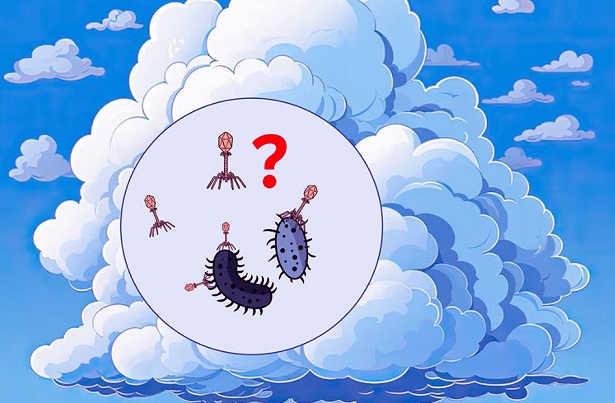 Scientists reveal that clouds may host vast numbers of viruses quietly shaping life in the atmosphere.
This research was led by Janina Rahlff from Linnaeus University in Sweden, Friedrich Schiller University Jena and the Leibniz Institute on Aging in Germany, together with Pierre Amato from Université Clermont Auvergne and CNRS in France.
A Vast Number of Viruses in The Sky
Using existing cloud microbiology data, the researchers estimated that there could be around one sextillion viruses inside clouds across the planet. That number is written as 1 followed by 21 zeros. While each cloud droplet contains very little water, the sheer number of droplets globally makes the total viral count extremely high.
These viruses are believed to come from oceans, soil, plants, and even dust particles. Winds lift them into the air where they can travel thousands of kilometers before becoming part of cloud water.
Tiny Droplets with Big Activity
Each cloud droplet is extremely small, but some contain bacteria and viruses together. The study estimates that about one in every million cloud droplets may host both a virus and a bacterium at the same time. This might sound rare, but on a global scale it adds up to a huge number of potential interactions.
Inside these droplets, viruses may infect bacteria just like they do in oceans. When this happens, bacteria burst and release nutrients back into the cloud water. This process could help shape how microbial life survives in the atmosphere.
Clouds As Temporary Living Spaces
Clouds last from minutes to hours, yet during that time they can support active microbes. The researchers explain that clouds provide liquid water, nutrients, and high humidity, which allow bacteria to stay alive and even perform basic biological functions.
Viruses may take advantage of these conditions to survive harsh sunlight, cold temperatures, and long-distance travel. Some may even carry genes that help microbes adapt to stress such as ultraviolet radiation and freezing conditions.
Why This Matters For Earth
These findings suggest that clouds may play a role in spreading microbial life and genetic material across the planet. Viruses help move genes between bacteria, which can affect how microbes evolve and how ecosystems function.
This
Medical News report highlights that clouds could act as global mixers, influencing environmental processes far beyond what scientists previously imagined.
What Scientists Still Do Not Know
Despite the striking estimates, many questions remain. Researchers still do not know how many of these viruses are alive, how often infections truly happen, or how cloud conditions affect viral survival. Improved air sampling methods and further studies are needed to confirm these early models.
Conclusion
The study changes how we view clouds, transforming them from passive weather features into active biological environments. While viral infections inside cloud droplets may be rare individually, their massive global scale suggests they could influence microbial evolution, nutrient cycles, and long-range transport of life in ways science is only beginning to understand.
The study findings were published in the peer reviewed journal: Current Research in Microbial Sciences.
https://www.sciencedirect.com/science/article/pii/S2666517425002056
For the latest on viruses, keep on logging to Thailand
Medical News.
Read Also:
https://www.thailandmedical.news/articles/coronavirus
https://www.thailandmedical.news/articles/h5n1-avian-flu
https://www.thailandmedical.news/articles/monkeypox
https://www.thailandmedical.news/articles/hmpv-human-metapneumovirus




 Share
Share
 Tweet
Tweet
 Share
Share

































