Nikhil Prasad Fact checked by:Thailand Medical News Team Apr 14, 2026 5 months, 2 weeks, 5 days, 18 hours, 15 minutes ago
Medical News: Autism spectrum disorder (ASD) is no longer viewed as a single condition with one clear cause. Instead, scientists are uncovering a complex web of biological processes that interact during early brain development. A new scientific overview has brought together multiple cutting-edge studies, revealing how genetics, immune responses, brain signaling, and even events before conception may shape the condition in ways never fully understood before.
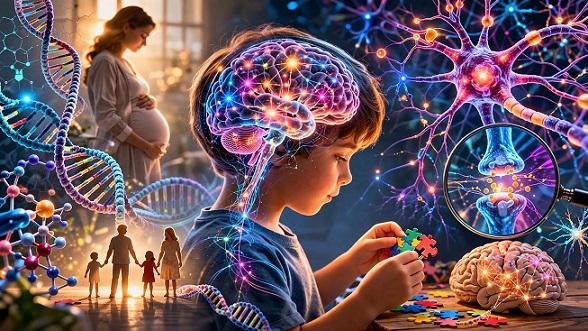 New research reveals how genes, immunity, and early development shape autism risk
A Disorder with Many Biological Roots
New research reveals how genes, immunity, and early development shape autism risk
A Disorder with Many Biological Roots
ASD affects how individuals communicate, behave, and process information. What makes it particularly challenging is its diversity - no two cases are exactly alike. Researchers now believe this diversity stems from multiple biological pathways that all converge on brain development.
Scientists from the Department of Comparative Biomedical Sciences, School of Veterinary Medicine, Louisiana State University, Baton Rouge, USA, along with contributions from various international research teams, explain that many different genes may be involved. While each gene may only slightly increase risk, together they disrupt key brain processes such as neuron communication, structure, and connectivity.
Recent genetic studies have identified new mutations in genes linked to brain development and cellular function. These discoveries are expanding diagnostic possibilities and may eventually help doctors identify ASD earlier or tailor treatments more effectively.
Timing Matters More Than Expected
One of the most striking insights is that autism risk may begin even before pregnancy. Studies involving maternal health found that conditions like obesity before conception can influence how a child’s brain develops.
Researchers observed that changes in gene expression - especially those affecting how brain cells communicate - can be “programmed” early. These changes may alter how neurons form connections, potentially leading to ASD-like behaviors later in life. Interestingly, some findings suggest that male offspring may be more vulnerable to these early influences.
The Role of the Immune System and Inflammation
Another major discovery involves the immune system. Scientists are increasingly linking ASD to chronic low-level inflammation in the brain. Specialized brain cells known as microglia and astrocytes appear to behave differently in individuals with ASD.
Laboratory studies using stem cells showed increased levels of inflammatory signals such as IL-6 and TGFB proteins. These changes were accompanied by structural differences in brain cells, including reduced growth and weaker connections between neurons. This suggests that inflammation may interfere with how the brain builds its communication networks.
Brain Signaling Goes Off Balance
Calcium, a key element in cell signaling, has also emerged as a critical factor. Researchers found that brain cells derived from individuals with ASD respond abnormally to stimuli that normally regulate calcium flow.&
lt;br />
This imbalance can disrupt essential processes such as learning, memory, and synaptic plasticity. In simple terms, the brain’s communication system becomes less efficient, which may contribute to the behavioral and cognitive features of autism.
Environmental and Sensory Influences
Beyond molecular biology, scientists are also examining how brain circuits function as a whole. Studies in animal models show that sensory processing pathways - how the brain interprets touch, sound, and other inputs - may be altered in ASD.
Interestingly, enriching the environment with more sensory experiences helped reduce repetitive behaviors in these models. This suggests that therapies targeting sensory processing could play a role in managing symptoms.
This
Medical News report highlights that autism is not caused by a single factor but rather by a combination of genetic, environmental, and developmental influences that interact over time.
Challenges and Future Directions
Despite these advances, researchers emphasize that much work remains. One major challenge is connecting findings from different models - such as animal studies, lab-grown brain cells, and human data - into a unified understanding.
Scientists are also focusing on how ASD develops over time, from fetal stages through childhood. Understanding these timelines could open the door to earlier interventions and possibly prevention strategies.
Conclusion
The emerging picture of autism is far more intricate than previously imagined. It involves a delicate interplay between genes, immune activity, brain signaling, and environmental factors - even before birth. While this complexity presents challenges, it also offers hope. By identifying the underlying mechanisms, researchers are moving closer to personalized treatments and earlier detection.
Importantly, these findings shift the narrative away from a one-size-fits-all explanation and toward a deeper, more compassionate understanding of ASD as a biologically diverse condition with multiple pathways and possibilities for intervention.
The study findings were published in the peer reviewed journal: Cells.
https://www.mdpi.com/2073-4409/15/8/688
For the latest on autism, keep on logging to Thailand
Medical News.
Read Also:
https://www.thailandmedical.news/news/probiotics-show-promise-in-improving-autism-symptoms-in-children
https://www.thailandmedical.news/news/melatonin-shields-developing-brains-from-toxic-autism-risks
https://www.thailandmedical.news/news/pediatricians-caution-against-routine-use-of-leucovorin-for-autism




 Share
Share
 Tweet
Tweet
 Share
Share

































