Nikhil Prasad Fact checked by:Thailand Medical News Team Jun 02, 2026 4 months, 2 days, 55 minutes ago
Medical News: Millions of people worldwide continue to struggle with lingering cognitive problems long after recovering from COVID-19. Often described as “brain fog,” these symptoms can include forgetfulness, difficulty concentrating, mental fatigue, slowed thinking, and problems finding the right words during conversations. While many patients report that these issues significantly affect their daily lives, scientists have remained uncertain about exactly what causes them. A new study from Scotland is now shedding light on this mystery and suggests that the relationship between brain fog and physical changes in the brain may be far more complex than previously believed.
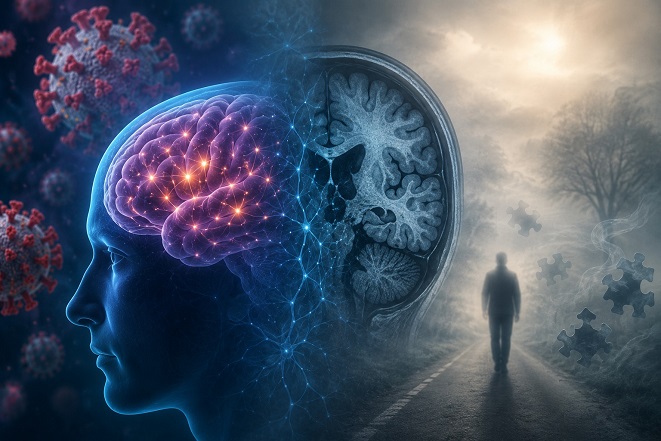 New research suggests that Long COVID brain fog may result from a complex interaction between subtle brain changes
and functional cognitive processes rather than structural brain damage alone.
Researchers from the Department of Psychological Medicine at NHS Grampian and the Aberdeen Biomedical Imaging Centre at the University of Aberdeen in the United Kingdom conducted an extensive investigation into the cognitive effects of post-COVID-19 condition (PCC), commonly known as Long COVID.
Long COVID Patients Show Measurable Cognitive Difficulties
The study recruited 30 adults who had previously been hospitalized with confirmed COVID-19 infections and who later reported ongoing cognitive symptoms. Participants underwent detailed neuropsychological testing and advanced brain imaging approximately two years after their original infection.
The cognitive assessments revealed that many participants continued to experience measurable difficulties with attention, working memory, and verbal fluency. Tasks requiring sustained concentration and the ability to manage distractions proved particularly challenging. Short-term memory functions were also affected, with many participants performing below expected levels for their age group.
Interestingly, the researchers found that overall intelligence and many aspects of long-term memory remained largely preserved. This indicates that Long COVID brain fog does not resemble widespread cognitive decline but instead affects specific mental functions that are essential for everyday activities.
Brain Scans Reveal Only Limited Structural Changes
One of the study's most surprising findings was that extensive brain imaging failed to identify widespread structural abnormalities.
Researchers compared the brains of participants with age- and sex-matched controls from a pre-pandemic imaging database. Despite expectations that lingering cognitive symptoms might be linked to visible brain damage, no major differences were found across most brain regions.
The only notable structural finding involved a reduction in the volume of a small region known as the left posterior hypothalamus. This area plays important roles in attention, wakefulness, autonomic regulation, sleep, and energy balance. Although intriguing, the researchers cautioned that this isolated finding requires confirmation in larger studies before firm conclusions can be drawn.
Altered Brain Connectiv
ity May Affect Attention
While major structural damage was largely absent, the study did uncover subtle differences in the way certain brain regions communicate with one another.
Researchers detected altered connectivity between parts of the occipital and parietal lobes, regions involved in visual processing and attentional control. These neural pathways are part of networks that help individuals focus on tasks, filter distractions, and maintain mental concentration.
The findings provide a possible biological explanation for some of the attention-related difficulties reported by Long COVID patients. However, the abnormalities were relatively limited and did not fully account for the severity of symptoms experienced by participants.
Brain Chemistry Appears More Significantly Affected
The strongest biological signals emerged from magnetic resonance spectroscopy, an advanced imaging technique that measures chemical activity within the brain.
The researchers discovered lower levels of N-acetylaspartate, a marker commonly associated with healthy neuronal function. At the same time, they found elevated levels of choline, myo-inositol, and glutamate-glutamine compounds.
These chemical changes may indicate ongoing neuronal stress, altered brain metabolism, glial cell activation, and low-grade neuroinflammatory processes that persist long after the initial infection has resolved.
Importantly, these abnormalities remained statistically significant even after rigorous scientific analysis and adjustment for multiple comparisons, making them among the study's most robust findings.
The Most Important Discovery Was the Disconnect
Perhaps the most significant conclusion from the study was that objective brain abnormalities did not closely match patients' subjective experiences.
Despite finding subtle differences in brain chemistry, connectivity, and certain brain structures, researchers were unable to demonstrate strong links between these changes and the severity of brain fog symptoms or cognitive performance.
This disconnect suggests that Long COVID brain fog cannot be explained solely by measurable physical changes in the brain.
This
Medical News report notes that the findings resemble patterns observed in functional cognitive disorders, conditions in which individuals experience genuine and often disabling cognitive symptoms despite relatively modest objective abnormalities on brain testing.
The researchers emphasize that this does not mean symptoms are imaginary. Instead, it suggests that brain fog may result from an interaction between subtle biological effects, psychological factors, fatigue, mood disturbances, attention mechanisms, and functional cognitive processes.
A More Complex Picture of Long COVID Emerges
Participants in the study also reported moderate levels of fatigue, anxiety, depression, and psychological distress. Although these factors did not fully explain the cognitive symptoms, they may contribute to the overall clinical picture.
The findings challenge simplistic explanations that attempt to attribute Long COVID brain fog exclusively to brain inflammation, brain damage, or psychological factors alone. Instead, the evidence points toward a multifaceted condition involving both biological and functional influences.
Conclusions
The study provides compelling evidence that Long COVID brain fog is far more complex than a straightforward consequence of structural brain injury. Although researchers identified subtle changes in brain chemistry, neural connectivity, and specific brain regions, these findings did not closely correspond to the severity of patients' symptoms. This important mismatch suggests that persistent cognitive complaints following COVID-19 likely arise through a combination of mild neurobiological changes and functional cognitive processes working together. The findings reinforce the need for healthcare providers to consider both brain-based and functional contributors when evaluating and treating Long COVID patients.
Future larger studies will be essential to determine how these mechanisms interact and whether targeted therapies can help alleviate the cognitive difficulties that continue to affect millions of people worldwide years after infection.
The study findings were published in the peer reviewed Journal of Clinical Medicine.
https://www.mdpi.com/2077-0383/15/11/4241
For the latest on Long COVID, keep on logging to Thailand
Medical News.
Read Also:
https://www.thailandmedical.news/articles/long-covid




 Share
Share
 Tweet
Tweet
 Share
Share

































