Nikhil Prasad Fact checked by:Thailand Medical News Team Jul 27, 2026 2 months, 1 week, 18 hours, 34 minutes ago
Medical News: Scientists have uncovered an important clue that could help explain why SARS-CoV-2, the virus responsible for COVID-19, can linger in the brain and contribute to long-term neurological problems. Their research shows that as the human brain matures, changes in brain cells and fat metabolism create a more favorable environment for the virus to infect and multiply.
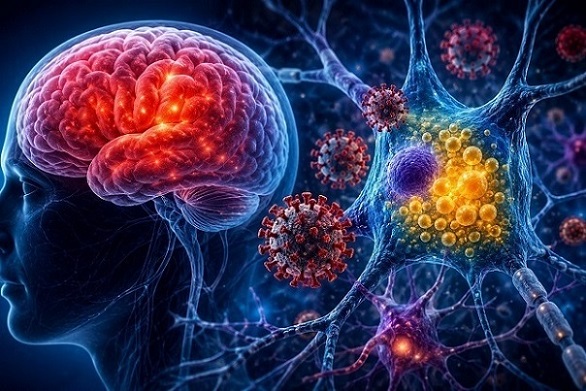 Scientists found that brain maturation boosts lipid metabolism, allowing SARS-CoV-2 to infect neurons and
supporting cells far more efficiently.
The study was conducted by researchers from Yeungnam University, the Korea Research Institute of Chemical Technology (KRICT), the University of North Carolina at Chapel Hill, Chonnam National University, and Kyungpook National University in South Korea and the United States.
Brain Development Changes the Way the Virus Behaves
The researchers used laboratory-grown human brain organoids, often called "mini-brains," created from human induced pluripotent stem cells. They compared younger brain organoids that had developed for 60 days with more mature organoids grown for 120 days.
The mature brain tissue contained many more fully developed neurons and support cells known as astrocytes. It also developed organized cortical structures that closely resemble those found in the developing human brain. These mature organoids proved to be far more vulnerable to SARS-CoV-2 infection than the younger versions.
Unlike previous studies that followed infection for only a few days, the team monitored viral activity for 20 days. They found that mature brain tissue consistently supported much higher levels of viral replication and released significantly more infectious virus particles over time.
Lipids Turn Out to Be a Major Factor
One of the most surprising discoveries was that brain maturation dramatically changed lipid metabolism. Lipids are fats that cells use to build membranes, produce energy and maintain normal function.
The researchers found widespread activation of genes involved in lipid production, cholesterol synthesis and fat metabolism in mature brain cells. These changes were accompanied by much larger lipid droplets accumulating inside the mature organoids.
This
Medical News report highlights an important finding from the study: SARS-CoV-2 appears to exploit these increased lipid resources to replicate more efficiently. The investigators believe that the virus depends heavily on these fat-related pathways to complete its life cycle inside brain cells.
Mature Brain Cells Become Easier Targets
The study also revealed that mature neurons and astrocytes were much more susceptible to infection than immature brain cells. While increased levels of the viral entry receptor ACE2 contributed to this vulnerability, the researchers found that ACE2 alone could not explain the dramatic increase in viral growth.
Instead, the combination of m
ature neurons, supportive glial cells and enhanced lipid metabolism appeared to create ideal conditions for sustained viral replication. The virus infected neurons more readily than astrocytes, while neuron-astrocyte co-cultures supported even greater viral infection than either cell type alone.
Single-cell genetic analysis further showed that mature cortical neurons had increased activity of protein-making machinery and other pathways that favor coronavirus replication, giving SARS-CoV-2 an additional advantage.
Existing Lipid-Lowering Drugs Show Promise
To determine whether lowering lipid levels could reduce infection, the scientists treated infected brain cells with the lipid-lowering drugs gemfibrozil and lovastatin.
Both drugs significantly reduced viral infection, but the combination therapy produced the strongest effect. In mature brain organoids, the combined treatment lowered viral RNA levels by approximately twelve-fold compared to untreated tissue. It also sharply reduced infection of neurons and astrocytes while decreasing virus-induced cell death to levels nearly matching uninfected controls. These findings suggest that modifying lipid metabolism may offer a promising strategy for limiting viral persistence in the brain.
Conclusion
The findings suggest that normal brain maturation unintentionally creates conditions that help SARS-CoV-2 thrive by increasing lipid metabolism and supporting viral replication in neurons and glial cells. Although the work was performed in laboratory-grown brain organoids rather than in patients, it provides compelling evidence that targeting lipid metabolism could become a valuable therapeutic approach for reducing viral persistence and potentially lowering the risk of long-term neurological complications associated with COVID-19.
The study findings were published in the peer reviewed journal: Stem Cell Reports.
https://www.cell.com/stem-cell-reports/fulltext/S2213-6711(26)00231-6
For the latest COVID-19 news, keep on logging to Thailand
Medical News.
Read Also:
https://www.thailandmedical.news/articles/coronavirus
https://www.thailandmedical.news/articles/long-covid




 Share
Share
 Tweet
Tweet
 Share
Share

































