Nikhil Prasad Fact checked by:Thailand Medical News Team Jan 08, 2026 8 months, 3 weeks, 6 days, 1 hour, 2 minutes ago
Medical News: A strange fold in the virus blueprint
Scientists from University of Siegen (Germany), the Luxembourg Institute of Health, and the University of Luxembourg have uncovered a surprising trick used by SARS-CoV-2 to take over human cells.
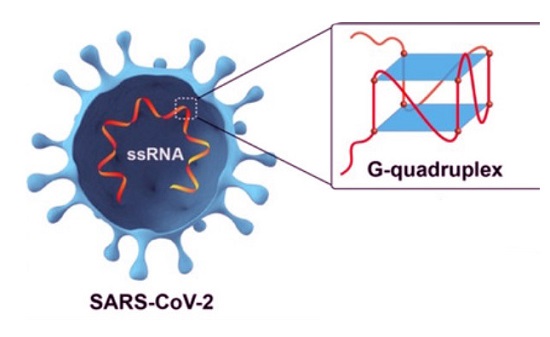 A quirky knot in SARS-CoV-2 RNA traps a human enzyme and could be a new weak spot for antiviral drugs.
The virus’s RNA does not always sit straight like a long rope. Sometimes it bends and folds into tight knots called G-quadruplexes. These form only when certain guanine-rich sequences stack into square blocks. Even though they are tiny, these shapes can behave like fishing hooks that catch human proteins.
What researchers found
Using laboratory pull-down experiments, the research teams proved that one of these G-quadruplexes—known as L-RG1, located in the instructions for making the viral N protein—recruits a human enzyme called TOP1 (topoisomerase I).
This enzyme normally works on human DNA by snipping and smoothing out twists so genetic material can be copied correctly. It was already known that TOP1 can interact with G-quadruplexes in DNA, but this study shows for the first time that SARS-CoV-2 RNA itself can attract TOP1.
The scientists confirmed that the L-RG1 region really folds into a quadruplex, while a mutated version does not. Only the correctly folded viral structure pulled TOP1 from human cell extracts.
Why TOP1 matters
The presence of TOP1 could help the virus. TOP1 might unwind this knotted RNA to open it up, allowing faster translation of viral proteins or smoother replication of the virus’s genome. Previous work has also shown that blocking TOP1 calms severe inflammation caused by COVID-19, hinting that the virus may rely on the enzyme more than expected.
Plant compound boosts viral trap
The teams did not stop at identifying the interaction. They tested several small molecules known to bind G-quadruplexes. One stood out: berberine, a natural alkaloid found in many medicinal plants.
Berberine bound strongly to the viral G-quadruplex and actually increased the amount of TOP1 trapped on the RNA. Other chemicals did the same, including tetraazoniapentaphenopentaphene, naphthyridinium and naphthoquinolizinium.
Laboratory measurements showed that berberine stabilizes the folded RNA structure and increases its heat resistance. In simple terms, the quadruplex becomes harder to unwind once berberine is present.
What it could mean
If TOP1 is busy sticking to this viral structure and stabilizing it, the virus might mismanage its own replication steps or produce fewer proteins needed to multiply. This opens a fresh doorway for antiviral drug development.
The researchers propose that G-quadruplex-binding chemicals could reduce the virus’s power, either by locking the knot tightly or by preventing TOP1’s usual function inside infected cells.
Conclusion
This
hailandmedical.news/">Medical News report highlights how a tiny fold in the coronavirus genome can hijack a human enzyme to assist infection. By revealing exactly which proteins are pulled in—and showing that natural plant molecules like berberine can influence this partnership—the study widens our understanding of viral biology and points to a new antiviral drug class. Continued research is needed, but drugs that lock or disrupt these RNA knots may one day provide extra protection alongside vaccines and immune-based therapies. If successful, such strategies could slow viral replication, reduce inflammation and offer a broader shield against future coronavirus variants.
The study findings were published in the peer reviewed journal: Frontiers in RNA
Research.
https://www.frontiersin.org/journals/rna-research/articles/10.3389/frnar.2025.1722301/full
For the latest COVID-19 News, keep on logging to Thailand
Medical News.
Read Also:
https://www.thailandmedical.news/articles/coronavirus




 Share
Share
 Tweet
Tweet
 Share
Share

































