Nikhil Prasad Fact checked by:Thailand Medical News Team Jun 28, 2026 3 months, 5 days, 23 hours, 49 minutes ago
Medical News: A growing body of scientific evidence is raising concerns that a toxin commonly found in freshwater lakes and reservoirs could have far-reaching effects on reproductive health. Researchers from the School of Public Health, Hengyang Medical School, University of South China; the School of Basic Medical Sciences, Hengyang Medical School, University of South China; and the Laboratory of Ecological Environment and Critical Human Diseases Prevention of Hunan Province, all in Hengyang, China, have reviewed decades of research showing that Microcystin-LR may damage the reproductive system in both males and females while also potentially affecting future generations.
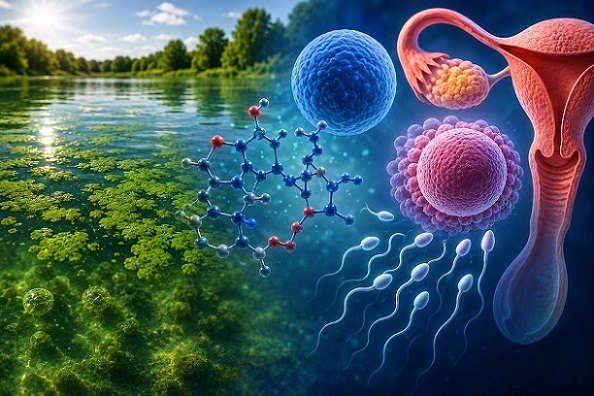 Researchers warn that the widespread freshwater toxin Microcystin-LR may threaten fertility and could potentially
affect future generations
What Is Microcystin-LR?
Microcystin-LR (MC-LR) is a powerful natural toxin produced by cyanobacteria, commonly known as blue-green algae. It is frequently found in freshwater lakes, ponds, and reservoirs during harmful algal blooms that become more common as water pollution and nutrient runoff increase. The "LR" refers to the amino acids leucine and arginine that form part of its chemical structure.
MC-LR is considered the most toxic and widely studied member of the microcystin family. It is highly stable and can survive heat, changes in acidity, and even boiling, meaning contaminated water cannot simply be made safe by heating it. People can be exposed by drinking contaminated water, eating crops or aquatic animals that have accumulated the toxin, or even inhaling tiny water droplets containing the toxin during recreational activities.
A Hidden Threat to Fertility
The researchers found that although MC-LR has long been known to damage the liver, it also targets reproductive organs. Experimental studies consistently show that exposure can reduce fertility by damaging sperm, eggs, reproductive tissues, and hormone-producing cells.
In males, the toxin lowers sperm count and movement while increasing abnormal sperm formation. It also damages the testes, disrupts the protective blood-testis barrier, and reduces testosterone production by interfering with hormones that regulate reproduction.
Female reproductive health is also affected. Studies found that MC-LR damages ovarian tissue, disrupts communication between egg cells and surrounding support cells, interferes with normal follicle development, and reduces the chances of successful ovulation. Eggs exposed to the toxin also showed abnormal chromosome alignment and damaged mitochondria, making healthy embryo development less likely.
How the Toxin Damages Cells
Researchers found that MC-LR attacks cells through several destructive mechanisms at the same time. It blocks two critical enzymes known as Protein Phosphatases 1 and 2A, causing normal cellular regulation to fail.
The toxin also triggers excessive oxidative stress, allowing harmful reactive oxygen species to accumulate and damage DNA, proteins, and cell membranes. At the same time, mitochondria—the tiny structures that generate cel
lular energy—begin to fail, while prolonged stress inside the endoplasmic reticulum activates pathways that lead to programmed cell death.
This
Medical News report highlights that the review also found MC-LR disrupts the body's reproductive hormone network, affecting signals between the brain, pituitary gland, and reproductive organs. Together, these changes reduce hormone production, impair fertility, and damage reproductive tissues.
Effects May Extend to Future Generations
Perhaps the most alarming finding is evidence suggesting that parental exposure could leave lasting biological changes in sperm and egg cells through epigenetic modifications. Rather than altering DNA itself, these changes influence how genes function.
Animal studies found that offspring of exposed parents showed reduced fertility, developmental abnormalities, altered brain development, lung defects, delayed reproduction, and lower survival rates. Some harmful effects even appeared in later generations that had never been directly exposed to the toxin, raising concerns about long-term reproductive health.
Although most evidence currently comes from laboratory and animal studies, the researchers note that limited human studies have already linked higher microcystin exposure with poorer semen quality and altered reproductive hormone levels. They stress that larger long-term human studies are urgently needed.
Conclusion
The review paints an increasingly concerning picture of Microcystin-LR as more than just a liver toxin. Evidence now suggests it can interfere with nearly every stage of reproduction, from hormone production and sperm formation to egg development and healthy pregnancies. Even more worrying is the possibility that some harmful effects may be passed to future generations through epigenetic changes. As harmful algal blooms continue to increase worldwide, protecting drinking water supplies and reducing environmental contamination may become increasingly important for safeguarding fertility and long-term public health.
The study findings were published in the peer reviewed journal: Toxins.
https://www.mdpi.com/2072-6651/18/7/281
For the latest on common toxins that affect human reproductive health, keep on logging to Thailand
Medical News.
Read Also:
https://www.thailandmedical.news/news/diabetes-damage-to-male-fertility-may-be-reversible
https://www.thailandmedical.news/news/scientists-shockingly-discover-that-ibuprofen-and-naproxen-are-linked-to-male-fertility-risks
https://www.thailandmedical.news/news/hidden-sperm-microbiome-may-be-silently-fueling-male-infertility-crisis




 Share
Share
 Tweet
Tweet
 Share
Share

































