Nikhil Prasad Fact checked by:Thailand Medical News Team May 28, 2026 4 months, 1 week, 58 minutes ago
Medical News: A new international study has raised serious concerns that chikungunya virus, a painful mosquito-borne disease once largely confined to tropical regions, could soon become a major health threat across parts of Europe and North America. Scientists warn that climate change is rapidly expanding the habitats of disease-carrying mosquitoes, allowing them to move into countries that were previously too cold for survival.
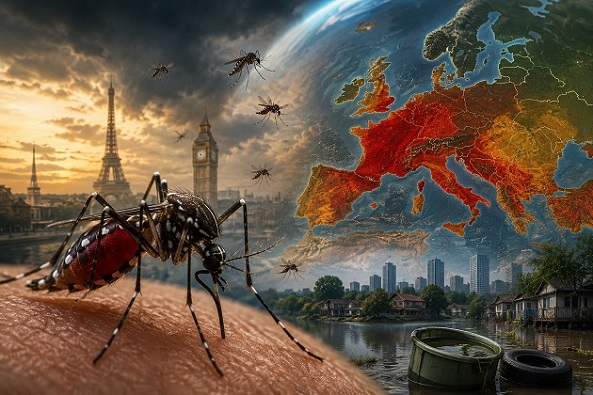 Rising temperatures are helping dangerous mosquitoes spread chikungunya into Europe and North America
The research was conducted by scientists from Zhejiang Chinese Medical University in Hangzhou, China, and examined how rising global temperatures could dramatically reshape the future spread of chikungunya virus, also known as CHIKV. The findings suggest that countries such as the United Kingdom, Germany, the United States, China, and Japan may face increasing risks of local outbreaks before 2040.
A Virus Known for Severe Pain
Chikungunya is a viral disease spread mainly through the bites of infected mosquitoes. Although the illness is rarely fatal, it can cause extremely painful symptoms including high fever, severe joint pain, muscle aches, headaches, fatigue, and skin rashes. In some cases, the joint pain can continue for months or even years, leaving patients struggling with mobility and long-term disability.
The name “chikungunya” comes from the Kimakonde language of East Africa and means “to bend over in pain,” describing the posture many sufferers adopt because of intense joint inflammation.
According to the World Health Organization, chikungunya is considered a neglected tropical disease. Yet global cases have been steadily increasing. In 2025 alone, more than 502,000 cases and 186 deaths were reported across 41 countries and territories.
Climate Change Is Fueling Mosquito Expansion
The study explains that two mosquito species are mainly responsible for spreading the virus: Aedes aegypti, commonly called the yellow fever mosquito, and Aedes albopictus, better known as the Asian tiger mosquito.
Traditionally, Aedes aegypti thrived in warm tropical climates. However, the Asian tiger mosquito has proven far more adaptable. It can tolerate cooler weather and survive in temperate regions, making it especially dangerous as the climate warms.
Dr. Yang Wu, one of the study’s co-authors, explained that warming temperatures are creating ideal conditions for these mosquitoes to establish themselves in new regions.
The researchers noted that during the massive chikungunya outbreak in the Indian Ocean between 2005 and 2006, the virus underwent a mutation that improved its ability to infect the Asian tiger mosquito. This development significantly increased the virus’s ability to spread into cooler climates.
Scientists found that temperature also affects how quickly the virus develops inside mosquitoes. At temperatures between 18°C and 28°C, the virus becomes infectious four to five times faster. This means mosquitoes can spread the disease much more efficiently during warmer conditions,
sharply increasing outbreak risks.
Europe And North America Could Become New Hotspots
Using tens of thousands of geo-tagged mosquito and virus records from around the world, researchers built advanced computer models to predict future chikungunya risk zones through the year 2100.
The study examined 16 climate scenarios developed by the United Nations’ Intergovernmental Panel on Climate Change (IPCC). These scenarios considered how greenhouse gas emissions, warming trends, and societal changes may influence disease spread in the future.
The results were alarming. Scientists identified 139 countries or regions as current risk zones for chikungunya transmission, covering approximately 21.3 percent of the Earth’s land area. More importantly, the models consistently predicted major northward expansion into north-central Europe, northeastern North America, and parts of East Asia.
This
Medical News report highlights that the virus is currently not considered endemic in Europe or North America, where most cases are linked to infected travelers returning from tropical regions. However, if mosquito populations become permanently established in these cooler climates, local transmission could quickly become a reality.
The researchers also discovered that mosquito suitability accounted for an astonishing 84 percent of the virus’s distribution patterns, emphasizing how critical these insects are in determining future outbreaks.
Why The Asian Tiger Mosquito Is So Dangerous
One of the study’s key findings is the dominant role of the Asian tiger mosquito in future chikungunya spread.
Unlike the yellow fever mosquito, the Asian tiger mosquito can produce cold-resistant eggs capable of surviving winter conditions. This ability allows it to colonize higher-latitude regions previously considered unsuitable for tropical diseases.
Researchers found that the Asian tiger mosquito contributed roughly 72.5 percent to chikungunya distribution patterns, while the yellow fever mosquito accounted for only 11.9 percent.
The study also revealed that climate conditions do not simply increase mosquito populations indefinitely. In some extremely hot tropical regions, temperatures may eventually become too severe even for mosquitoes to survive. This creates a complex pattern where some tropical regions may later see reduced risk, while temperate regions experience sharp increases in disease spread.
Health Systems Must Prepare Early
Scientists stressed that countries located along future expansion zones need to prepare immediately.
Recommended measures include stronger mosquito surveillance programs, rapid identification of infected patients, improved mosquito control systems, public awareness campaigns, and advanced genomic monitoring of virus mutations.
The researchers warned that countries with little experience handling mosquito-borne viral diseases may face major challenges if outbreaks occur suddenly in densely populated urban areas.
They pointed to the 2007 chikungunya outbreak in Italy as an example of how quickly the disease can spread once local mosquito populations become infected.
Conclusions
The study paints a troubling picture of how climate change may reshape global infectious diseases in the coming decades. Chikungunya is no longer viewed as only a tropical illness. Rising temperatures are steadily pushing dangerous mosquitoes into regions that have historically been protected by colder climates. Europe, northeastern America, and East Asia are now emerging as future hotspots where millions of people with little natural immunity could become vulnerable to outbreaks. Scientists believe early preparation will be critical in preventing large-scale epidemics. Strengthening mosquito surveillance, healthcare readiness, and rapid-response systems before 2040 may ultimately determine whether countries can successfully contain this growing public health threat.
The study findings were published in the peer reviewed journal: Frontiers in Cellular and Infection Microbiology.
https://www.frontiersin.org/journals/cellular-and-infection-microbiology/articles/10.3389/fcimb.2026.1808175/full
For the latest on the Chikungunya virus, keep on logging to Thailand
Medical News.
Read Also:
https://www.thailandmedical.news/articles/dengue-news
https://www.thailandmedical.news/articles/zika-virus




 Share
Share
 Tweet
Tweet
 Share
Share

































