Phytochemicals from Vietnamese Plants Show Powerful Activity Against COVID-19 Virus Target
Nikhil Prasad Fact checked by:Thailand Medical News Team Jun 12, 2026 3 months, 3 weeks, 1 day, 10 hours, 20 minutes ago
Medical News: Scientists Discover Potent SARS-CoV-2 Protease Inhibitors in Vitex rotundifolia and Liverwort Species
Researchers from Ton Duc Thang University, Ho Chi Minh City University of Education, Saigon University, the Vietnam Academy of Science and Technology, Graduate University of Science and Technology, and Kasetsart University in Thailand have identified a collection of natural compounds from two Vietnamese plant species that can strongly block a key enzyme used by SARS-CoV-2, the virus responsible for COVID-19. The findings suggest that nature may still hold untapped resources for the development of future antiviral drugs.
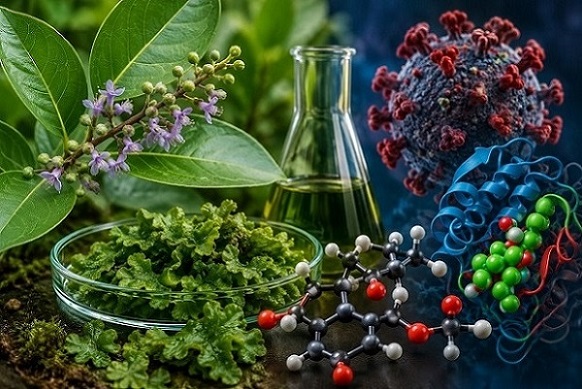 Vietnamese medicinal plants and liverworts yield powerful natural compounds capable of blocking a key
enzyme required for SARS-CoV-2 replication
Searching Nature for New Antiviral Solutions
Although several antiviral drugs targeting COVID-19 have already been developed, scientists remain concerned about the possibility of viral mutations, drug resistance, and limitations associated with current treatments. This has intensified the search for new antiviral compounds with different chemical structures.
The research focused on two natural plants found in Vietnam: Vitex rotundifolia, a medicinal coastal plant widely used in traditional medicine, and Ptychanthus striatus, a liverwort species that has received relatively little scientific attention. Both plants are known to contain unique bioactive compounds, making them attractive candidates for antiviral screening.
Dozens of Phytochemical Compounds Isolated
Using a bioassay-guided approach, the research team extracted and separated chemical compounds from the leaves of Vitex rotundifolia and from Ptychanthus striatus. Their efforts resulted in the identification of 23 phytochemicals in total.
From Vitex rotundifolia, researchers isolated 13 compounds including diterpenoids, triterpenoids, and flavonoids. The liverwort Ptychanthus striatus yielded 10 compounds consisting of terpenoids, phenolic substances, bibenzyl compounds, and bisbibenzyl derivatives. Remarkably, many of these compounds had never before been reported from these species, and one phytochemical compound designated P8 was identified as a completely new natural product.
One Compound Stands Out
The most exciting discovery involved a flavonoid known as chrysoplenol D. When tested against the SARS-CoV-2 main protease, also called Mpro, chrysoplenol D demonstrated exceptional potency.
The viral main protease is essential for coronavirus replication because it processes proteins that the virus needs to reproduce inside human cells. Blocking this enzyme effectively stops the virus from completing its life cycle.
Among all tested compounds, chrysoplenol D showed an IC50 value of just 0.08 micromolar, making it by far the most powerful inhibitor identified in the study. For comparison, other active compounds such as lupeol and kaempferol were significantly less potent. A newly discovered compound from the liverwort also displayed promising activity, though it was much weaker than chrysoplenol D.
Why Chrysoplenol D Works So Well
Computer-based molecular docking studies helped explain the remarkable effectiveness of chrysoplenol D. The analyses revealed that the compound fits neatly into the active pocket of the viral protease and forms multiple hydrogen bonds with critical amino acid residues involved in the enzyme's function.
These interactions included contacts with Gly143 and Cys145, two residues considered essential for the enzyme's activity. By establishing a dense network of molecular interactions, chrysoplenol D was able to bind strongly and stabilize within the enzyme's active site, preventing it from functioning normally.
This
Medical News report notes that the compound also demonstrated favorable predicted drug-like characteristics. Researchers found that chrysoplenol D complied with Lipinski's Rule of Five, a commonly used guideline for assessing the potential of molecules to become orally administered drugs. Its molecular weight, lipophilicity, hydrogen-bonding properties, and polar surface area all fell within desirable ranges.
More Work Still Needed
Despite the encouraging results, the researchers caution that these findings are still at an early stage. The current work only demonstrates enzyme inhibition in laboratory assays and computer simulations.
Before chrysoplenol D or any related compound can be considered a genuine antiviral drug candidate, extensive testing will be required. Future studies must evaluate toxicity, cellular antiviral activity, metabolic stability, pharmacokinetics, and effectiveness in animal models. Scientists also need to determine whether the compound can selectively target the viral enzyme without interfering with important human proteins.
Conclusion
The study highlights the remarkable pharmaceutical potential hidden within Vietnam's biodiversity. The discovery of chrysoplenol D as an extremely potent inhibitor of the SARS-CoV-2 main protease provides a promising new chemical scaffold for future antiviral drug development. Equally important, the work demonstrates that underexplored medicinal plants and liverworts can serve as valuable sources of novel bioactive compounds. While significant research remains before any clinical application becomes possible, these findings offer an exciting foundation for the development of next-generation antiviral therapies that could help combat current and future coronavirus threats.
The study findings were published in the peer reviewed journal: Molecules.
https://www.mdpi.com/1420-3049/31/12/2009
For the latest COVID-19 news, keep on logging to Thailand
Medical News.
Read Also:
https://www.thailandmedical.news/articles/coronavirus
https://www.thailandmedical.news/articles/covid-19-herbs
https://www.thailandmedical.news/articles/herbs-and-phytochemicals




 Share
Share
 Tweet
Tweet
 Share
Share

































