Nikhil Prasad Fact checked by:Thailand Medical News Team Apr 22, 2026 5 months, 1 week, 4 days, 22 hours, 47 minutes ago
Medical News: A new preclinical study is drawing attention to a naturally occurring plant compound that may significantly improve how certain childhood eye cancers respond to chemotherapy. Researchers investigating retinoblastoma, a rare but serious cancer affecting young children, have found that quercetin, a flavonoid present in many fruits and vegetables, can enhance the cancer-killing effects of the drug topotecan.
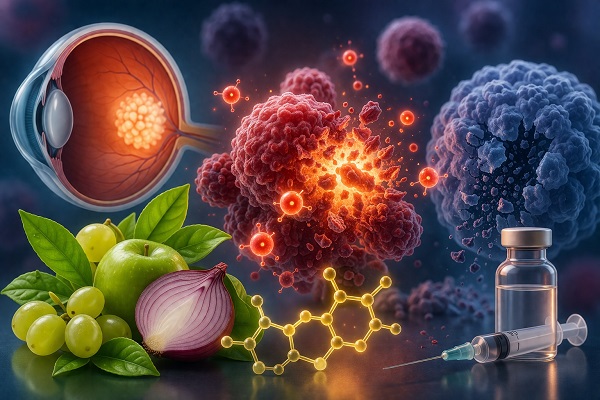 Natural flavonoid dramatically enhances chemotherapy effectiveness against childhood eye cancer in lab studies
A Common Cancer with Treatment Challenges
Natural flavonoid dramatically enhances chemotherapy effectiveness against childhood eye cancer in lab studies
A Common Cancer with Treatment Challenges
Retinoblastoma is the most common eye cancer in children under five. While treatments such as chemotherapy, laser therapy, and surgery have improved survival rates, challenges remain. Drugs like topotecan are effective but can cause serious side effects, especially at higher doses. Scientists have therefore been searching for ways to make these treatments more powerful while potentially reducing toxicity.
Natural Compound Shows Unexpected Strength
Quercetin is widely found in foods like apples, onions, grapes, and green tea. It is known for its antioxidant and anti-inflammatory properties. However, in cancer settings, it can behave differently. Instead of protecting cells, it can increase stress inside cancer cells, making them more vulnerable to treatment.
In this study, researchers explored whether combining quercetin with topotecan could produce a stronger anti-cancer effect. Experiments were conducted using retinoblastoma cells grown in both traditional lab conditions and more advanced three-dimensional tumor models.
Stronger Cancer Cell Killing Observed
The results were striking. When used together, quercetin and topotecan showed a synergistic effect, meaning their combined impact was greater than the sum of their individual effects. Cancer cell survival dropped sharply, and the combination triggered significantly higher levels of programmed cell death.
Study data showed that combination treatment reduced viable cancer cells far more effectively than either drug alone. Apoptosis, or controlled cell death, increased to over 50 percent in treated cells, compared to much lower levels in single-drug treatments.
Oxidative Stress Plays a Key Role
One of the most important discoveries was the role of oxidative stress. The combination therapy caused a surge in reactive oxygen species, or ROS, inside cancer cells. These unstable molecules damage cellular structures and push cells toward death.
Interestingly, when researchers introduced an antioxidant compound to block ROS, some of the cancer-killing effects were reduced. This confirmed that oxidative stress was a major driver of the treatment’s effectiveness, though not the only factor involved.
This
Medical News report highlights how this dual mechanism, involving both oxidative stress and cellular signaling disruption, may offer a new therapeutic a
ngle.
Impact on Tumor Structure and Growth
The study also used three-dimensional tumor spheroids to better mimic real tumors. Analysis revealed that the combination treatment caused severe structural damage, shrinking tumor size and breaking down cell organization. These models showed that cancer cells not only died more rapidly but also lost their ability to maintain tumor integrity, an important factor in preventing disease progression.
Gene-Level Changes Support Findings
Further analysis showed major shifts in gene activity. Genes that promote cell death became more active, while those that help cancer cells survive were suppressed. Key cancer-related pathways, including the PI3K/Akt/mTOR pathway, were significantly disrupted.
This suggests that the treatment works on multiple levels, attacking cancer cells from several angles at once.
Conclusion
The findings from this study provide strong evidence that quercetin could serve as a powerful add-on to existing chemotherapy treatments for retinoblastoma. By enhancing drug effectiveness and triggering multiple cancer-killing mechanisms, it may help overcome current treatment limitations. However, these results are still based on laboratory models, and further studies in animals and humans are needed before clinical use can be considered. If confirmed, this approach could mark an important step toward safer and more effective cancer therapies.
The study findings were published in the peer reviewed journal: Biomolecules.
https://www.mdpi.com/2218-273X/16/4/597
For the latest on treating eye cancer, keep on logging to Thailand
Medical News.
Read Also:
https://www.thailandmedical.news/articles/cancer
https://www.thailandmedical.news/articles/herbs-and-phytochemicals
https://www.thailandmedical.news/articles/ophthalmology-(eye-diseases)




 Share
Share
 Tweet
Tweet
 Share
Share

































