Nikhil Prasad Fact checked by:Thailand Medical News Team Jun 15, 2026 3 months, 2 weeks, 5 days, 8 hours, 43 minutes ago
Medical News: New study finds lingering breathing abnormalities months after infection even in children with mild illness
For much of the COVID-19 pandemic, children were believed to escape the worst effects of SARS-CoV-2 infection. While most young patients experienced only mild symptoms or no symptoms at all, new research is raising concerns that the virus may leave behind subtle but potentially important effects on lung function long after recovery.
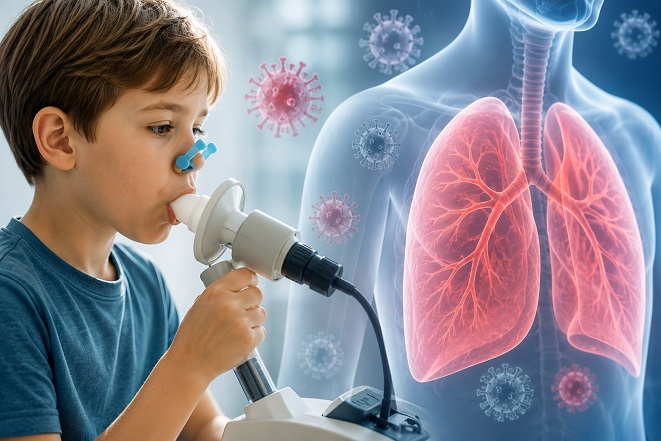 Researchers found that almost one in four children showed measurable lung function abnormalities months after recovering from COVID-19
A new study conducted by researchers from the Department of Pediatrics, Immunology and Nephrology at the Institute of the Polish Mother’s Health Center in Lodz, the Department of Pediatrics, Nephrology and Immunology at the Medical University of Lodz, and the Department of Obstetrics and Gynecology at the Institute of the Polish Mother’s Health Center in Lodz, Poland, has found that nearly one in four children and adolescents showed measurable abnormalities in lung function several months after recovering from COVID-19.
Examining the Lungs of Children After COVID-19
The study involved 109 children and adolescents between the ages of 6 and 18 who had previously contracted COVID-19. The participants included children who had asymptomatic infections, mild illness, and more symptomatic forms of the disease.
Researchers assessed lung function using spirometry, a common breathing test that measures how much air a person can inhale and exhale and how effectively the lungs work. Testing was carried out an average of 4.3 months after infection, although some children were examined as early as one month and others up to 14 months after recovering.
The findings revealed that 23.85 percent of participants had abnormal lung function results. This means almost one in every four children examined showed signs that their lungs were not functioning entirely normally following infection.
Reduced Lung Capacity Emerged as the Main Concern
The most common abnormality observed was a reduction in Forced Vital Capacity (FVC), a measurement that reflects the total amount of air a person can forcefully exhale after taking a deep breath.
Seventeen children, representing 15.6 percent of the study group, had abnormally low FVC values. Researchers noted that reduced FVC may suggest a restrictive pattern of lung impairment, where the lungs are unable to fully expand.
Other abnormalities were less common. Reduced airflow measurements were detected in a smaller number of children, while some showed combinations of different breathing impairments.
Importantly, 83 of the 109 participants still had completely normal spirometry results, showing that most children recover without measurable respiratory consequences.
Severity of COVID Did Not Predict Lung Problems
One of the most surprising findings was that lung abnormalities did not appear to be linked to how sick a child became during their initial infection.
;
Children who had no symptoms, mild symptoms, or more significant respiratory symptoms all showed similar rates of abnormal spirometry results. Researchers also found no meaningful connection between age, existing medical conditions, or the amount of time that had passed since infection and the likelihood of abnormal lung function.
This
Medical News report highlights an important observation from the study: even children who experienced relatively mild COVID-19 were not completely protected from later respiratory changes.
Why Might COVID Affect Children’s Lungs?
Scientists believe SARS-CoV-2 can directly damage cells lining the airways and tiny air sacs in the lungs. Previous research has shown that the virus can injure blood vessels, disrupt the barrier between air sacs and blood vessels, and trigger prolonged inflammatory responses.
These processes may reduce lung volumes and contribute to lower breathing capacity months after the initial infection. Researchers cautioned, however, that spirometry alone cannot determine the exact cause of the abnormalities and more advanced testing will be needed to understand what is happening inside the lungs.
Important Limitations Remain
The investigators emphasized several limitations. They did not have lung function measurements from before the children became infected, making it impossible to know whether some abnormalities existed beforehand. The study also lacked a non-infected control group for comparison.
Additionally, only spirometry was used, meaning more detailed assessments of lung structure and function were not performed.
Conclusions
The findings suggest that measurable respiratory abnormalities may persist in a notable proportion of children months after COVID-19 infection, even when the initial illness was not severe. Nearly one quarter of the participants demonstrated abnormal lung function, with reduced lung capacity emerging as the most frequent finding. Although the study could not identify clear risk factors that predicted which children would be affected, the results indicate that post-COVID respiratory monitoring may be warranted in some pediatric patients. Researchers stress that larger long-term studies are urgently needed to determine whether these abnormalities eventually resolve, remain stable, or progress over time, and to better understand their true clinical significance for children's future respiratory health.
The study findings were published in the peer reviewed Journal of Clinical Medicine.
https://www.mdpi.com/2077-0383/15/12/4624
For the latest COVID-19 news, keep on logging to Thailand
Medical News.
Read Also:
https://www.thailandmedical.news/articles/coronavirus
https://www.thailandmedical.news/articles/long-covid




 Share
Share
 Tweet
Tweet
 Share
Share

































