Nikhil Prasad Fact checked by:Thailand Medical News Team Feb 22, 2026 5 months, 4 days, 14 hours, 14 minutes ago
Medical News: Scientists Discover How Coronaviruses Quietly Reprogram Cells
Researchers have uncovered a surprising strategy used by coronaviruses to multiply inside human cells. Instead of only relying on their genetic material, these viruses appear to reprogram tiny molecular systems that control how proteins are made, allowing viral proteins to be produced more efficiently. The discovery offers new insight into how viruses like SARS-CoV-2 gain an advantage during infection and may open the door to future broad-spectrum antiviral treatments.
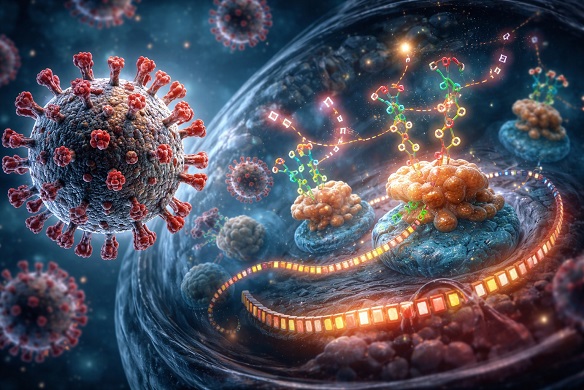 Scientists reveal how coronaviruses manipulate cellular protein-making machinery to strengthen viral growth.
This
Medical News report explains how an international team of scientists showed that coronaviruses alter the chemical modifications of transfer RNA (tRNA), a key component involved in translating genetic instructions into proteins. The study was carried out by researchers from multiple institutions including the Molecular Virology Group at Universitat Pompeu Fabra in Barcelona, the Instituto de Biología Integrativa de Sistemas at the Universitat de València, the MRC-University of Glasgow Centre for Virus Research, the Universitat Autònoma Barcelona, Vall d’Hebron Institut de Recerca, and other collaborating centers in Spain and the United Kingdom.
What Are tRNAs and Why Do They Matter?
To understand the findings, it helps to think of tRNAs as delivery workers inside cells. Their job is to read genetic code and bring the right building blocks so proteins can be assembled correctly. Viruses depend entirely on this cellular machinery because they cannot make proteins on their own.
The researchers found that coronavirus genomes are rich in what scientists call “suboptimal codons,” which normally slow protein production. Yet despite this disadvantage, coronaviruses still manage to produce large amounts of viral proteins. The new study reveals that viruses overcome this problem by reshaping the tRNA environment inside infected cells.
Viruses Change Chemical Marks to Favor Themselves
During infection, the team observed that coronaviruses altered several chemical modifications on tRNAs. These changes essentially helped the cell’s machinery read viral genetic instructions more efficiently. The study focused on two viruses: SARS-CoV-2, which causes severe disease, and HCoV-OC43, which usually causes milder illness.
Both viruses triggered changes in four key tRNA modifications that influence how genetic code is interpreted. These modifications made it easier to decode the specific codons heavily used by coronaviruses, giving viral proteins a production boost while potentially slowing some host proteins.
Stress Responses Inside Cells Play a Major Role
Interestingly, infection caused signs of cellular stress, including DNA damage and oxidative stress. These stress responses naturally alter tRNA chemistry, and the viruses appear to take advan
tage of this process. In simple terms, the viruses exploit the cell’s own emergency response to create a protein-making environment that benefits viral growth.
Laboratory experiments showed that changing the levels of enzymes responsible for these tRNA modifications could reduce viral protein production. When certain enzymes were blocked or overexpressed, the viruses struggled to make proteins efficiently, suggesting that these molecular pathways could become future drug targets.
Potential for New Antiviral Strategies
The findings are especially important because many RNA viruses—not just coronaviruses—use similar genetic patterns. If scientists can develop treatments that interfere with these tRNA modifications, it may be possible to create antivirals that work against multiple viruses rather than a single strain.
Researchers also noted that these mechanisms may help explain differences between mild and severe coronaviruses, as some codon patterns varied between strains. This could eventually help scientists predict how dangerous new viral variants might become.
Conclusion
Overall, the study reveals a hidden layer of viral strategy: coronaviruses do not simply hijack cells, they actively reshape the molecular translation system to favor their own survival. By modifying tRNA chemistry, the viruses turn normally inefficient genetic codes into an advantage, allowing rapid viral protein production while the host cell struggles to keep balance. Understanding this process offers a promising pathway for future antiviral development, especially therapies that target shared cellular mechanisms rather than constantly chasing new viral mutations.
The study findings were published in the peer reviewed journal: Nature Communications.
https://link.springer.com/article/10.1038/s41467-026-69700-w
For the latest on Coronaviruses, keep on logging to Thailand
Medical News.
Read Also:
https://www.thailandmedical.news/articles/coronavirus
Visit Also:
https://thailandwellness.news/
https://thailandhotel.news/
https://bangkokhotel.news/
https://bangkokgems.news/
https://bangkokbusiness.news/
https://thailandai.news/
Coming Soon:
https://thailandfood.news/
https://thailandexpats.news/
https://thailandherbs.news/
https://dubaijewelry.news/
We own and operate a fast-growing network of more than 800 niche news websites, with plans to scale to 60,000 AI-optimized properties by the end of 2027, creating one of the world’s largest independent digital publishing ecosystems. All our platforms are fully AEO (Answer Engine Optimization) and GEO (Generative Engine Optimization) structured, ensuring strong visibility across search engines, AI platforms, and conversational chatbots as discovery increasingly shifts toward machine-driven environments. Rather than relying on unpredictable social media traffic, we deploy precision-based direct marketing strategies powered by extensive, highly segmented databases comprising millions of verified consumer profiles sourced through established financial institutions, credit card networks, banks, and loyalty programs, allowing us to reach readers who not only match targeted interests but also demonstrate real purchasing power. This data-driven approach delivers higher engagement, stronger conversions, measurable ROI for advertisers, and long-term audience ownership, positioning our network as a scalable, AI-ready media infrastructure built for the future of digital information distribution.




 Share
Share
 Tweet
Tweet
 Share
Share