Nikhil Prasad Fact checked by:Thailand Medical News Team May 16, 2026 4 months, 2 weeks, 4 days, 13 hours, 34 minutes ago
Medical News: Scientists are raising new concerns that two little-known viruses may play a much bigger role in breast cancer than previously believed. A major new review of global research has found that traces of Epstein–Barr virus (EBV) and Bovine Leukemia Virus (BLV) appear far more often in breast cancer tissues than in healthy breast tissues, strengthening suspicions that viral infections could contribute to the development of the disease.
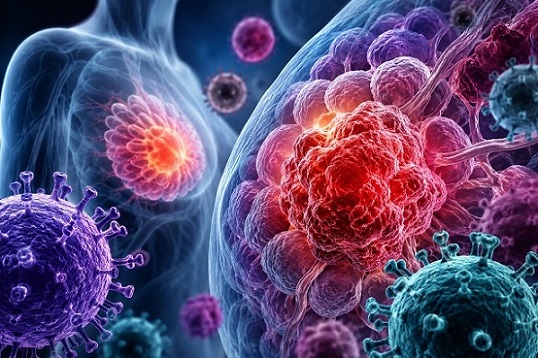 Researchers found that two common viruses appear far more frequently in breast cancer tissue,
raising new questions about viral involvement in cancer development
The study was conducted by researchers from the 2nd Department of Obstetrics and Gynaecology at Aristotle University of Thessaloniki, the Laboratory of Biochemistry at the School of Medicine of Aristotle University of Thessaloniki, and the 3rd Department of Obstetrics and Gynaecology at Aristotle University of Thessaloniki in Greece.
Scientists Review Decades of Global Research
Breast cancer remains the most commonly diagnosed cancer among women worldwide. While genetics, hormones, environmental exposures, and lifestyle factors are already known contributors, scientists have long suspected that infections may also influence cancer risk.
To investigate this possibility, the Greek research team analyzed 29 previous studies published between 2005 and 2024. Together, these studies included 2,572 women with breast cancer and 1,467 women without breast cancer. The researchers specifically examined whether viral genetic material from EBV or BLV could be detected in breast tissue samples using PCR molecular testing techniques.
The findings were striking.
Women with breast cancer were about three times more likely to have detectable Epstein–Barr virus genetic material in their breast tissue compared to women without cancer. Similarly, women with breast cancer were around 3.5 times more likely to carry genetic traces of Bovine Leukemia Virus in breast tissue.
What Are These Viruses?
Epstein–Barr virus is extremely common. More than 95 percent of the world’s population is believed to have been infected at some point. It is best known for causing infectious mononucleosis, often called the “kissing disease.” EBV has already been linked to several cancers, including Burkitt lymphoma, nasopharyngeal cancer, and some stomach cancers.
Researchers believe EBV may help trigger cancer by interfering with normal cell signaling pathways and encouraging uncontrolled cell growth.
BLV, on the other hand, is mainly a cattle virus associated with leukemia in cows. Scientists suspect humans may become exposed through consumption of unpasteurized dairy products or contaminated meat. Earlier studies have hinted that BLV might interfere with DNA repair systems inside breast cells, increasing the risk of cancer-causing mutations.
Consistent Results Across Multiple Countries
One of the most important aspects of the study was the consistency of the findings across many regions o
f the world. Studies included patients from countries such as Jordan, Iran, Egypt, Colombia, Brazil, Australia, the United States, Pakistan, Croatia, Qatar, Lebanon, Eritrea, France, Morocco, and Turkey.
The increased viral detection rates were observed regardless of whether researchers used fresh frozen tissue or preserved tissue samples. The association also remained significant across different PCR testing methods.
This
Medical News report highlights how the researchers also performed additional sensitivity analyses to verify the reliability of the findings. Even when only higher-quality studies were examined, the link between EBV and breast cancer remained strong.
Interestingly, EBV was significantly associated with breast cancer in studies from Africa, Asia, and Europe, though not in Oceania. Researchers said geographical differences, lifestyle factors, and viral strain variations may help explain these differences.
Important Caution from Researchers
Despite the alarming findings, the researchers emphasized that the study does not prove these viruses directly cause breast cancer.
Detecting viral genetic material inside tumors does not automatically mean the virus started the cancer. It is still possible that the viruses infect tissues after tumors develop or simply coexist within cancerous tissues.
The scientists stressed that more research is urgently needed to determine whether EBV and BLV are true drivers of breast cancer or merely associated markers. Future studies may also investigate whether viral screening could one day help identify women at higher risk or even lead to antiviral therapies as part of breast cancer treatment.
Conclusions
The growing evidence linking EBV and BLV to breast cancer is becoming increasingly difficult to ignore. Although researchers are careful not to claim direct causation, the repeated discovery of viral genetic material in malignant breast tissues across many independent studies suggests these infections may play an important biological role. If future studies confirm a causal relationship, the findings could transform how breast cancer is prevented, diagnosed, and possibly even treated. Scientists may eventually develop screening tools, vaccines, or targeted antiviral strategies aimed at reducing cancer risk in susceptible populations.
The study findings were published in the peer reviewed International Journal of Molecular Sciences.
https://www.mdpi.com/1422-0067/27/10/4452
For the latest on breast cancer, keep on logging to Thailand
Medical News.
Read Also:
https://www.thailandmedical.news/articles/cancer




 Share
Share
 Tweet
Tweet
 Share
Share

































