Nikhil Prasad Fact checked by:Thailand Medical News Team Jun 11, 2026 3 months, 3 weeks, 2 days, 41 minutes ago
Medical News: Heart failure is often associated with a weakened heart that struggles to pump blood. However, a less understood form known as heart failure with preserved ejection fraction (HFpEF) is rapidly becoming one of the biggest cardiovascular challenges among older adults. New research now suggests that aging cells and the inflammatory substances they release may be key drivers of this increasingly common condition, opening the door to entirely new treatment approaches.
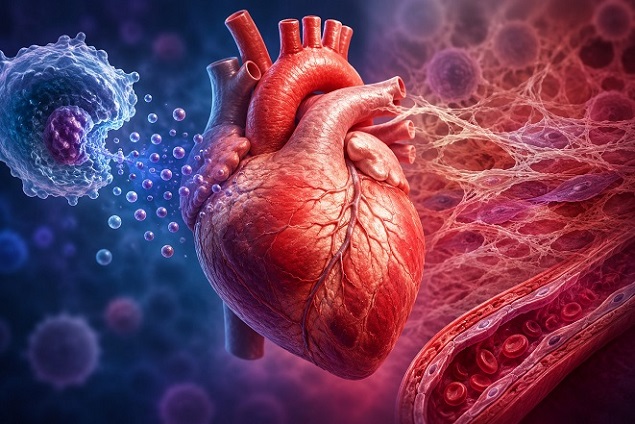 Aging cells and their inflammatory secretions may be the hidden force driving a common form of heart failure in older adults
Researchers from Li-Yuan Hospital, Tongji Medical College, Huazhong University of Science and Technology in Wuhan, China, and the Laboratory of Metabolic Abnormalities and Vascular Aging at Huazhong University of Science and Technology, Wuhan, China, have published a comprehensive review examining how cellular aging contributes to HFpEF and how emerging therapies may help combat the disease.
A Different Kind of Heart Failure
HFpEF accounts for more than half of all heart failure cases worldwide and is especially common in people over the age of 65. Unlike traditional heart failure, where the heart loses its ability to pump effectively, HFpEF occurs when the heart muscle becomes stiff and unable to relax properly between beats. This prevents the heart chambers from filling adequately with blood.
Patients often experience fatigue, breathlessness, exercise intolerance, and fluid retention. The condition is strongly linked to aging, obesity, diabetes, hypertension, and chronic inflammation.
Scientists now believe that one of the major factors connecting these conditions is a biological process called cellular senescence.
When Aging Cells Refuse to Die
Cellular senescence occurs when damaged or stressed cells permanently stop dividing but do not die. Instead, they remain in tissues and begin releasing a mixture of inflammatory chemicals, proteins, growth factors, and signaling molecules collectively known as the senescence-associated secretory phenotype, or SASP.
While senescence can help prevent cancer and assist tissue repair in the short term, problems arise when these cells accumulate with age.
The review explains that senescent cells build up in the heart, blood vessels, and surrounding tissues over time. These cells continuously release inflammatory molecules such as IL-6, TNF-alpha, IL-1 beta, transforming growth factor-beta (TGF-beta), and numerous other substances that create a toxic environment.
How SASP Damages the Heart
Researchers found that SASP contributes to HFpEF through three major pathways. First, it promotes extensive cardiac fibrosis. SASP factors stimulate cardiac fibroblasts to produce excessive collagen and scar tissue. As collagen accumulates and becomes increasingly cross-linked, the heart muscle grows stiffer and loses flexibility.
Second, SASP damages the tiny blood vessels that nourish the heart. Chronic inflammation reduces nitric oxide production, impairs blood vessel relaxation, and causes micr
ovascular rarefaction, a condition in which small blood vessels gradually disappear. This reduces oxygen delivery to heart tissue and worsens cardiac performance.
Third, SASP directly injures heart muscle cells. Inflammatory signaling disrupts calcium regulation inside cardiomyocytes, damages mitochondria that produce cellular energy, and reduces the ability of heart muscle fibers to contract and relax efficiently.
According to the review, these interconnected mechanisms create a vicious cycle in which inflammation, fibrosis, vascular dysfunction, and cellular aging continually reinforce each other.
New Therapeutic Possibilities
One of the most exciting aspects of the review covered in this
Medical News report, is its discussion of emerging treatments that specifically target senescent cells and SASP activity.
Scientists are investigating drugs known as senolytics, which selectively eliminate aging senescent cells. Experimental compounds such as dasatinib combined with quercetin, navitoclax, fisetin, and FOXO4-DRI have shown promising results in preclinical studies. These therapies reduced inflammation, improved heart function, and lessened cardiac remodeling in laboratory models.
Another promising group of treatments, known as senomorphics, does not kill senescent cells but instead suppresses harmful SASP production. Drugs such as metformin, rapamycin, resveratrol, melatonin, and certain p38 MAPK inhibitors have demonstrated the ability to reduce inflammation and improve cardiac health.
Researchers also highlighted the growing interest in targeting specific inflammatory molecules such as IL-1 beta and TGF-beta, both of which play major roles in fibrosis and chronic inflammation.
Lifestyle Changes Still Matter
The review emphasizes that exercise, weight management, caloric restriction, and control of diabetes and hypertension remain essential strategies. These interventions can reduce cellular stress, decrease inflammation, and potentially slow the accumulation of senescent cells.
Interestingly, commonly prescribed SGLT2 inhibitors, which have already shown benefits in HFpEF patients, may partly work by reducing SASP-related inflammation and improving cellular metabolism.
Conclusion
The evidence reviewed strongly suggests that cellular senescence and SASP are not merely byproducts of aging but active contributors to the development and progression of HFpEF. By driving chronic inflammation, cardiac fibrosis, microvascular dysfunction, and direct injury to heart muscle cells, senescent cells appear to sit at the center of many disease processes seen in older heart failure patients. Although most findings currently come from laboratory and animal studies, the growing success of senolytic and senomorphic therapies provides hope that future treatments could address the root biological causes of HFpEF rather than simply managing symptoms. Researchers caution that important challenges remain, including improving drug specificity, identifying reliable biomarkers, and conducting large-scale human clinical trials. Nevertheless, targeting cellular aging may ultimately transform how this increasingly common and difficult-to-treat form of heart failure is managed.
The study findings were published in the peer reviewed International Journal of Molecular Sciences.
https://www.mdpi.com/1422-0067/27/12/5278
For the latest research on heart failure, keep on logging to Thailand
Medical News.
Read Also:
https://www.thailandmedical.news/articles/cardiology




 Share
Share
 Tweet
Tweet
 Share
Share

































