Nikhil Prasad Fact checked by:Thailand Medical News Team Mar 04, 2026 6 months, 4 weeks, 2 days, 17 hours, 30 minutes ago
Medical News: A team of scientists from Huashan Hospital and Fudan University in Shanghai, The First Affiliated Hospital of Fujian Medical University in Fuzhou, Cedars-Sinai Medical Center in Los Angeles, and the Institute of Integrated Traditional Chinese and Western Medicine at Huashan Hospital have uncovered compelling new evidence that a natural compound called Icaritin may slow prostate cancer by reshaping gut bacteria and boosting vitamin K2 production.
Their findings reveal a surprising link between diet, intestinal microbes, and cancer progression.
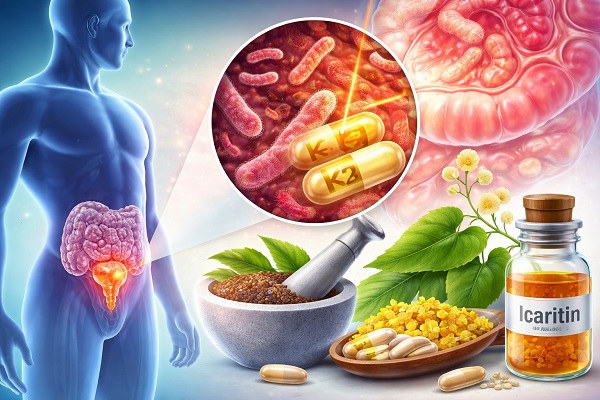 New research shows natural compound Icaritin may slow prostate cancer by restoring gut bacteria and boosting
vitamin K2 production
How a High-Fat Diet Fuels Cancer Risk
Using both normal mice and a special prostate cancer mouse model known as TRAMP, researchers examined how a high-fat diet affects the body. They discovered that mice fed high-fat food had far lower levels of a beneficial gut bacteria family called Akkermansiaceae. In healthy mice on a normal diet, Akkermansiaceae made up over 9 percent of gut bacteria. But in high-fat-fed mice, levels dropped dramatically, in some cancer-prone mice falling below 1 percent.
At the same time, vitamin K2 levels in the intestines also declined. In fact, high-fat-fed normal mice had only 41 percent of the vitamin K2 levels seen in mice on a regular diet. Since vitamin K2 has known anti-cancer properties, this drop raised concern.
Icaritin Reverses Harmful Changes
The researchers then gave high-fat-fed cancer-prone mice a daily dose of Icaritin, a compound derived from the traditional Chinese medicinal plant Epimedium. The results were striking.
Akkermansiaceae levels significantly increased after treatment. Vitamin K2 levels also rose sharply compared to untreated high-fat mice. In addition, the balance of major bacterial groups in the gut shifted toward a healthier pattern.
This
Medical News report highlights that Icaritin did not simply slow tumor growth directly. Instead, it appeared to work through the gut microbiome, restoring beneficial bacteria that in turn boosted vitamin K2 production.
Direct Bacteria Supplement Extends Survival
To confirm the connection, scientists directly fed Akkermansiaceae bacteria to high-fat-fed cancer mice. The effects were powerful. Vitamin K2 levels increased. Harmful hormone leptin, which promotes tumor growth, decreased. Protective hormone adiponectin, which helps suppress tumors, increased.
Most importantly, survival improved significantly. Mice receiving Akkermansiaceae lived noticeably longer than those on a high-fat diet alone.
Laboratory analysis also showed that Icaritin could bind to leptin and adiponectin proteins, potentially influencing how these hormones behave in the body.
Why Vitamin K2 Matters
Vitamin K2 has been shown in other research to slow both hormone-dependent and h
ormone-independent prostate cancer growth. It can interfere with cancer cell survival pathways and reduce tumor development. The new findings suggest that maintaining healthy gut bacteria may be key to preserving adequate vitamin K2 levels.
A Promising but Early Step
The scientists caution that these results come from animal studies. While Icaritin has already been approved in China for advanced liver cancer treatment, its use for prostate cancer remains experimental. Questions about long-term safety, optimal dosing, and effectiveness in humans still need careful study.
Conclusion
In conclusion, this research provides strong evidence that Icaritin may slow prostate cancer progression by restoring beneficial gut bacteria, increasing vitamin K2 production, and rebalancing tumor-related hormones. By reversing the damaging effects of a high-fat diet on the gut microbiome, Icaritin improved survival in cancer-prone mice. While more human studies are needed, these findings open an exciting new pathway that links diet, gut health, and cancer treatment in a way that could reshape future prostate cancer therapies.
The study findings were published in the peer reviewed journal: Cancers.
https://www.mdpi.com/2072-6694/18/5/804
For the latest news on Herbs and Phytochemicals, and Cancer, keep on logging to Thailand
Medical News.
Read Also:
https://www.thailandmedical.news/articles/cancer
https://www.thailandmedical.news/articles/herbs-and-phytochemicals




 Share
Share
 Tweet
Tweet
 Share
Share

































