Nikhil Prasad Fact checked by:Thailand Medical News Team Jun 15, 2026 3 months, 2 weeks, 4 days, 16 hours, 22 minutes ago
Medical News: As the world continues to learn more about how SARS-CoV-2, the virus behind COVID-19, interacts with the human body, a surprising new study suggests that the skin may play a bigger role than previously thought. While the respiratory tract remains the primary route of infection, scientists have discovered that inflamed skin may temporarily become more vulnerable to viral entry under certain conditions.
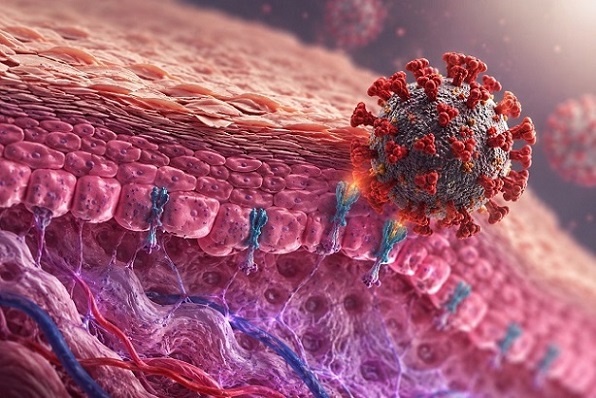 New research suggests inflamed skin may temporarily become more vulnerable to SARS-CoV-2 entry by
increasing key viral receptor proteins
Researchers from the Department of Dermatology at Northwestern University in Chicago, the Skin Biology and Diseases Resource-Based Center at Northwestern University, Rush Medical College in Chicago, the Center for Precision Genetic Technologies for Medicine at the Engelhardt Institute of Molecular Biology of the Russian Academy of Sciences in Moscow, Russia, and the Division of Medical Biochemistry at Wroclaw Medical University in Poland conducted the study.
Investigating the Skin’s Hidden Vulnerability
Since the start of the pandemic, scientists have known that SARS-CoV-2 primarily enters the body through the nose, throat, and lungs. However, many COVID-19 patients have also developed skin symptoms ranging from rashes and hives to the well-known “COVID toes.” Viral genetic material has even been detected in skin samples from infected patients.
To investigate whether skin could act as a potential entry point, researchers used advanced three-dimensional human skin organoids and neonatal skin tissue samples. These laboratory-grown skin models closely resemble real human skin and allow scientists to safely study viral interactions.
The team focused on two proteins that SARS-CoV-2 uses to infect cells: ACE2, the main receptor that allows the virus to attach to cells, and TMPRSS2, an enzyme that helps the virus enter those cells.
Inflammation Dramatically Boosts Viral Entry Proteins
One of the study’s most important findings was that inflammation significantly increased the levels of ACE2 and TMPRSS2 in skin tissue.
Researchers exposed the skin models to inflammatory molecules commonly found in severe COVID-19 and chronic skin diseases such as psoriasis and atopic dermatitis. These included TNF-alpha, IL-6, IL-1 beta, and IFN-gamma.
Each inflammatory molecule increased the production of ACE2 and TMPRSS2, but the strongest effects occurred when several cytokines were combined. In some cases, ACE2 levels increased more than fifteen-fold, while TMPRSS2 levels rose dramatically as well.
The findings suggest that inflamed skin may become biologically more receptive to interactions with SARS-CoV-2.
Psoriasis and Eczema-Like Inflammation Produce Different Effects
The researchers also recreated inflammatory conditions resembling psoriasis and atopic dermatitis.
Interestingly, psoriasis-related inflammation primarily boosted ACE2 levels, while eczema-related inflammation mainly increased TMPRSS2. This indica
tes that different skin diseases may alter susceptibility to viral interactions in different ways.
The study also observed that some skin models derived from African American donors showed stronger ACE2 responses to certain inflammatory signals, although these differences did not translate into significantly higher viral entry rates.
Laboratory Virus Successfully Entered Skin Cells
To determine whether the increased receptor levels actually mattered, the team used a specially engineered harmless virus carrying the SARS-CoV-2 spike protein.
When applied to the skin models, the spike-coated virus successfully entered skin cells. Entry rates rose sharply in skin tissues that had been pretreated with inflammatory cytokines.
The most dramatic increases were seen in skin exposed to cytokine combinations that mimic the so-called cytokine storm associated with severe COVID-19. Psoriasis-like inflammatory conditions also significantly enhanced viral entry.
This
Medical News report highlights an important observation: the stronger the increase in ACE2 expression, the greater the amount of viral entry detected by the researchers.
Skin Responses Resemble Changes Seen in COVID-19 Lungs
The scientists went a step further by examining how skin cells reacted after viral entry occurred.
They discovered that inflamed skin exposed to the spike-coated virus activated hundreds of genes involved in immune responses, inflammation, and cellular signaling. Remarkably, many of these genetic changes overlapped with patterns previously observed in the lungs of patients who died from COVID-19.
Although the skin model did not replicate a full viral infection, the findings suggest that spike protein interactions alone can trigger biological responses similar to those seen during actual disease.
Important Limitations and What It Means
The researchers stress that their findings do not mean healthy, intact adult skin is a major route of COVID-19 infection. The laboratory skin models used in the study possess weaker barrier properties than normal adult skin, making them more permissive to viral entry.
However, the results raise important questions about situations where the skin barrier is compromised, such as psoriasis, eczema, wounds, irritation, or other inflammatory conditions. Under such circumstances, the skin could potentially serve as a temporary and limited interface for SARS-CoV-2 interactions.
Conclusion
The study provides compelling evidence that inflammation can dramatically increase the expression of proteins needed for SARS-CoV-2 entry into skin cells. By showing that spike-coated viral particles can enter inflamed skin models and trigger immune responses resembling those seen in COVID-19 patients, the research offers a new perspective on how the virus may interact with the body outside the respiratory system. While healthy skin remains an effective barrier, inflamed or damaged skin may become temporarily more susceptible to viral contact and entry, emphasizing the importance of maintaining skin health during infectious disease outbreaks.
The study findings were published in the peer reviewed International Journal of Molecular Sciences.
https://www.mdpi.com/1422-0067/27/12/5382
For the latest COVID-19 news, keep on logging to Thailand
Medical News.
Read Also:
https://www.thailandmedical.news/articles/coronavirus
https://www.thailandmedical.news/articles/long-covid




 Share
Share
 Tweet
Tweet
 Share
Share

































