Nikhil Prasad Fact checked by:Thailand Medical News Team Jun 28, 2026 3 months, 1 week, 12 hours, 23 minutes ago
Medical News: Scientists Find the Coronavirus May Leave Lasting Effects on Blood Sugar and Metabolic Health
Although the COVID-19 pandemic has largely faded from daily headlines, scientists are warning that its health consequences may continue for years. A new comprehensive review suggests that SARS-CoV-2, the virus responsible for COVID-19, may leave behind a hidden legacy by increasing the risk of diabetes in some people. Rather than pointing to a single cause, the researchers found that the virus may disrupt blood sugar control through several biological mechanisms while also interacting with lifestyle changes brought on by the pandemic.
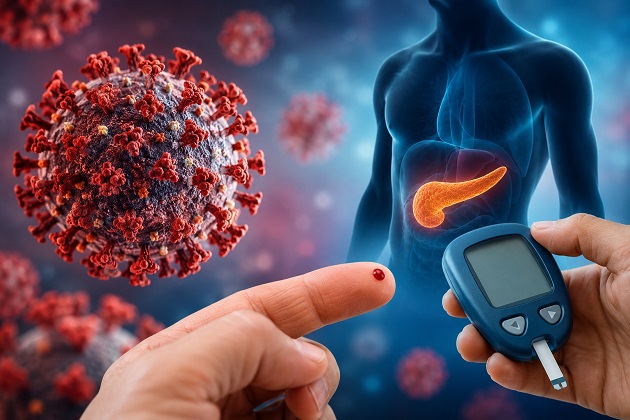 A major scientific review suggests COVID-19 may leave a lasting metabolic legacy by increasing diabetes risk through
multiple biological and lifestyle-related pathways.
The review was conducted by researchers from the Department of Pediatrics, the Center for Diabetes and Metabolic Diseases, the Herman B Wells Center for Pediatric Research, the Department of Medicine at the Indiana University School of Medicine, and the Richard L. Roudebush VA Medical Center in Indianapolis, Indiana, USA.
Scientists Revisit Years of COVID-19 Research
During the early stages of the pandemic, doctors quickly realized that people with diabetes faced a much higher risk of severe COVID-19 illness and death. As the pandemic progressed, doctors around the world also began reporting patients who developed diabetes after recovering from COVID-19. These observations raised an important question: Could the virus itself contribute to diabetes?
To answer that question, the researchers reviewed laboratory studies, clinical investigations, long-term follow-up studies and numerous meta-analyses published since the pandemic began. Their conclusion is that SARS-CoV-2 appears capable of disrupting glucose regulation through multiple pathways, although the exact level of risk differs from person to person.
How COVID-19 Can Affect the Body
One of the strongest findings involves the pancreas, the organ responsible for producing insulin. Several studies showed that SARS-CoV-2 can infect insulin-producing beta cells, reducing their ability to release insulin while increasing cell damage and death. Other studies found that the virus may damage the tiny blood vessels supplying the pancreas or even alter the identity of beta cells, making them function less effectively.
The review also highlights evidence that the virus can infect fat tissue, skeletal muscle and the liver. These organs play essential roles in maintaining normal blood sugar levels. Infection and inflammation within these tissues may increase insulin resistance, meaning the body's cells become less responsive to insulin and glucose remains in the bloodstream instead of entering cells for energy.
Researchers also explain that severe COVID-19 triggers widespread inflammation throughout the body. Stress hormones released during serious illness, together with steroid medications often used to treat hospitalized patients, can temporarily raise blood sugar levels and may expose previously hidden metabolic problems.
The Pandemic Itself Also Cha
nged Diabetes Risk
The researchers emphasize that the virus is only part of the story. Lockdowns, reduced physical activity, unhealthy eating habits, weight gain and increased psychological stress also created conditions that could increase the risk of diabetes, particularly type 2 diabetes.
Several studies found that children and adults gained weight during the pandemic, while some investigations reported higher rates of newly diagnosed type 2 diabetes, especially among young people. This
Medical News report highlights that COVID-19's impact extends beyond viral infection, with social and behavioral changes likely contributing to the growing burden of metabolic disease.
Strong Evidence but Important Questions Remain
Large population studies and multiple meta-analyses generally found that people recovering from COVID-19 had a higher likelihood of being diagnosed with diabetes than those who had not been infected. However, the researchers caution that many of these studies differed in design, making it difficult to prove that the virus alone caused diabetes. Some studies failed to distinguish between type 1 and type 2 diabetes, while others may have included people whose diabetes had gone undiagnosed before infection.
The review also found encouraging evidence that COVID-19 vaccination before infection may reduce the risk of developing diabetes afterward, although more prospective studies are needed to confirm this protective effect.
Conclusion
The researchers conclude that COVID-19's relationship with diabetes is complex and should not be viewed as a simple cause-and-effect relationship. Instead, SARS-CoV-2 appears capable of disrupting several systems involved in blood sugar regulation, including the pancreas, liver, muscles, fat tissue and immune system, while also interacting with lifestyle and environmental factors. Continued long-term studies will be critical to determine which people remain most vulnerable, how long these metabolic effects persist and whether future strategies can reduce the risk of diabetes following viral infections. The lessons learned from the COVID-19 pandemic may also help healthcare systems better prepare for future global outbreaks that could have similar long-term metabolic consequences.
The study findings were published in the peer reviewed journal: Diabetologia.
https://link.springer.com/article/10.1007/s00125-026-06785-4
For the latest COVID-19 news, keep on logging to Thailand
Medical News.
Read Also:
https://www.thailandmedical.news/articles/coronavirus
https://www.thailandmedical.news/articles/long-covid
https://www.thailandmedical.news/articles/diabetes




 Share
Share
 Tweet
Tweet
 Share
Share