Nikhil Prasad Fact checked by:Thailand Medical News Team Mar 07, 2026 6 months, 3 weeks, 6 days, 20 hours, 52 minutes ago
Medical News: Scientists are uncovering a surprising reason why many people continue to suffer months or even years after recovering from COVID-19. A new study suggests that lingering viral remnants inside the gut may keep the immune system in a constant state of alarm, potentially driving the symptoms known as long COVID or post-COVID syndrome.
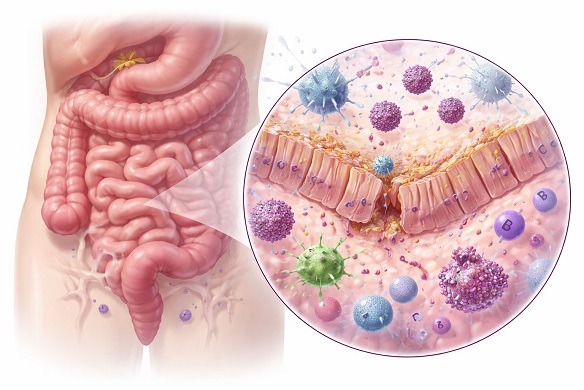 Persistent viral remnants in the gut may keep the immune system activated and drive long COVID symptoms
Researchers from the University Hospital Cologne and University of Cologne in Germany, the Vienna Healthcare Group Klinik Favoriten in Austria, Sigmund Freud University in Vienna, the German Center for Infection Research (DZIF), Bundeswehr Central Hospital Koblenz in Germany, Gemeinschaftskrankenhaus Bonn in Germany, the Cologne Excellence Cluster on Cellular Stress Responses in Aging-Associated Diseases (CECAD), the Institute for Biochemistry at the University Hospital Cologne, and Facharztzentrum Votivpark in Vienna carried out a detailed investigation into how the gut and immune system interact in long COVID patients.
Long COVID Still Puzzles Scientists
Post-COVID syndrome affects people long after the initial infection has cleared. Patients often report extreme fatigue, brain fog, breathing problems, headaches, sleep disturbances, and difficulty concentrating. Many individuals who develop the condition initially had only mild COVID-19.
To understand what might be happening inside the body, scientists analyzed 43 people who had recovered from COVID-19. Among them, 20 participants had persistent long-COVID symptoms, while 23 had recovered without ongoing health issues.
The researchers examined blood samples and also collected tiny tissue samples from the terminal ileum, a section of the small intestine rich in immune cells and known to play a major role in gut-immune interactions.
Viral Remnants Found in the Gut
One of the most striking findings was that fragments of the SARS-CoV-2 virus were still present in the intestinal tissue of long-COVID patients, even up to nearly two years after the initial infection.
Although the virus itself was not actively replicating, the study detected a viral protein called nucleocapsid inside cells of the gut lining. These remnants were significantly more common in individuals with long COVID compared to those who had fully recovered.
Researchers believe these leftover viral components may continue stimulating the immune system locally within the gut.
Signs of Gut Barrier Damage
The team also discovered evidence that the intestinal barrier in long-COVID patients was compromised. Blood levels of a protein called zonulin, which indicates increased gut permeability, were higher in affected individuals.
This means the gut wall may become “leakier,” allowing substances from the digestive tract to enter the bloodstream and trigger inflammation throughout the body.
At the same time, the researchers found elevated activity of mast cells—immune cells that release inflammatory chemicals. These cells were present in much higher numb
ers in intestinal tissue of long-COVID patients.
Immune System Remains Activated
Further analysis showed significant changes in immune cell populations within the gut. Certain antiviral immune cells known as plasmacytoid dendritic cells were greatly increased. Natural killer cells, another key immune defense, appeared to shift from the bloodstream into the intestinal tissue.
The study also identified elevated levels of a molecule called MMP-9, which is associated with inflammation and the breakdown of tissue structures. This suggests that ongoing immune activity may be reshaping the intestinal environment long after the virus has disappeared from the bloodstream.
Why the Gut May Hold the Key
Scientists increasingly suspect that the gut acts as an important reservoir for viral remnants that continue to influence the immune system. Because the intestine contains a large portion of the body’s immune cells, persistent signals there may keep the immune system activated.
This
Medical News report highlights how the gut-immune connection could play a crucial role in explaining long COVID symptoms.
Conclusions
The findings suggest that long COVID may partly stem from lingering viral proteins trapped in the gut combined with ongoing immune activation and damage to the intestinal barrier. Even without active viral infection, these remnants may continuously stimulate inflammation and disrupt normal immune balance. Understanding this gut-immune interaction could open the door to new treatments aimed at restoring intestinal health, calming immune overactivity, and potentially relieving persistent symptoms affecting millions of people worldwide.
The study findings were published in the peer reviewed journal: Mucosal Immunology.
https://www.sciencedirect.com/science/article/pii/S1933021926000267
For the latest on Long COVID, keep on logging to Thailand
Medical News.
Read Also:
https://www.sciencedirect.com/science/article/pii/S1933021926000267




 Share
Share
 Tweet
Tweet
 Share
Share

































