Nikhil Prasad Fact checked by:Thailand Medical News Team Jul 12, 2026 1 month, 3 weeks, 20 hours, 45 minutes ago
Medical News: Long COVID may be doing far more damage to the brain than previously recognized, according to a new Canadian study that found striking evidence of reduced dopamine-related nerve terminals in key brain regions involved in motivation, movement and memory. The findings could help explain why many people continue to struggle with persistent apathy, slowed thinking and memory problems months or even years after recovering from COVID-19.
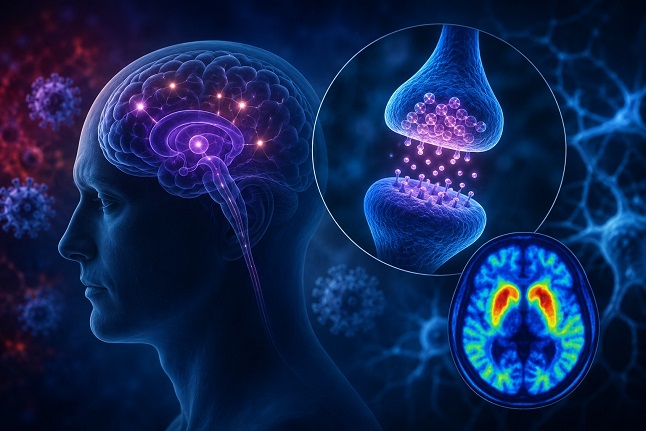 Brain scans reveal that long COVID is associated with significant dopamine-related nerve terminal loss linked to
apathy, memory decline and slowed movement
The research was led by scientists from the Brain Health Imaging Centre, Campbell Family Mental Health Research Institute at the Centre for Addiction and Mental Health (CAMH), the University of Toronto, McGill University, Sunnybrook Research Institute, Sunnybrook Health Sciences Centre, University Health Network, the Australian Nuclear Science and Technology Organisation, and Forward Thinking Psychological Services in Canada and Australia.
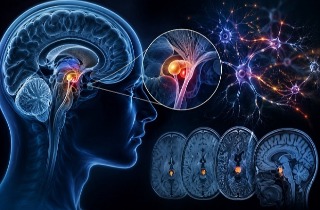
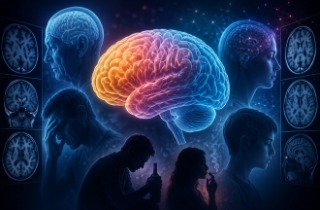
The investigators examined 24 adults with long COVID and compared them with 24 healthy age-matched individuals, later expanding the healthy comparison group to 43 participants. Using advanced positron emission tomography (PET) imaging, they measured vesicular monoamine transporter 2 (VMAT2), a reliable marker of dopamine-releasing nerve terminal integrity in the brain.
Brain scans reveal significant dopamine-related changes. Dopamine system appears damaged
The scans showed that people with long COVID had substantially lower VMAT2 binding throughout the ventral striatum, dorsal putamen and dorsal caudate. VMAT2 binding was reduced by approximately 20% in the ventral striatum, 16% in the dorsal putamen and 17% in the dorsal caudate compared with healthy controls.
Importantly, healthy individuals who had previously recovered from COVID-19 without developing long COVID displayed VMAT2 levels similar to people who had never been infected, suggesting that the changes are specifically associated with long COVID rather than prior infection alone. This
Medical News report highlights one of the strongest pieces of imaging evidence to date linking long COVID with damage to dopamine-related brain circuits.
Symptoms matched the brain abnormalities
The researchers discovered that lower dopamine-related activity closely tracked several of the most disabling symptoms experienced by long COVID patients.
Reduced VMAT2 binding in the ventral striatum was associated with greater apathy and cognitive complaints. Lower levels in the dorsal putamen correlated with slower motor performance on finger-tapping and reading-speed tests, while reduced activity in the dorsal caudate was linked to poorer delayed verbal memory.
Interestingly, the dopamine-related changes were not associated with depression severity, previous COVID variants or the time elapsed since infection, suggesting these abnormalities may represent a distinct biological feature of long COVID rather than a consequence of mood disorders. Blood biomarkers also failed to reflect the brai
n changes, emphasizing the value of advanced imaging techniques.
New direction for treatment
The researchers believe the findings point toward a new therapeutic strategy focused on improving dopamine signaling. They suggest future clinical trials could investigate treatments that enhance dopamine function, including dopamine precursors or medications that slow dopamine breakdown. However, they caution that such therapies would need careful evaluation because dopamine-enhancing drugs can produce significant side effects and may only benefit patients with this specific neurological profile. Larger studies are also needed to confirm whether restoring dopamine function improves motivation, movement and memory in long COVID sufferers.
Conclusion
This study provides compelling evidence that long COVID is associated with measurable disruption of dopamine-releasing nerve terminals in critical brain regions responsible for motivation, movement and memory. The close relationship between these biological abnormalities and the severity of neurological symptoms strengthens the argument that persistent brain dysfunction in long COVID has a genuine structural basis. If confirmed in larger clinical trials, these findings could reshape treatment strategies by shifting attention toward therapies that restore dopamine function and improve the quality of life of millions living with long COVID.
The study findings were published in the peer reviewed journal: eBioMedicine.
https://www.thelancet.com/journals/ebiom/article/PIIS2352-3964(26)00222-7/fulltext
For the latest on Long COVID, keep on logging to Thailand
Medical News.
Read Also:
https://www.thailandmedical.news/articles/long-covid




 Share
Share
 Tweet
Tweet
 Share
Share