Nikhil Prasad Fact checked by:Thailand Medical News Team May 25, 2026 4 months, 1 week, 2 days, 23 hours, 19 minutes ago
Medical News: Scientists are raising renewed concerns about the environmental persistence of the deadly Ebola virus after new research revealed that the pathogen can survive outside the human body far longer than previously assumed under certain conditions. The findings are now reshaping discussions about hospital safety, waste disposal, and the risks posed by contaminated surfaces and bodily fluids during outbreaks.
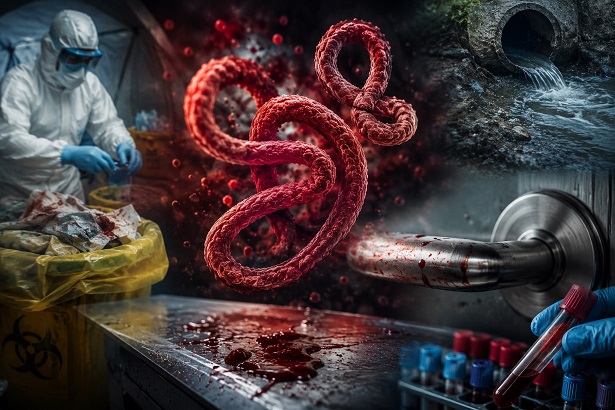 Studies reveal Ebola may remain infectious on surfaces and in body fluids far longer than previously believed
Researchers reviewed emerging evidence showing that Ebola virus can remain infectious on common surfaces for hours and in contaminated body fluids for several days. Their work highlights major gaps in scientific understanding about how long the virus can persist in wastewater, sewage systems, and healthcare environments.
Ebola Can Persist Longer Than Expected
The Ebola virus spreads primarily through direct contact with infected blood, vomit, urine, saliva, or other bodily fluids. However, scientists say the danger may not end once those fluids leave the body.
Studies examined by the researchers showed that Ebola can survive on dry, non-porous surfaces such as plastic, stainless steel, countertops, and doorknobs for several hours. More alarming was the discovery that when the virus is suspended in fluids like blood or vomit, it can remain viable and infectious for days at room temperature.
In experimental investigations involving human blood and blood from infected non-human primates, viable Ebola virus particles were detected in drying blood samples for as long as five days under different environmental conditions. The virus also demonstrated an unexpected ability to persist in water, surviving up to three days at 27 degrees Celsius and as long as six days at cooler temperatures around 21 degrees Celsius.
Scientists warn that these findings raise troubling questions about whether contaminated wastewater, sewage canals, or improperly discarded medical waste could potentially contribute to virus dissemination during outbreaks.
Hospital Waste and Sewage Concerns Intensify
The research has intensified scrutiny over existing international waste management guidelines. Current recommendations from the World Health Organization allow liquid waste from Ebola patients to be disposed of in pit latrines or flushed into ordinary sanitary sewer systems. However, some researchers argue that the scientific evidence supporting these recommendations remains surprisingly limited.
Experts noted that while health authorities assume the virus dies rapidly in sewage systems, there is insufficient direct evidence confirming this belief.
The researchers stressed that understanding how long Ebola survives in wastewater is essential because infected bodily fluids frequently enter drainage systems during outbreaks. If the virus persists longer than expected, it could create new environmental transmission risks, especially in regions with poor sanitation infrastructure.
This
uot;>Medical News report highlights that researchers are now urgently calling for more environmental surveillance studies to determine whether infectious Ebola particles can survive in real-world sewage conditions long enough to pose public health threats.
Sunlight Heat and Disinfectants Still Effective
Despite the concerning findings, scientists emphasized that Ebola is not an indestructible virus. Environmental conditions strongly influence its survival.
Sunlight, drying, and heat rapidly weaken the virus. Research showed that Ebola becomes inactive after exposure to temperatures of about 60 degrees Celsius for approximately one hour. Porous materials such as fabrics and clothing also appear less hospitable to the virus compared to smooth non-porous materials like metal and plastic.
Importantly, Ebola remains highly vulnerable to proper disinfection measures. Hospital-grade disinfectants, including diluted bleach solutions and 0.5 percent chlorine mixtures, effectively destroy the virus on contaminated surfaces.
Researchers stressed that rigorous disinfection procedures, proper removal of protective equipment, and careful handling of contaminated waste remain among the most critical defenses against Ebola transmission.
Scientists Turn to Surrogate Viruses
One major challenge slowing progress in Ebola environmental research is the extreme danger and cost associated with handling the live virus. Only a limited number of high-security laboratories worldwide can safely conduct Ebola experiments.
To overcome this obstacle, scientists are now exploring the use of surrogate viruses that mimic Ebola’s physical behavior without posing the same deadly risks. Viruses such as adenovirus, hepatitis A, and poliovirus are being evaluated as possible stand-ins for environmental persistence studies.
Researchers hope these safer models can help generate urgently needed data about virus survival in water systems, sludge, and contaminated surfaces while direct Ebola studies continue under strict biosafety conditions.
Important Questions Still Unanswered
Although the findings provide valuable insights, researchers acknowledged several limitations. Laboratory experiments were conducted under controlled sterile conditions that may not perfectly reflect real outbreak environments where bacteria, chemicals, humidity, and sunlight interact unpredictably with the virus.
Scientists also noted that variations in blood composition, fluid volume, and environmental contamination could significantly alter Ebola stability in real-world settings. Additionally, while viable Ebola has been isolated from urine, it has not yet been consistently recovered from human stool samples, leaving uncertainties about fecal transmission through wastewater.
The growing body of evidence nevertheless demonstrates that Ebola’s environmental survival capabilities are more complex than previously believed. Researchers say future outbreak responses must consider not only direct human-to-human transmission but also the potential risks associated with contaminated surfaces, fluids, and waste systems.
The findings reinforce the urgent need for stronger infection control measures, improved wastewater management, and expanded environmental monitoring during Ebola outbreaks. Scientists believe that understanding precisely how long the virus survives outside the body may ultimately prove critical for preventing future epidemics and protecting frontline healthcare workers from accidental exposure.
References:
https://wwwnc.cdc.gov/eid/article/21/7/15-0253_article
https://pubs.acs.org/doi/abs/10.1021/ez5003715
https://drexel.edu/news/archive/2014/December/Ebola-assessment-study
For the latest on Ebola, keep on logging to Thailand
Medical News.
Read Also:
https://www.thailandmedical.news/articles/ebola




 Share
Share
 Tweet
Tweet
 Share
Share

































