Nikhil Prasad Fact checked by:Thailand Medical News Team Apr 20, 2026 5 months, 2 weeks, 2 hours, 55 minutes ago
Medical News: A groundbreaking new study is raising serious questions about the long-term health risks faced by COVID-19 survivors, particularly when it comes to lung cancer. Researchers have uncovered compelling evidence that the SARS-CoV-2 spike protein—the same protein that allows the virus to enter human cells—may play a direct role in triggering lung damage and even accelerating cancer development under certain conditions.
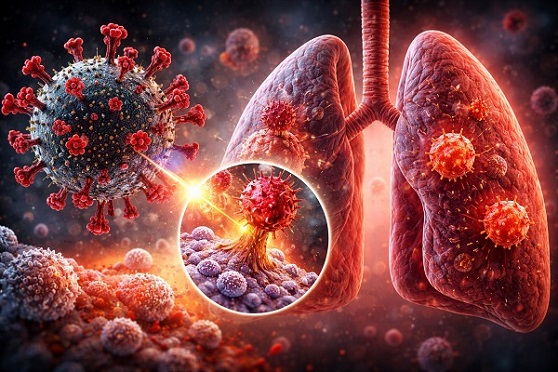 New research reveals how the COVID-19 spike protein may trigger lung damage and increase cancer risk over time
Readers should also note that it is this same SARS-CoV-2 spike protein that is being utilized in the COVID-19 mRNA vaccines.
The study, conducted by scientists from the Joan C. Edwards School of Medicine at Marshall University in the United States and the Hadassah Medical Center and Hebrew University Faculty of Medicine in Israel, reveals a complex chain reaction inside the lungs that could leave lasting consequences. Alarmingly, the findings suggest that this process may be especially dangerous for smokers and those with pre-existing lung conditions.
How the Spike Protein Damages the Lungs
Researchers found that even without the full virus, the spike protein alone can cause significant injury to lung tissue. In laboratory models, exposure to the spike protein triggered inflammation, immune cell infiltration, and the formation of tiny blood clots within lung vessels.
This cascade of damage does not stop there. The study shows that the spike protein also promotes fibrosis, a condition where lung tissue becomes scarred and stiff. Over time, fibrosis is a well-known risk factor for lung cancer, creating an environment where abnormal cells can grow unchecked.
A Key Protein That Fuels the Process
At the center of this discovery is a protein called thymidine phosphorylase (TYMP). Researchers observed that TYMP levels increase significantly following COVID-19 infection and appear to amplify the harmful effects of the spike protein.
In experimental models, when TYMP was removed or suppressed, lung damage was dramatically reduced. Tumor formation also dropped sharply—from about 50 percent of lung regions affected to just 18 percent.
This
Medical News report highlights that TYMP acts like a “fuel switch,” intensifying inflammation, promoting tissue scarring, and reshaping the immune environment into one that favors tumor growth rather than fighting it.
Evidence From Real-World Patient Data
To strengthen their findings, researchers analyzed a massive dataset of over 166,000 individuals using the TriNetX research network. The results were striking. People who had previously contracted COVID-19 showed a significantly higher risk of developing lung cancer compared to those who had not.
The risk was highest among current smokers, followed by former smokers, and then non-smokers. This pattern suggests that pre-existi
ng lung damage or irritation may make individuals more vulnerable to the long-term effects of the virus.
Interestingly, the increased cancer risk appeared specific to the lungs, with no consistent rise seen in cancers of the mouth or bladder.
A Dangerous Biological Chain Reaction
The study also uncovered how the spike protein disrupts normal cellular processes. It alters the function of ACE2, a key receptor in the lungs, and activates a signaling pathway known as STAT3. This pathway is linked to inflammation, fibrosis, and cancer progression.
Additionally, the immune system itself is reshaped. Instead of mounting a protective anti-tumor response, the body shifts toward a pro-inflammatory, tumor-supporting state. This creates what scientists describe as a “tumor-friendly environment,” where cancer cells can emerge or grow more aggressively.
Conclusion
The findings of this study provide a powerful warning about the potential long-term consequences of COVID-19, particularly for lung health. While not everyone who recovers from COVID-19 will develop cancer, the research clearly shows that the virus—and specifically its spike protein—can trigger biological changes that increase risk over time. Importantly, the identification of TYMP as a key driver opens the door for new treatments aimed at blocking this pathway and reducing future complications. Continued monitoring of COVID-19 survivors, especially those with additional risk factors like smoking, may be essential in detecting and preventing serious outcomes such as lung cancer.
The study findings were published in the peer reviewed journal: Frontiers in Immunology.
https://www.frontiersin.org/journals/immunology/articles/10.3389/fimmu.2026.1798566
For the latest COVID-19 News, keep on logging to Thailand
Medical News.
Read Also:
https://www.thailandmedical.news/articles/coronavirus
https://www.thailandmedical.news/articles/long-covid




 Share
Share
 Tweet
Tweet
 Share
Share

































