Nikhil Prasad Fact checked by:Thailand Medical News Team Jun 08, 2026 3 months, 3 weeks, 6 days, 14 hours, 39 minutes ago
Medical News: Chronic nerve pain caused by diabetes and shingles may soon have a powerful new treatment option, according to a new study that found a peptide derived from marine cone snails not only reduced pain more effectively than the commonly prescribed drug gabapentin but also appeared to help repair damaged nerves. The research offers fresh hope for millions of people struggling with diabetic neuropathic pain and postherpetic neuralgia, two debilitating conditions that are often difficult to treat.
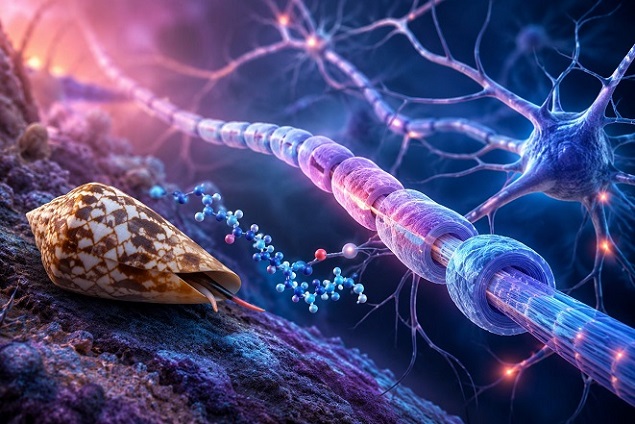 Marine cone snail peptide GeXIVA[1,2] showed superior pain relief and nerve-repair effects compared to gabapentin in
chronic neuropathic pain models
A Major Burden for Patients
Diabetic neuropathic pain develops when prolonged high blood sugar damages nerves, while postherpetic neuralgia is a lingering complication of shingles caused by the reactivation of the varicella-zoster virus. Both conditions can trigger persistent burning, tingling, stabbing sensations, and extreme sensitivity to touch.
Current treatments such as gabapentin, pregabalin, antidepressants, and opioids provide only partial relief for many patients and can cause troublesome side effects including dizziness, drowsiness, nausea, and dependence. As a result, researchers worldwide have been searching for safer and more effective alternatives.
The new study was conducted by scientists from the Guangxi Key Laboratory of Special Biomedicine, School of Medicine, Guangxi University, Nanning, China. The research focused on a marine-derived peptide called αO-conotoxin GeXIVA[1,2], a compound originally isolated from cone snails found in the South China Sea.
Powerful Pain Relief Without Signs of Tolerance
The researchers tested GeXIVA[1,2] in laboratory rat models designed to mimic diabetic neuropathic pain and postherpetic neuralgia. Initial experiments showed that the peptide produced strong pain-relieving effects within hours of administration.
The most impressive findings emerged during long-term treatment. Animals received daily injections for three weeks and were monitored for changes in pain sensitivity.
In both disease models, GeXIVA[1,2] consistently reduced pain responses and restored pain thresholds to levels approaching those seen in healthy animals. Remarkably, its effectiveness surpassed that of gabapentin, one of the most widely used drugs for neuropathic pain.
Even after 21 consecutive days of treatment, the peptide continued to provide strong pain relief without any evidence that the animals were becoming tolerant to its effects. This is particularly important because many chronic pain treatments gradually lose effectiveness over time.
More Than a Painkiller
One of the most intriguing discoveries was that GeXIVA[1,2] appeared to do much more than simply block pain signals.
Researchers found that treatment significantly lowered levels of inflammatory molecules including IL-1β, TNF-α, and IL-6, which are known to contribute to nerve injury and chronic pain. Excessive inflammation is believed to play
a major role in maintaining neuropathic pain long after the original damage occurs.
This
Medical News report highlights that reducing inflammation could be one of the key reasons why the peptide delivered such strong and sustained pain relief.
The team also discovered that GeXIVA[1,2] reduced the infiltration of immune cells around damaged nerves. In chronic neuropathic pain, immune cells often accumulate around injured nerves and release substances that worsen inflammation and amplify pain signals. By limiting this process, the peptide may help create a healthier environment for nerve recovery.
Evidence of Nerve Repair
Perhaps the most exciting finding involved the structural condition of the nerves themselves.
Using advanced microscopic analysis, the researchers examined the sciatic nerves of treated animals. Untreated diabetic and postherpetic neuralgia models showed clear signs of nerve deterioration, including damaged myelin sheaths, structural collapse, and demyelination.
The myelin sheath acts as an insulating layer around nerves, allowing electrical signals to travel efficiently. Damage to this protective covering can lead to abnormal nerve firing and persistent pain.
Animals treated with GeXIVA[1,2] displayed significantly healthier nerve structures. Their myelin sheaths were thicker, more organized, and showed fewer signs of degeneration. The findings suggest that the peptide may promote nerve repair and restoration rather than merely masking symptoms.
Safety and Functional Benefits
Importantly, the peptide did not appear to impair movement or coordination. Behavioral tests showed no harmful effects on normal motor function. In animals with postherpetic neuralgia, improvements in coordination were actually observed, likely because pain relief enabled more natural movement.
Researchers also reported no significant weight loss or major safety concerns during the treatment period, supporting previous studies that have suggested a favorable safety profile for GeXIVA[1,2].
Conclusions
The findings suggest that αO-conotoxin GeXIVA[1,2] could represent a new generation of neuropathic pain treatment. Unlike many current therapies that primarily suppress pain signals, this peptide appears to target multiple underlying disease mechanisms simultaneously. It reduced inflammation, limited harmful immune-cell activity, protected nerve tissues, and promoted restoration of damaged myelin structures while providing stronger pain relief than gabapentin. Although the results are currently limited to animal studies and human clinical trials will be needed to confirm safety and effectiveness, the research provides compelling evidence that GeXIVA[1,2] may eventually offer a more durable and disease-modifying treatment approach for patients suffering from diabetic neuropathic pain and postherpetic neuralgia.
The study findings were published in the peer reviewed journal: Toxins.
https://www.mdpi.com/2072-6651/18/6/249
For the latest on treating diabetic neuropathic pain, keep on logging to Thailand
Medical News.
Read Also:
https://www.thailandmedical.news/articles/diabetes
https://www.thailandmedical.news/articles/peptides




 Share
Share
 Tweet
Tweet
 Share
Share