SARS-CoV-2 Enzyme Disarms Innate Immunity and Rewires Cell Metabolism by Removing ISG15 Tags from Proteins
Nikhil Prasad Fact checked by:Thailand Medical News Team Aug 09, 2026 1 month, 3 weeks, 4 days, 23 hours, 49 minutes ago
Scientists have uncovered how a key SARS-CoV-2 enzyme can simultaneously weaken the body's early antiviral defenses and reorganize the metabolism of infected cells, creating conditions that help the coronavirus multiply.
The study focused on the viral papain-like protease, or PLpro, an enzyme contained within the SARS-CoV-2 Nsp3 protein. Researchers discovered that PLpro removes protective molecular tags called ISG15 from important human proteins. This seemingly small molecular action affects immune signaling, glucose metabolism and protection against damaging oxidative stress.
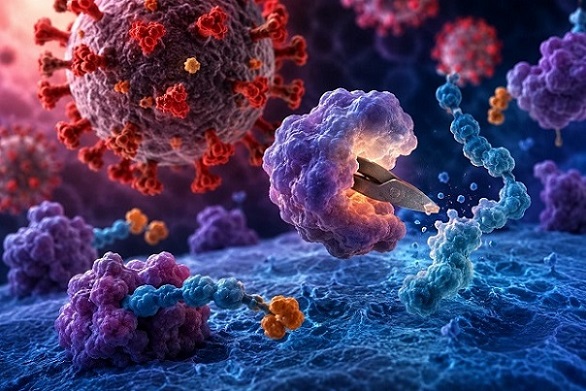 SARS-CoV-2 uses its PLpro enzyme to remove ISG15 tags from human proteins, weakening innate immunity
while reshaping cellular metabolism to favor viral replication
Researchers involved in the study were from the Florida Research and Innovation Center at Cleveland Clinic; Department of Genomic Sciences and Systems Biology at Cleveland Clinic Research; Cleveland Clinic Genome Center; Center for Therapeutics Discovery at Cleveland Clinic Research; Cleveland Clinic Lerner College of Medicine of Case Western Reserve University; West Coast Metabolomics Center at the University of California, Davis; and Department of Microbiology & Immunology at McGill University.
How ISG15 Helps Cells Fight Viruses
ISG15 is a protein whose production rises strongly following interferon signaling during infection. Cells attach ISG15 to selected proteins through a process known as ISGylation. These molecular tags can change protein activity and strengthen antiviral defenses.
SARS-CoV-2 fights back using PLpro, which removes ISG15 tags through deISGylation.
To determine how important this ability really is, researchers engineered a SARS-CoV-2 mutant with PLpro mutations that severely impaired its ability to remove ISG15 while preserving other essential functions.
The mutant virus performed considerably worse when confronted by functioning antiviral defenses. It showed reduced viral levels in several interferon-competent human cell types and produced lower viral titers and transcripts in infected mice.
The mutant also triggered stronger interferon-related responses and was cleared faster.
Virus Silences Important Cellular Alarm Systems
Detailed experiments revealed that PLpro-mediated removal of ISG15 interfered with antiviral signaling involving MDA5-MAVS and TRIF.
These pathways essentially operate as cellular alarm systems, detecting signs of infection and helping initiate interferon-driven defenses. Which pathway dominated depended partly on the cell type examined.
As this Thailand
Medical News report explains, PLpro therefore appears to give SARS-CoV-2 an important advantage by interfering with the cell's ability to sound an effective early antiviral alarm.
PLpro Also Reprograms Cellular Metabolism
One of the most significant discoveries was that deISGylation e
xtended far beyond immune signaling.
Metabolic studies showed that disabling PLpro's ISG15-removing activity disrupted both glycolysis and the pentose phosphate pathway, two interconnected systems involved in processing glucose and generating molecules required for cellular and viral activities.
Mutant-virus-infected cells accumulated glucose-6-phosphate while showing reduced ribose-5-phosphate and ribulose-5-phosphate. Ribose-5-phosphate is particularly important because it supports production of nucleotides needed to construct new viral RNA.
Researchers also detected reduced glutathione, an important antioxidant that protects against oxidative damage.
Three Enzymes Help Explain the Effect
Proteomic analysis identified 578 candidate PLpro deISGylation substrates, with 61 considered particularly strong candidates because they also interacted with Nsp3.
Three metabolic enzymes emerged as important targets: ALDOA, G6PD and PRDX1.
ALDOA supports glycolysis, G6PD controls a critical part of the pentose phosphate pathway, while PRDX1 helps control oxidative stress. ISGylation suppressed their activities, whereas PLpro-mediated removal of ISG15 restored them.
Remarkably, supplying cells with N-acetylcysteine, which supports antioxidant defenses, or D-ribose, which can support ribose-5-phosphate availability, partially restored mutant-virus replication. Combining both treatments nearly restored replication, providing functional evidence that PLpro's metabolic manipulation benefits the virus.
Conclusions
The findings show that SARS-CoV-2 PLpro operates as more than a protein-processing enzyme. By removing ISG15 tags, it can weaken innate immune signaling while preserving metabolic and antioxidant pathways that support viral replication. The results identify viral deISGylation as a potentially important therapeutic target, although additional research is required to determine whether selectively blocking this activity can be safely translated into antiviral treatments.
The study findings were published in the peer reviewed journal: Immunity.
https://www.cell.com/immunity/fulltext/S1074-7613(26)00306-7
Read Also:
https://www.thailandmedical.news/articles/coronavirus
https://www.thailandmedical.news/articles/long-covid 



 Share
Share
 Tweet
Tweet
 Share
Share