Nikhil Prasad Fact checked by:Thailand Medical News Team Feb 02, 2026 8 months, 2 days, 3 hours, 35 minutes ago
Medical News: Scientists Warn Virus Evolution Far from Over
A sweeping new review warns that SARS-CoV-2—the coronavirus behind COVID-19—continues to shift, strengthen and change how it attacks the human body years after the original outbreak. The research was conducted by teams from George Emil Palade University of Medicine, Pharmacy, Science, and Technology of Târgu Mureș and the Clinical County Hospital of Mureș, Romania, with contributions from units including the university’s Departments of Pneumology, Pathophysiology, Genetics, Clinical Laboratory, and Plastic and Reconstructive Microsurgery.
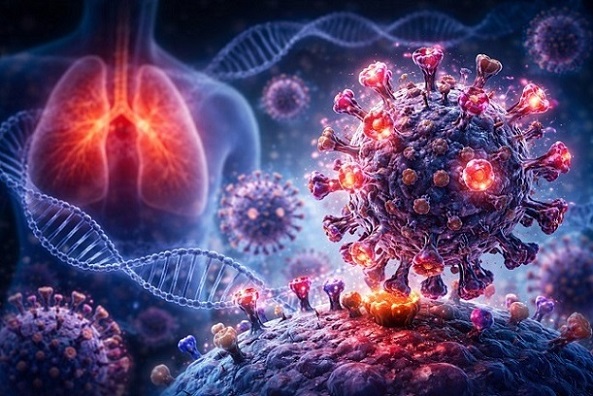 Evolving Omicron variants are changing how SARS-CoV-2 enters cells and damages organs, according
to a major scientific review.
Constant mutations make the virus harder to predict
Although the pandemic emergency has ended, scientists say the virus is still adapting rapidly. The review found that new Omicron descendants—including BA.2.86, JN.1 and the KP variants—carry mutations that allow them to latch onto human cells more tightly, slip past antibodies and exploit weaknesses in the immune system. Researchers explain that genetic tweaks in the spike protein change how the virus grabs the ACE2 receptor, with mutations such as L455F boosting binding strength and others like H146K and I210T helping variants evade immune recognition.
Hidden entry routes help infection spread
The review also reveals that the coronavirus now uses more than one doorway to invade cells. Besides ACE2, it relies on cell enzymes such as TMPRSS2 and even backup entry helpers like neuropilin-1, found in the lungs, liver, heart and nerve cells. This
Medical News report notes that neuropilin-1 is especially worrying because it is found in organs that continue to be damaged by the virus, even when respiratory symptoms fade.
Once inside the body the virus rewires cells
After attaching to cells, SARS-CoV-2 forces the host machinery to copy its genetic code and build new virus particles. A crucial viral enzyme called nsp14 edits errors in viral RNA while helping camouflage it from immune alarms. The study highlights that even small changes in nsp14 can dramatically alter viral survival, mutation rates and the virus’s ability to resist antiviral drugs.
Multi organ damage supported by powerful omics data
The scientists warn that internal injury does not stem only from the virus multiplying but from how it disturbs normal cell chemistry.
•
Heart: Blood samples from myocarditis patients showed high levels of TNF-related inflammation and mitochondrial stress, suggesting energy collapse inside heart muscle cells.
•
Liver: Clusters of aggressive CD8 T cells were found sitting directly next to liver cells, armed with tissue-destroying enzymes.
• Kidneys:
Seve
re COVID-related acute kidney injury was linked to failing cellular energy systems and burned-out metabolic pathways, unlike typical sepsis-related kidney failure.
These discoveries come from advanced tools such as spatial transcriptomics, which show where cells are altered inside organs, and proteomics, which measures thousands of proteins simultaneously.
What it all means moving forward
The SARS-CoV-2 virus is learning how to sidestep neutralizing antibodies and may be slowly pressuring T-cell defenses as well. The authors stress that next-generation vaccines must include components that do not mutate frequently, such as parts of the spike’s S2 region and internal viral proteins. They also argue that therapies that support cell metabolism—mitochondria, stress pathways and inflammation control—may help prevent long-term damage.
Conclusion
The study concludes that SARS-CoV-2 continues to evolve in ways that reshape infection, immune escape and organ disease. Its success comes from a powerful combination of structural mutations, immune suppression tools, and the ability to reprogram metabolism inside infected tissues. Scientists emphasize that staying ahead of future variants will require global surveillance, smarter vaccines and treatments that also target the host pathways the virus hijacks. Only with this two-pronged approach can health systems remain prepared for future waves and long-term COVID complications.
The study findings were published in the peer reviewed International Journal of Molecular Sciences.
https://www.mdpi.com/1422-0067/27/2/891
For the latest COVID-19 News, keep on logging to Thailand
Medical News.
Read Also:
https://www.thailandmedical.news/articles/long-covid
https://www.thailandmedical.news/articles/coronavirus




 Share
Share
 Tweet
Tweet
 Share
Share

































