Nikhil Prasad Fact checked by:Thailand Medical News Team Aug 18, 2026 1 month, 2 weeks, 3 days, 4 hours, 40 minutes ago
A treatment designed to remove potentially harmful antibodies from the blood can dramatically lower these antibodies in people with Long COVID, but the biological change does not appear to translate into meaningful improvements in physical performance, according to a new prospective exploratory study.
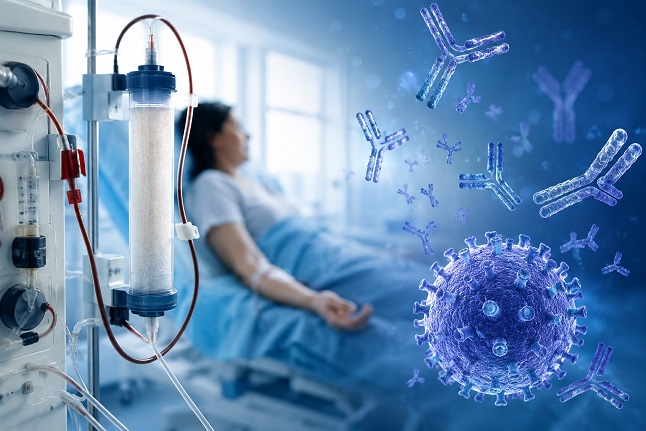 Blood-filtering immunoadsorption sharply reduced suspected Long COVID autoantibodies but failed to significantly
improve objectively measured physical performance
Researchers investigated immunoadsorption, a blood-filtering procedure that removes immunoglobulins, including antibodies suspected of contributing to post-COVID syndrome. The findings challenge the idea that reducing certain circulating autoantibodies alone may be enough to improve the condition.
The research team were from the Department of Internal Medicine, Division of Infectious Diseases, Nephrology, Endocrinology and Tropical Medicine, University Medical Center Rostock, Rostock, Germany, and the Core Facility for Cell Sorting and Cell Analysis, University Medical Center Rostock, Rostock, Germany.
Five Blood-Filtering Treatments
The study involved 18 Long COVID patients—15 women and three men—with an average age of 47. All had elevated antibodies targeting β1/β2-adrenergic receptors and/or M3/M4-muscarinic acetylcholine receptors.
These receptors help regulate important functions involving the nervous system, heart, blood vessels and other organs. Scientists have suspected that antibodies interfering with these receptors might contribute to symptoms such as fatigue, heart palpitations and problems with physical activity.
Participants underwent five immunoadsorption sessions over one week. Researchers then followed them for up to 24 weeks while measuring antibodies, walking ability, handgrip strength, lung function, heart measurements and daily steps.
Antibodies Plunged but Later Returned
The treatment clearly worked at removing antibodies from the bloodstream. Levels of all four measured autoantibodies fell significantly immediately after treatment. Total IgG also dropped sharply, falling from an average 11.3 g/L before treatment to near or below the laboratory detection limit after the second session.
However, the effect did not last. By 12 and 24 weeks, autoantibody concentrations had increased again and returned toward baseline levels.
Importantly, this Thailand
Medical News report highlights a major disconnect: even when antibody concentrations were at their lowest, researchers could not detect significant improvements in objective physical performance.
Daily Activity Barely Changed
Handgrip strength, clinical six-minute walking distance and lung-function measurements showed no significant improvement. Average daily steps were 9,029 before treatment compared with 8,944 afterward—effectively no meaningful increase.
Researchers also found no significant relationship between changes in autoantibody concentrations and daily step
counts.
Patients nevertheless reported some subjective improvements. Pain scores declined from 5.5 to 4.1, while fatigue decreased from 5.6 to 5.0. Overall symptom burden fell from 5.8 to 5.1. Bell Disability Scale scores improved from 39.8 to 52.4, suggesting participants felt more physically capable.
Yet these perceived improvements were not significantly associated with falling autoantibody levels. Home-based six-minute walking distances also increased, while standardized clinic testing failed to show corresponding improvement.
Treatment Was Generally Well Tolerated
Three adverse events were documented, including an arterial mispuncture during catheter placement, a panic attack and superficial thrombophlebitis. No allergic reactions, major cardiovascular problems, bleeding complications or catheter-related infections were reported during treatment.
Conclusions
The findings suggest that simply removing circulating autoantibodies may not address the mechanisms responsible for Long COVID symptoms. Although immunoadsorption produced a powerful short-term biological effect, it failed to deliver significant objective improvements in physical performance, while antibody levels eventually rebounded. The small study lacked a placebo group, so larger controlled studies remain important, but the results raise serious questions about using this invasive and potentially costly procedure as a Long COVID treatment.
The study findings were published in the peer reviewed journal: Infection.
https://link.springer.com/article/10.1007/s15010-026-02914-8
Read Also:
https://www.thailandmedical.news/articles/long-covid 



 Share
Share
 Tweet
Tweet
 Share
Share

































