Nikhil Prasad Fact checked by:Thailand Medical News Team Jan 31, 2026 8 months, 3 days, 21 hours, 22 minutes ago
Medical News: A new scientific investigation has uncovered how COVID-19 infection may quietly increase the risk of dangerous brain clots and strokes, even in patients with mild or unnoticed symptoms. The findings shed new light on why some people infected with SARS-CoV-2 suddenly develop ischemic strokes, while others do not.
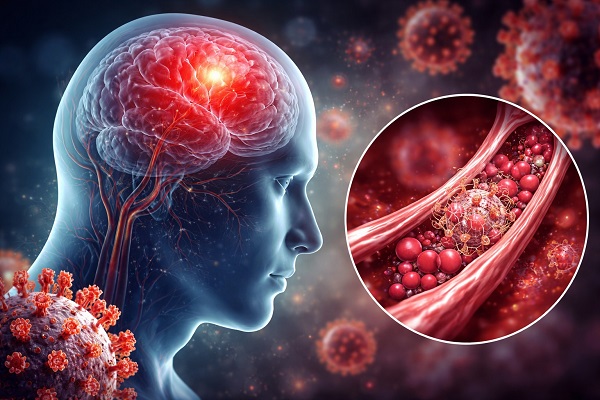 New research reveals how COVID-19 disrupts immune clot control and raises stroke risk even in mild infections
Scientists Investigate Hidden Stroke Risks in COVID-19
New research reveals how COVID-19 disrupts immune clot control and raises stroke risk even in mild infections
Scientists Investigate Hidden Stroke Risks in COVID-19
Researchers from multiple German and Swiss institutions, including Hannover Medical School, University of Veterinary Medicine Hannover, University Medical Center Göttingen, Goethe University Frankfurt, University Hospital of Augsburg, and University Hospital Basel, conducted a detailed pilot study to understand how COVID-19 affects the body’s clotting and immune systems at the same time.
This
Medical News report highlights that COVID-19 is not just a lung disease. It can disrupt the immune system in ways that promote abnormal blood clot formation in the brain, leading to strokes or transient ischemic attacks.
Understanding Immunothrombosis in Simple Terms
When the body fights infections, white blood cells called neutrophils release sticky web-like structures known as neutrophil extracellular traps, or NETs. These traps are meant to catch viruses and bacteria, but they can also make blood thicker and more likely to clot. Normally, an enzyme called DNase helps break down these traps to prevent harm.
The study analyzed blood samples from 84 patients divided into three equal groups. One group had COVID-19 with stroke or mini-stroke, another had stroke without COVID-19, and the third had COVID-19 without stroke. Researchers measured NET markers, DNase activity, and inflammatory substances called cytokines.
Key Findings Reveal a Dangerous Imbalance
Patients with COVID-19, regardless of stroke status, showed higher levels of NET markers such as citrullinated histone H3 and neutrophil elastase. However, the most alarming discovery was seen in patients who had both COVID-19 and stroke. These individuals had significantly lower DNase activity, meaning their bodies were less able to clear harmful NETs from the blood.
This imbalance allows NETs to accumulate, forming scaffolds that trap platelets and clotting proteins. The result is a higher chance of clot formation in brain blood vessels. Elevated inflammatory molecules such as interleukin-6 and platelet-derived growth factors were also observed, further fueling clot formation and blood vessel damage.
Why This Matters for Public Health
Importantly, many stroke patients with COVID-19 did not show typical infection symptoms. This suggests that silent or mild infections may still trigger dangerous immune-clotting reactions. The findings also hint that therapies targeting NETs or boosting DNase activity could help prevent strokes in viral infections.
Study Limitations and Future Directions
As a pilot study, the sample size was limited, and timing of infection onset varied. However, the carefully matched patient groups and detailed immune profiling provide strong early evidence of a unique COVID-19-related stroke mechanism.
Conclusion
This study clearly demonstrates that COVID-19 can disrupt the body’s natural balance between clot formation and clot breakdown by increasing harmful immune traps while reducing their clearance. These changes create a high-risk environment for stroke, even in patients without severe respiratory illness. Understanding this mechanism opens the door to new preventive and treatment strategies that target immune-driven clotting rather than traditional stroke risk factors alone.
The study findings were published in the peer reviewed journal: Frontiers in Immunology.
https://www.frontiersin.org/journals/immunology/articles/10.3389/fimmu.2026.1662418/full
For the latest COVID-19 News, keep on logging to Thailand
Medical News.
Read Also:
https://www.thailandmedical.news/articles/coronavirus
https://www.thailandmedical.news/articles/long-covid




 Share
Share
 Tweet
Tweet
 Share
Share

































